




Truckload carrier Pamt Corp. lost money again during the third quarter. Like other carriers, it pointed to elevated driver procurement costs and the spike in diesel fuel prices as the culprits.
Pamt (NASDAQ: PAMT) reported a net loss of $8.1 million, or 38 cents per share, on Monday after the market closed.
Earnings-per-share headwinds in the period included a $3.7-million year-over-year decline in gains on equipment sales (14 cents per share), and a $3.2-million y/y decline in non-operating income (12 cents per share). (The non-operating income line captures the change in value of its stock portfolio.)
Pamt booked a net loss of 27 cents per share in the year-ago quarter.
Pamt President Lance Stewart said that while the company is “aligning customer rates with the inflationary cost increases experienced over the past four years,” the “cumulative cost increases continue to outpace the pricing improvements achieved to date.”
Consolidated revenue increased 8% y/y to $163 million. Revenue was up just 2% excluding fuel surcharges.
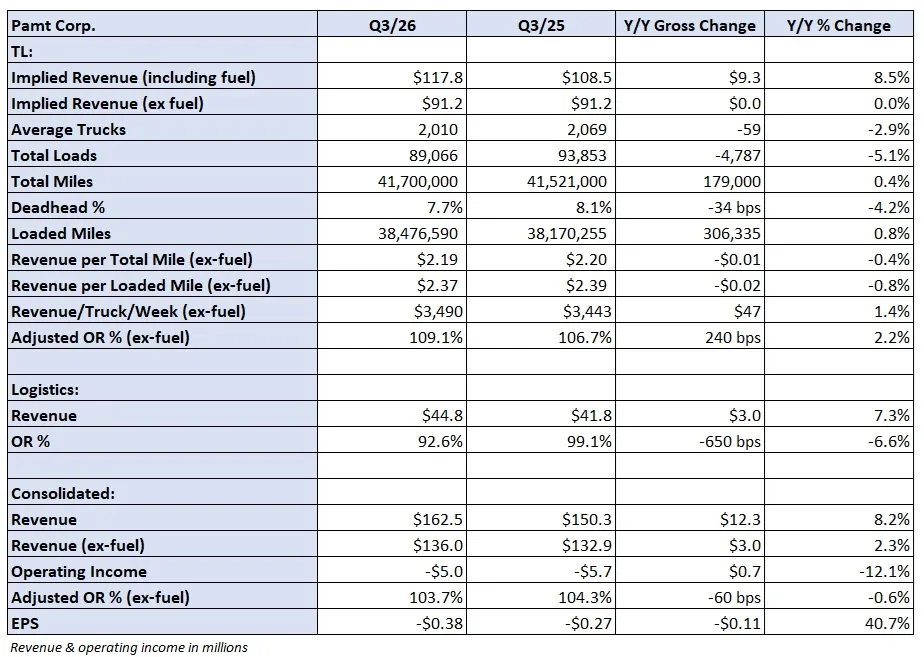
Truckload revenue (ex-fuel) was flat y/y as a 3% decline in average trucks was mostly offset by a 1.4% increase in revenue per truck per week. Loaded miles per truck increased 4% y/y in the quarter. Revenue per loaded mile (ex-fuel) was down 1% y/y, but up 11% from the second quarter.
The third quarter marked 12 straight operating losses for the TL unit. It recorded a 109.1% operating ratio (ex-fuel), 240 basis points worse y/y.
The logistics unit reported $45 million in revenue, a 7% y/y increase, and a 92.6% OR, 650 bps better y/y.
(Pamt doesn’t provide gross profit margins for the unit, nor operating metrics like load counts and revenue per load.)
Pamt used $18 million in operating cash flow in the first nine months of the year. Liquidity (cash, equity holdings and availability on its line of credit) of $102 million was $15 million lower than in the second quarter. Outstanding debt was down $10 million to $323 million.
“While I am disappointed that the progress achieved in customer pricing was offset by these cost pressures, I am encouraged by the continued sequential improvement in our operating performance,” said Stewart. “I remain confident that our ongoing initiatives, combined with improving market conditions, will contribute to stronger financial results as we move forward.”
Why it matters? Pamt’s results show fleets are having difficulties addressing multiple years of cost inflation, which occurred alongside weak pricing.
