




Executives from Werner Enterprises outlined a path to double-digit truckload margins, but said cost headwinds will likely limit progress over the next two quarters.
Werner (NASDAQ: WERN) reported third-quarter adjusted earnings per share of 16 cents after the market closed on Tuesday. The result was in line with a profit warning issued earlier in the month, calling for adjusted EPS of 15 to 16 cents versus the 36-cent consensus estimate at the time.
Consolidated revenue of $951 million was 23% higher year over year and at the top end of management’s revised outlook ($946 million to $951 million). The increase was largely due to higher fuel surcharges and the January acquisition of dedicated carrier FirstFleet.
EPS bridge from Q3 to Q4
Sequential cost increases from elevated diesel fuel prices, higher driver procurement expenses and a reserve adjustment for prior claims were an 18-cent EPS drag on the third quarter. Gains on asset sales increased y/y from $4.5 million to $8 million, providing a 4-cent tailwind. (The company booked an adjusted net loss of 3 cents per share in the 2025 third quarter.)
Werner said some costs, like driver recruiting and training, were front-loaded expenses incurred ahead of a revenue offset. For instance, it had to bear the costs of adding 130 dedicated trucks and drivers throughout the quarter, even though the revenue stream didn’t begin until the end of the period.
“We made the deliberate decision to accelerate investments in driver recruiting and onboarding to capture rising customer demand and support fleet expansion as industry capacity tightens,” said Chairman and CEO Derek Leathers. “We remain confident in our trajectory and our ability to capitalize on the early stages of this freight upcycle.”
However, it also said some cost headwinds will linger into the first quarter.
It provided a soft guide for “modest sequential [EPS] improvement” in the fourth quarter (from the 16-cent result in the third quarter). But the result will probably be materially below the current 38-cent fourth-quarter consensus estimate.
Approximately one third of the 18-cent third-quarter EPS drag was tied to driver recruiting and sign-on bonuses, and does not represent “structural labor inflation,” management said. The remaining 12 cents stemmed from fuel and insurance claims, which should largely dissipate in the fourth quarter. However, lower gains on sale (guided to total just $1.7 million), higher interest expense and a higher tax rate are additional headwinds. Better pricing and a slightly larger fleet to accommodate peak season demand will provide some offsets.
Truckload fuel surcharges operate on a one-week lag. Diesel prices were up sequentially in nine of the 13 weeks of the third quarter. By month, retail diesel prices dipped 1% sequentially in July, but increased 10% sequentially in August and another 15% in September. The near-term headwind will become an earnings tailwind when diesel prices revert.
Other Q3 takeaways
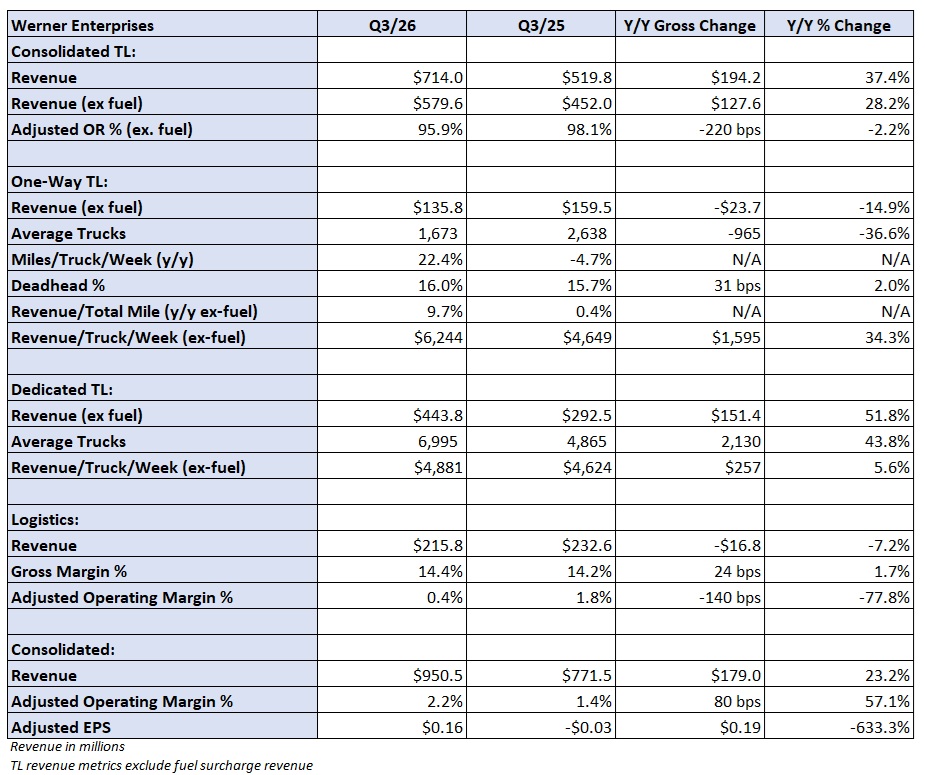
The company’s dedicated segment (81% of its total truck fleet) reported a 52% y/y increase in revenue (ex-fuel) as the average truck count was up 44% y/y to nearly 7,000 units and revenue per truck per week (ex-fuel) increased 6% y/y. (The FirstFleet deal added over 2,400 tractors and $615 million in annual revenue.)
Dedicated revenue per truck per week is now expected to increase by 4 to 5% y/y for full-year 2026, an increase from the prior outlook for a 3-to-5% increase.
The one-way unit again saw big gains in utilization following a restructuring earlier in the year, which included exiting non-profitable accounts and repurposing under-utilized equipment. One-way revenue was down 15% y/y (ex-fuel) as the average truck count declined 37% y/y. Revenue per truck per week (ex-fuel) increased 34% y/y as miles per truck increased 22% and revenue per total mile (ex-fuel) increased 10%. The rate-per-mile metric was negatively impacted by a 116-mile increase in length of haul. (Longer hauls usually accompany lower per-mile rates.)
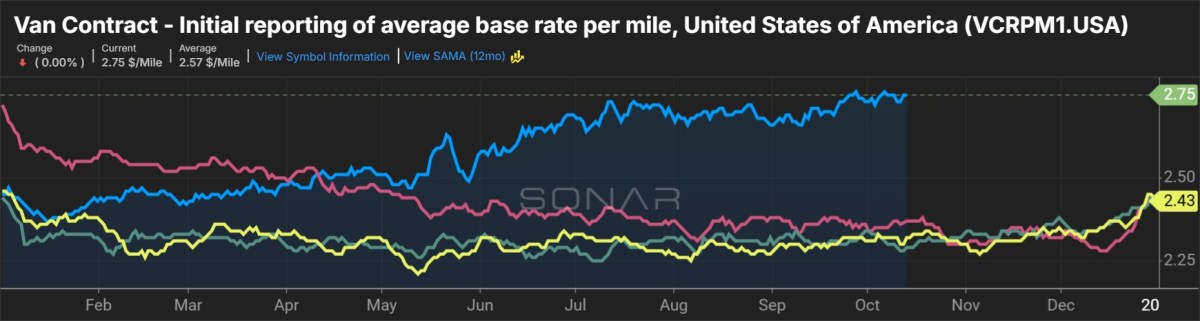
Guidance for the one-way fleet again calls for a 10-to-13% y/y increase in revenue per total mile during the fourth quarter. Roughly 60% of the one-way revenue book renews in the first half of 2027. Management is eyeing double-digit increases on many of these renewals.
One-way saw more than 800 basis points of y/y margin improvement in the quarter (actual margin not disclosed). Werner is again looking to grow this fleet.
The TL unit recorded $714 million in combined revenue, a 37% y/y increase (up 28% y/y excluding fuel surcharges). A 95.9% adjusted operating ratio (4.1% adjusted operating margin) was 220 bps better y/y, but 140 bps worse than the prior quarter. Management said the sequential cost headwinds represented a 200-bp drag.
The company’s logistics unit reported a 7% y/y revenue decline to $216 million, but returned to profitability, posting a 0.4% adjusted operating margin. Truckload brokerage, which operates within the logistics unit, booked 600 bps of sequential operating margin improvement. (Werner does not disclose this subsegment’s margin results.)
Why it matters? Werner’s third-quarter result shows the significant cost pressures carriers are currently facing—specifically rising diesel fuel prices and higher driver procurement costs. It signals that the industry’s recovery will not be linear, and that while carriers are raising rates, profitability is still being squeezed by early-upcycle cost inflation.
F3: Future of Freight Festival
Industry-defining keynotes, rapid-fire technology demos, and industry leaders networking in experiences across Chattanooga - plus the inaugural F3 Awards Dinner featuring the FreightTech and Shipper of Choice reveals.
Industry-defining keynotes, rapid-fire technology demos, and industry leaders networking in experiences across Chattanooga - plus the inaugural F3 Awards Dinner featuring the FreightTech and Shipper of Choice reveals.
The Signal at Chattanooga Choo Choo • Chattanooga, TN Register Now