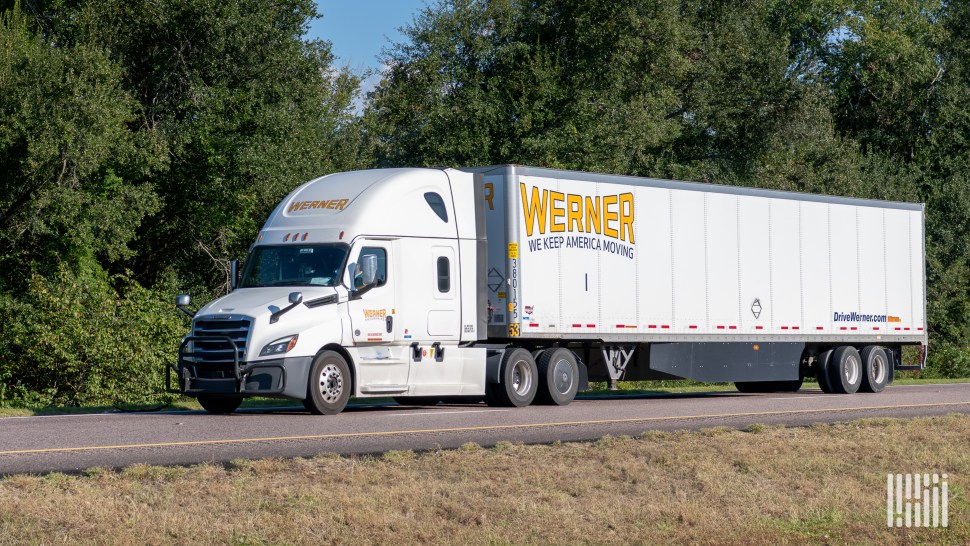
Werner’s quarterly earnings released Tuesday made it the first carrier that could be considered something of a pure play truckload company to publish numbers, and it was difficult to find much bad news in the report.
Most other carriers that have reported their earnings so far have their truckload operations as less a share of revenue, such as intermodal-focused J.B. Hunt, mixed LTL and truckload carrier TFI International or refrigerated-heavy Marten.
Werner CEO Derek Leathers came into the earnings call with analysts riding a strong 2026 performance in the company’s stock. Before a recent selloff, Werner had been up about 54% since the start of the year.
A year ago, on the second quarter 2025 Werner earnings call, Leathers gave an optimistic outlook on how he thought the then still-beleaguered trucking market might turn around.
Predicted a year ago
“We’ve said all along, we think it’s going to be supply-driven up cycle, if you will, more than demand,” he said at the time.
And according to Leathers a year later, that’s pretty much what happened.
This year, while praising his company’s own steps behind several key metrics improving year on year in the 2026 second quarter, he also described the supply shift–driven by the disappearance of thousands of drivers–as being only in “the third inning.”
“The structural capacity attrition we’ve been talking about for several quarters is playing out as predicted,” Leathers said. “This tightness is being driven by intensifying regulatory pressure, specifically around non-domiciled CDOs, English language proficiency, and cabotage enforcement.”
He revisited the issue again during the call.
“Enforcement efforts are continuing, and in our view, greater agency collaboration and exchange of data, combined with utilization of technology, will further accelerate enforcement from here,” Leathers said.
ELDs disappearing
Leathers also noted the statistic that has been getting an increasing amount of attention as a factor in shrinking driver supply: FMCSA’s ongoing withdrawal of its approval of various ELDs. Leathers said about one-third of all ELDs either are gone or on the way out. “This reduction in ELD options is dismantling shadow capacity and compounding structural supply contractions,” he said.
Leather also said he sees a boost from the fallout from Montgomery vs. Caribe and the greater liability risk now faced by brokers, evidenced clearly last week in a Dallas jury decision against C.H. Robinson.
Montgomery ”has resulted in shippers and brokers taking an even more cautious view of who they do business with that plays directly into Werner’s strengths, given our strong track record and reputation,” Leathers said.
The adjusted operating margin for all of Werner’s (NASDAQ: WERN) trucking operations rose to 4.6% from 2.5% a year ago. On the call, Leathers said the One-Way segment’s operating margin was up more than 700 basis points year-on-year.
Although the company’s One-Way Truckload division has far less revenue than Werner’s Dedicated segment–$138 million versus $434 million in the quarter, respectively–the number that was highlighted both in the earnings’ prepared statements and in the call–was the big jump in One-Way’s revenue per truck per week.
A year ago in the second quarter it was $4,787. This year it was $6,114.
By contrast, Dedicated’s figure–which would be expected to fluctuate less in the short term–rose to $4,789 from $4,542.
Margins weren’t huge
The numbers overall were strong but not spectacular. As Citi’s Ariel Rosa said in a quick-hit note released after the earnings were published but before the call with analysts, “Continued thin margins (97% adj. Operating Ratio, 3% adj. op. margin vs. our 97.1%/2.9% estimates.) reflect ongoing operational challenges as Werner continues its restructuring and cost-cutting efforts.”
The Dedicated segment now includes the operations of FirstFleet, which Werner acquired earlier this year. That acquisition is the key reason why trucks operated by the Dedicated segment in the quarter were up to 6,976 from 4,855 a year earlier.
Leathers said the FirstFleet integration is “progressing very well.”
“Continuity with drivers, associates and customers have been outstanding, and synergy realization is ahead of schedule,” Leathers said. He said customer renewal has been 98% on more than 80% of the portfolio that came with the acquisition, and he said Werner expects that to continue on the business that hasn’t been renegotiated yet.
Upping the forecast
Werner is positive enough on the future that it increased its forecast on several key metrics for the remainder of 2026.
Its forecast at the end of the first quarter was that Dedicated’s revenue per truck per week would be flat to up 3%; that forecast now is an increase of 3% to 5%.
Leathers added to that outlook when he answered an analyst question by saying Werner has been getting “low to middle single-digit increases” in renewal of its Dedicated business.
Revenue per truck per mile is now expected to grow 10% to 13% from a year ago. The forecast at the end of the first quarter was 1% to 4%.
“We are updating our guidance to reflect the significant productivity improvement that we are realizing with our assets,” CFO Chris Wyckoff said on the call of the changes. “At the same time, there are currently fewer quality drivers available across the industry. “
Werner operates an extensive driving school. Roadmaster Drivers School, with more than 20 outlets around the country.
Asked about the school and how challenging it has been to hire new drivers into the program, Leathers said that “clearly, qualified driver hires are more difficult as we look forward. The market is tightening.”
Werner also is pushing to hire experienced drivers, Leathers said, “and we’ve seen some benefits on that front.”
With Dedicated being such a large part of Werner’s operations, and with it the likelihood that a driver might get home far more frequently than an over-the-road driver, Leathers described a position with Werner’s Dedicated operations as a job that “doesn’t just pay better, but they often have better lifestyles associated with them as well.”
“We’ve got the right kind of jobs to be positioned in the market today, and we’re going to continue to lean into that.” Leathers added.
More articles by John Kingston
Trump promise on military CDLs sounds similar to existing programs
Brokerage Compliance Symposium
The day before F3. Every compliance issue you face - fraud exposure, carrier liability, FMCSA rules, cargo theft, insurance gaps - navigated by attorneys and operators defining best practices in a changing industry.
F3 Awards Dinner
The night before F3. FreightTech100 companies honored. FreightTech 25 and Shipper of Choice winners revealed live. Cocktail reception into dinner and live music - 300 industry leaders in one purpose-built room.
F3: Future of Freight Festival
Industry-defining keynotes, rapid-fire technology demos, and industry leaders networking in experiences across Chattanooga - plus the inaugural F3 Awards Dinner featuring the FreightTech and Shipper of Choice reveals.
The day before F3. Every compliance issue you face - fraud exposure, carrier liability, FMCSA rules, cargo theft, insurance gaps - navigated by attorneys and operators defining best practices in a changing industry.
The Signal at Chattanooga Choo Choo • Chattanooga, TN Register NowThe night before F3. FreightTech100 companies honored. FreightTech 25 and Shipper of Choice winners revealed live. Cocktail reception into dinner and live music - 300 industry leaders in one purpose-built room.
The Signal at Chattanooga Choo Choo • Chattanooga, TN Register NowIndustry-defining keynotes, rapid-fire technology demos, and industry leaders networking in experiences across Chattanooga - plus the inaugural F3 Awards Dinner featuring the FreightTech and Shipper of Choice reveals.
The Signal at Chattanooga Choo Choo • Chattanooga, TN Register Now