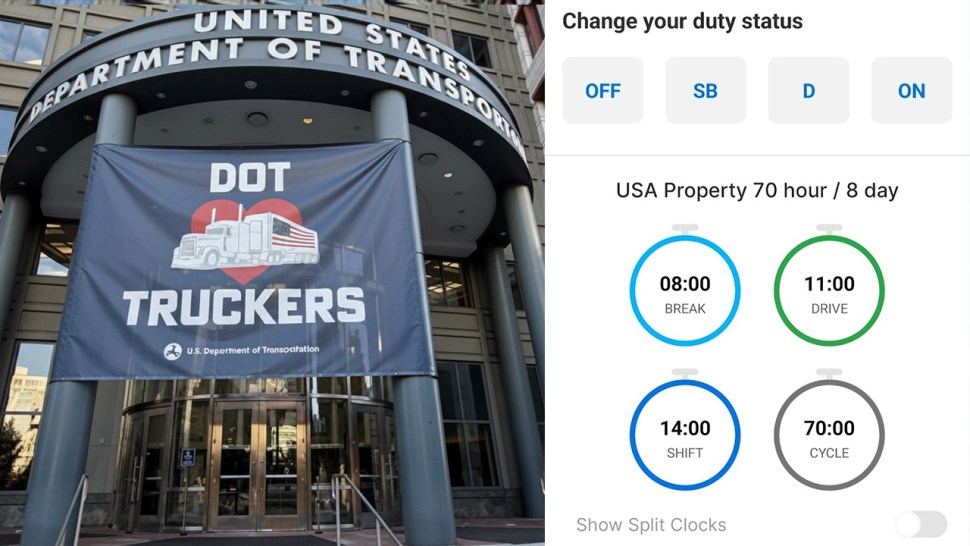
The FMCSA removed 10 more electronic logging devices from the registered list today. OnTime Logs iOSix from OnTime Logs Inc. LAST MINUTE ELD from Last Minute ELD. Porter ELD from Porter ELD. Zee HOS Compliance from Zee App. EV ELD IOSIX from Ev ELD Inc. Light and Travel ELD from LIGHT AND TRAVEL LLC. PREMIERRIDE LOGS from PREMIERRIDE LOGS LLC. Two devices, 2BRO ELD and 305 ELD, from TWO BRO SECURITY & IT SOLUTIONS. TT ELD 40 from TT ELD Inc. All ten failed the minimum technical requirements in 49 CFR Appendix A to Subpart B of Part 395. All ten are on the revoked list as of this afternoon.
Add today’s ten to the twelve from May 20, and TRUCKSTAFF ELD from June 23, and the total since January 2025 is ninety. Ninety devices in eighteen and a half months. 4.9 per month, which is exactly the pace I calculated seven weeks ago. Nothing about the enforcement tempo has changed. The pace is the pace.
Administrator Derek Barrs again put everybody on notice: “We will continue to take decisive enforcement action to ensure that only compliant, reliable devices are used on our nation’s roadways. Accurate hours-of-service records are essential to protecting public safety, supporting fair enforcement, and ensuring accountability across the commercial motor vehicle industry.”
Note the word that was not in the May statement. Accountability. If you are running one of the ten devices named today, your timeline is the same as it always is. Stop using it now. Revert to paper logs or compliant logging software. Replace the device with a compliant ELD from the registered list before September 8, 2026. Before that date, roadside enforcement is being told not to cite drivers using the revoked devices for 395.8(a)(1) or 395.22(a). Officers will ask for your paper logs instead. On and after September 8, you will be cited for no record of duty status and will go out of service under the CVSA criteria. The truck stops. The load does not move. The violation lands in SMS and in every carrier vetting system that pulls FMCSA data, and it stays there.
That is the compliance guidance. You have read it here before. I wrote it on May 20. I wrote it thirteen days before that. I wrote it last May for the Gorilla Fleet batch. The guidance does not change because the underlying problem does not change.
Here’s what changes. Today’s list is not ten independent failures. There are fewer companies than it looks like. Go back to my last piece on this. Near the bottom, in the section where I told carriers to audit their own vendors, I wrote: “Check whether any of the manufacturer’s other devices have been revoked, because a manufacturer that loses one device to a compliance failure may have the same engineering problems across its entire product line.”
Today’s bulletin is that sentence with a case number attached. Moral of the story: listen to Rob Carpenter. He knows things.
ONTIME LOGS INC is on this list. FMCSA already revoked an OnTime Logs device on November 20, 2025. That one was called Ontime Logs PT, model number OTL100. The one pulled today is called Ontime Logs iosix, model number OTL101. One digit apart. Eight months apart. Same company, both devices gone.
EV ELD Inc. is on this list. Except the bulletin does not say Ev ELD Inc. It says Ev ELD Inc. (f/k/a Evo ELD Inc.). Formerly known as. The device is EV ELD IOSIX, f/k/a EVO ELD IOSIX. The model is EV 2, f/k/a EVO 2. FMCSA revoked EVO ELD 1 on October 17, 2025. That device carried ELD identifier G711H2. The device revoked today carries the identifier G711H3.
Sequential. Consecutive. Registered back-to-back by the same company, revoked nine months apart, with a rebrand in between. Evo became Ev. They dropped a letter.
We spend years tracking chameleon carriers that die under one DOT number and reappear the next quarter under another, with the same trucks, the same officers, the same phone number, and a marginally different spelling of the same name. We have white-label, chameleon ELD networks, many of which run on the same Telegram and RingCentral systems, tying them together. The mechanics on display in today’s ELD bulletin are the same behavior applied to a different registry.
It works at scale. Last month, I published an investigation into an hours-of-service falsification operation run from Moldova through a Wyoming holding company. That one parent entity owned at least fourteen ELD brands, added to its portfolio by signed annex, the way a carrier adds trucks. FMCSA revoked six of those brands. It revoked them the way the registry allows, one device at a time, each revocation a standalone line in a standalone bulletin, and when I last checked the registry in late June, sibling brands from the same corporate family were still on the registered list. Not because the agency missed something, but because the registry has no field for “same owner.” Six revocations against one company, and the registry recorded them as six unrelated events.
Then there is TWO BRO SECURITY & IT SOLUTIONS, which lost two devices, 2BRO ELD and 305 ELD, in the same announcement. Not sequentially. Simultaneously. Whatever engineering problem existed in one existed in both, because there was never really more than one thing there. Two SKUs, one codebase. Also worth noting: this is an IT security firm selling hours-of-service compliance hardware to motor carriers.
One more, and I want to be careful with this one because I have not confirmed it with the vendor. The revoked device for Zee App is called Zee HOS Compliance. Its model number, as printed in the FMCSA bulletin, is TTELD101. Also revoked today: TT ELD 40, from TT ELD Inc. I am not going to tell you that those two companies are the same company. I’m interested in why Zee App entered TTELD101 as their model number.
Two of today’s devices also carry “iosix” in the name. IOSiX is a Michigan-based hardware maker whose vehicle dongle is white-labeled by ELD sellers that do not build hardware. In April 2024, CISA published an advisory on the iOSix IO-1020 Micro ELD covering vulnerabilities, including a default WiFi password and a flaw, scored 9.6 out of 10, that let the device download and run code without checking where it came from. IOSiX shipped a fix. My point is not that today’s iOS-badged devices carry that flaw. My point is that when the same physical box sits behind a dozen brand names, a defect in the box is a defect in all of them, and the registry has no way to show you that. The list of ten providers is not ten engineering teams.
Now go back to Accountability.
The structural problem is that when the agency revokes a device, it revokes a device. It does not revoke a provider. There is no debarment. There is no waiting period. There is no bar on a company whose ELD was pulled for failing the technical spec from filling out a fresh self-certification form the next morning, under the same LLC or a new one, and receiving a fresh ELD identifier for a device running the same firmware that just failed.
Evo ELD Inc. lost a device in October. Evo ELD Inc. became Ev ELD Inc. Ev ELD Inc. had another device on the registered list, using the next identifier in sequence, until this afternoon. Nothing in the ELD rule prevented any of that. FMCSA appears to have caught it, which is why the f/k/a is in the bulletin at all, and that is genuinely a sign the agency is paying attention in a way it was not two years ago.
Today’s bulletin shows that the filing cabinet doesn’t have a memory. Nothing in it links a provider’s revoked device to that provider’s still-registered devices. Nothing in it links a company to its own prior name. Nothing in it links fourteen brands to the one holding company that owns them all. There is no vendor-level record. Carriers vetting an ELD purchase cannot query “has this company ever had a device revoked” and get an answer, because the list is organized by device, not by the entity behind it.
That is a fixable problem, and it does not require a rulemaking. It requires a database join.
Publish a provider-level view of the registry. Show every device a provider has registered, every device a provider has had revoked, every prior corporate name, and the date each device went on the list. Give carriers the ability to see, in 10 seconds, that the company selling them an ELD lost another device 8 months ago. Right now, the only person in the transaction who cannot see the provider’s history is the payer.
There is also the reinstatement clause. If the provider corrects all identified deficiencies, FMCSA puts the device back on the registered list. Devices should be fixable. The same question applies. Who verifies the fix? The rule that put the device on the list in the first place was self-certification. Is the fix self-certified too? If a provider tells the FMCSA that it has corrected the deficiency, what does the agency verify before the device is returned?
So the advice from May stands, with an amendment. If your ELD is still on the registered list, do not assume you are safe. Check when the device was registered. Check whether the manufacturer answers the phone. Check whether they have shipped a software update in the last twelve months. Now, check the harder thing: whether the company selling you that device is the same company it was a year ago, and whether the name on your invoice has ever appeared on a revoked-device bulletin under a different spelling.
Ninety devices in eighteen months. Three of today’s ten came from companies the agency had already pulled once. One of them changed its name. Last year, I documented a single holding company that lost six brands and kept others on the list. Barrs said the word accountability, and I believe he meant it. I believe they’ll keep falling off. Ninety and counting.
Brokerage Compliance Symposium
The day before F3. Every compliance issue you face - fraud exposure, carrier liability, FMCSA rules, cargo theft, insurance gaps - navigated by attorneys and operators defining best practices in a changing industry.
F3 Awards Dinner
The night before F3. FreightTech100 companies honored. FreightTech 25 and Shipper of Choice winners revealed live. Cocktail reception into dinner and live music - 300 industry leaders in one purpose-built room.
F3: Future of Freight Festival
Industry-defining keynotes, rapid-fire technology demos, and industry leaders networking in experiences across Chattanooga - plus the inaugural F3 Awards Dinner featuring the FreightTech and Shipper of Choice reveals.
The day before F3. Every compliance issue you face - fraud exposure, carrier liability, FMCSA rules, cargo theft, insurance gaps - navigated by attorneys and operators defining best practices in a changing industry.
The Signal at Chattanooga Choo Choo • Chattanooga, TN Register NowThe night before F3. FreightTech100 companies honored. FreightTech 25 and Shipper of Choice winners revealed live. Cocktail reception into dinner and live music - 300 industry leaders in one purpose-built room.
The Signal at Chattanooga Choo Choo • Chattanooga, TN Register NowIndustry-defining keynotes, rapid-fire technology demos, and industry leaders networking in experiences across Chattanooga - plus the inaugural F3 Awards Dinner featuring the FreightTech and Shipper of Choice reveals.
The Signal at Chattanooga Choo Choo • Chattanooga, TN Register Now