




Sharp increases in rates and extra fees have continued into the fourth quarter, putting 2026 on track to be the most expensive year on record for parcel shipping as carriers strive to maximize revenue, according to the latest market snapshot from investment bank TD Cowen and AFS Logistics.
Analysts say the onslaught of surcharges is spurring businesses to diversify their vendor pool and helping alternative carriers gain market share from the large legacy carriers.
Fuel surcharges are a major cost driver this year for businesses that purchase parcel transportation. Diesel fuel prices have soared since the start of the Iran war in February, which slowed crude oil and refined fuel traffic through the Strait of Hormuz, but repetitive carrier changes to the formula that sets fuel surcharges have more to do with elevated rates than the actual rise in fuel prices, the companies said in the benchmark report.
Carriers have frequently reindexed surcharge tables since 2021 to not only capture additional revenue as fuel prices rise, but keep fuel surcharges high even as actual fuel prices fall, according to the TD Cowen/AFS Freight Index released on Tuesday.
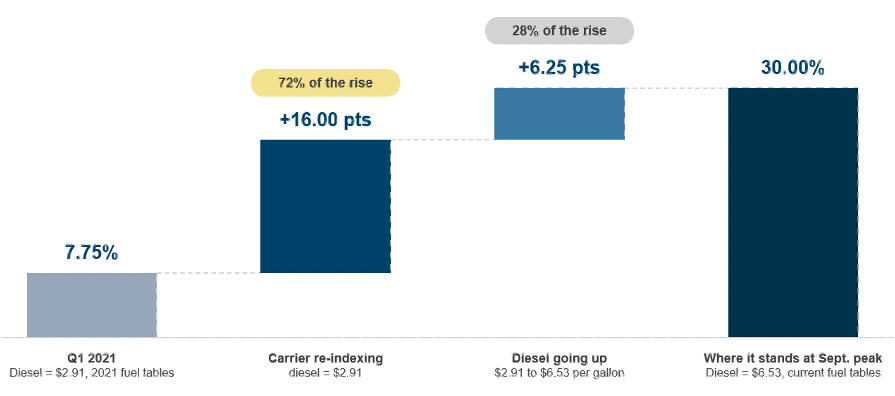
The fuel surcharge has increased from 7.75% of the transportation rate in the first quarter of 2021, when the average diesel fuel price was $2.91 per gallon, to 30% in September, when diesel peaked at $6.53 per gallon. Nearly three quarters of the increase is the result of carrier adjustments to fuel surcharge tables, not the price at the pump, the report said.
Even if fuel prices returned to the 2021 level, the current fuel surcharge would be 23.75% — about three times higher than five years ago.
The TD Cowen/AFS Freight Index has pointed all year to tinkering with the fuel-surcharge mechanism as a major cause of shipping inflation.
“While diesel and jet fuel are major costs for ground and express parcel, the fuel surcharge has become a revenue lever for carriers in addition to a pass-through mechanism for covering the cost of doing business,” said Mingshu Bates, chief analytics officer and president of parcel at AFS Logistics, in a news release promoting the report. “Even if crude oil normalizes and fuel prices recede, the effective fuel surcharge will not show a material decrease.”
AFS Logistics uses transactional data to help companies manage their parcel, less-than-truckload and truckload freight costs.
New FedEx surcharges
Fuel isn’t the only area where large carriers make pricing changes that often go unnoticed by customers. Carriers have replaced predictable annual hikes with continuous, targeted pricing to protect margins even as overall demand growth slows, and are able to do so with limited pushback because most shippers still plan annually, industry practitioners say.
From the start of 2025 through mid-summer, FedEx implemented or announced more than 50 pricing changes, including general rate increases, delivery area surcharges, customs fees and demand surcharges, parcel spend management firm LJM previously reported.
For the fourth consecutive year, FedEx (NYSE: FDX) last month announced a 5.9% average general rate increase, effective Jan. 4. Embedded in the new pricing policy is a change that reclassifies 2,533 ZIP codes from extended delivery area surcharge to remote DAS — the most expensive tier. The change was much more extensive than an earlier one in which 102 ZIP codes were added to the standard delivery area surcharge tier, 74 moved from standard to extended area and 63 moved from extended to remote area.
For packages destined for ZIP codes reclassified from extended to remote, the DAS fee will jump to $17.75 — roughly doubling the fee for residential deliveries and more than tripling it for commercial destinations, the TD Cowen/AFS report said.
Shippers with high residential volume, rural deliveries, lightweight packages, or heavy accessorial exposure, the effective increase can expect materially higher shipping increases than 5.9%, warned Charles Moore, vice president of parcel solutions at Transportation Insight, on LinkedIn.
Ground pricing has flattened across zones, with increases almost uniform across all regions instead of just for long-haul routes. Lightweight e-commerce shipments take the biggest hit, with packages in the one-to-five pound range getting increases of nearly 6.5%, making small parcel shipping more expensive for many retailers. The FedEx Ground minimum charge is set to increase to $12.70, representing a compounded increase of more than 12% over the last two years. Additional handling fees are increasing between 7% and 7.6%, he pointed out. And FedEx is introducing a $25 Paper Document Fee and a $5 Paper Air Waybill Fee to reinforce the carrier’s push toward fully electronic shipping and trade documentation.
DHL eCommerce recently posted its peak season surcharges UPS (NYSE: UPS) has similarly hiked a broad spectrum of surcharges, including new cubic-volume rules, in recent years. Amazon, the U.S. Postal Service and more independent carriers are beginning to follow suit.
So far, DHL eCommerce, Amazon Shipping and OnTrac, besides FedEx, UPS and the USPS, have announced peak season surcharges. DHL eCommerce’s surcharge has three pricing windows, starting in late October. The highest charges are between Nov. 22 and Dec. 26, when package volume is at its most. Fees also change by distance.
Consultancy LJM recommends DHL customers model peak costs by shipping week, product, weight and zone. A single average per-package surcharge will no longer provide an accurate forecast, it said on its website.
“Introduced with unprecedented frequency and often with little warning, [accessorial] charges are now a preferred lever for increasing revenue-per-package. . . . A fundamental change is to blame. Carriers that for years pushed to gain market share now only want the shipments which are most profitable in their networks” and are implementing pricing strategies accordingly, wrote Josh Dunham, co-founder and CEO of shipping intelligence platform Reveel, in an online column. He recommended shippers expand their rotation of parcel carriers.
Q3 parcel rates
With peak shipping season and demand surcharges around the corner, the index for ground parcel rate per package in the fourth quarter is projected to reach a record of 43.3% above the January 2018 baseline — up 5.8% year over year and up 3.2% from the previous quarter, TD Cowen and AFS Logistics said.
Similarly, the express parcel index is estimated to set a record for the fifth consecutive quarter, reaching 20.3% this quarter, a 13.8% increase year over year.
Third-quarter express parcel cost per package increased 1.1% from the prior quarter on higher billed weight, more premium service mix and increased accessorial fees.
The average billed weight continued to increase, reflecting an ongoing decline in the share of lightweight shipments and carrier rating rule changes that raise billable weight.
The report’s authors said FedEx and UPS have more room to offer deeper customer discounts this year as their network streamlining and efficiency programs lower operating costs and boost margins. FedEx is moving further than UPS, with discounting skewed strongly toward large customers, while UPS increases were concentrated in the small and medium segments.
UPS has repeatedly stated that one of its strategic target markets is small-and-medium businesses, which often don’t have the wherewithal to manage all their logistics needs internally and can benefit from a carrier with value-added services.
Meanwhile, ground parcel cost per package declined 2% quarter over quarter as lower fuel surcharges, reduced accessorials and deeper discounting offset continued rate pressure, according to TD Cowen/AFS Logistics. The average effective fuel surcharge paid by shippers fell 4.7%, as diesel moderated through the first two months of the quarter before reaching a record-high in September.
With discounts, FedEx and UPS both favored large shippers over small and medium ones. With diesel prices reaching a historic-high late last month, the Freight Index predicted carriers are likely to make further fuel-related adjustments to capture the revenue windfall.
Click here for more FreightWaves/American Shipper stories by Eric Kulisch.
Write to Eric Kulisch at ekulisch@freightwaves.com.
RELATED STORIES:
Fuel surcharges push parcel shipping rates near record high
Fuel surcharges trigger spike in parcel shipping costs
FedEx, UPS peak season surcharges could drive shippers to competitors
Brokerage Compliance Symposium
The day before F3. Every compliance issue you face - fraud exposure, carrier liability, FMCSA rules, cargo theft, insurance gaps - navigated by attorneys and operators defining best practices in a changing industry.
F3 Awards Dinner
The night before F3. FreightTech100 companies honored. FreightTech 25 and Shipper of Choice winners revealed live. Cocktail reception into dinner and live music - 300 industry leaders in one purpose-built room.
F3: Future of Freight Festival
Industry-defining keynotes, rapid-fire technology demos, and industry leaders networking in experiences across Chattanooga - plus the inaugural F3 Awards Dinner featuring the FreightTech and Shipper of Choice reveals.
The day before F3. Every compliance issue you face - fraud exposure, carrier liability, FMCSA rules, cargo theft, insurance gaps - navigated by attorneys and operators defining best practices in a changing industry.
The Signal at Chattanooga Choo Choo • Chattanooga, TN Register NowThe night before F3. FreightTech100 companies honored. FreightTech 25 and Shipper of Choice winners revealed live. Cocktail reception into dinner and live music - 300 industry leaders in one purpose-built room.
The Signal at Chattanooga Choo Choo • Chattanooga, TN Register NowIndustry-defining keynotes, rapid-fire technology demos, and industry leaders networking in experiences across Chattanooga - plus the inaugural F3 Awards Dinner featuring the FreightTech and Shipper of Choice reveals.
The Signal at Chattanooga Choo Choo • Chattanooga, TN Register Now