




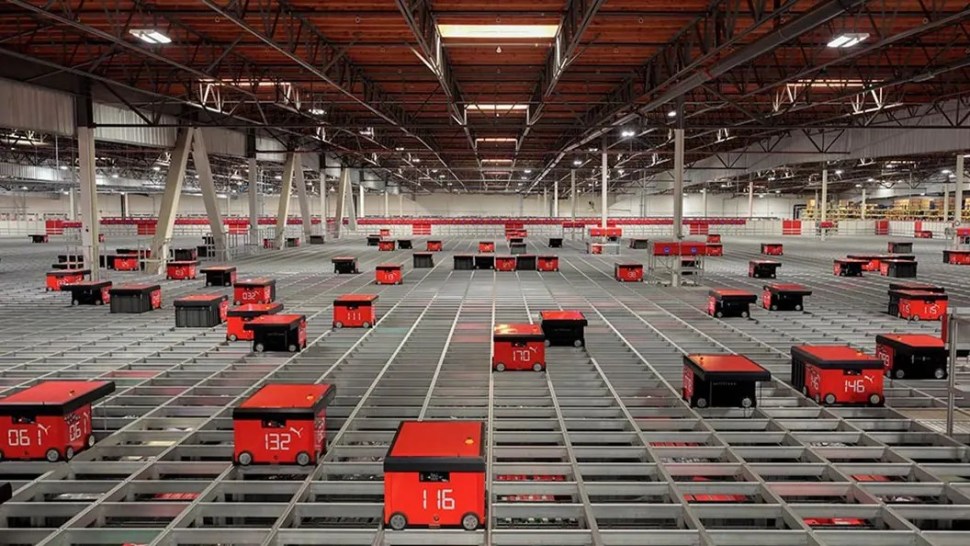
Danish shipping and integrated logistics group A.P. Moller-Maersk has taken over management of Puma’s three large, highly automated distribution centers in the United States and has turned them into multi-client facilities to increase utilization and revenue.
Puma (XETRA: PUM) will let Maersk rent out unused space to other companies.
The Germany-based sportswear manufacturer has an existing long-term agreement with Maersk for integrated logistics services, including international ocean shipping, airfreight, customs and inland transportation services, as well as warehousing and distribution in Europe. Under the contract logistics agreement for North America, Maersk will operate warehouses in Torrance, California; Phoenix; and Whitestown, Indiana (outside Indianapolis) totaling about 2.3 million square feet, Maersk announced Thursday.
Puma said outsourcing its U.S. distribution network to Maersk will help maximize the performance of its automated facilities, speed up order processing and reduce costs, while supporting retail stores, wholesale customers and online shoppers.
The warehouses serve stores, wholesale customers and online shoppers. Experts say the challenge will be for Maersk to manage the inventory and warehouses as one network. Direct-to-consumer reached 35.2% of group sales in the second quarter, up from 32.1% a year earlier, according to Puma’s earnings report.
Why It Matters: The decision represents a major expansion of a customer relationship for Maersk and is another example of companies commercializing their in-house logistics infrastructure to optimize capacity utilization.
The three Puma distribution centers are equipped with AutoStore systems. AutoStore is a robotic technology company specializing in automated storage and retrieval systems in which inventory is stored within a compact grid and automatically retrieved by robots that bring goods directly to employees at workstations for picking and packing. It has a flexible and scalable design that helps operators adapt to changing demand and maintain fulfillment performance.
Beyond supporting Puma’s business, the contract logistics agreement enables Maersk to use available capacity in the network for other customers, turning excess capacity into a revenue generator for both parties. A key component of the network is the Torrance facility, which will become Maersk North America’s first AutoStore deployment supporting multiple clients. Starting in 2027, Maersk will have capacity in the Torrance facility for other brands that need fast, automated order fulfillment near strategic air and ocean gateways as well as one of the largest consumer markets in the country. The site will be capable of handling roughly 20 million units of throughput each year, Maersk said.
“Many companies are looking for ways to get more value from the logistics infrastructure they’ve already invested in. This partnership is a great example of how Maersk can combine our operational expertise, technology, and logistics network with a customer’s existing assets to improve efficiency, maximize the value of automation, and reduce costs,” said David Hune, North America head of Maersk Contract Logistics, in a news release.
Maersk North America operates more than 70 warehouses covering about 22.5 million square feet and offering consolidation, deconsolidation, storage, distribution and omnichannel fulfillment. Globally, Maersk has more than 500 warehouses under management.
Click here for more FreightWaves/American Shipper stories by Eric Kulisch.
Write to Eric Kulisch at ekulisch@freightwaves.com.
RELATED STORIES:
Maersk to run $100M Boston fulfillment center for large retailer
