




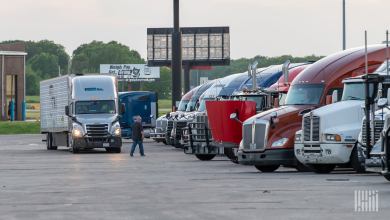
Craig Fuller, CEO at FreightWaves
Tuesday, September 5, 2023
The perpetual truck driver shortage is not real
There’s no perpetual, industry-wide truck driver shortage. The market quickly corrects any shortage of labor.
There’s no perpetual, industry-wide truck driver shortage. The market quickly corrects any shortage of labor.

The Federal Motor Carrier Safety Administration on Wednesday released parameters on data collection for a new study to determine the impact of detention time on drivers. The Information Collection Request (ICR) was submitted to the Office of Management and Budget (OMB) for review and approval and opened the window for public comments.
Proposed rulemaking on automatic emergency braking (AEB) introduced in June by the National Highway Traffic Safety Administration and the Federal Motor Carrier Safety Administration is getting more pushback from a coalition of state law enforcement officials and brake manufacturers that argue more dialogue is needed before moving forward.

Owner-operators Toni and Chris Murphy of New Egypt, New Jersey, said it’s been hard to fight back against an invisible tech-savvy fraudster who stole their trucking company’s identity.

“Poor CSA scores can lead to warning letters from the FMCSA, more inspections, higher insurance rates and negative publicity,” said J. J. Keller & Associate Inc.’s Josh Lovan.

After experiencing two years of record growth during the COVID-19 pandemic, Jacksonville, Florida-based Surge Transportation, a digital freight brokerage, sought to find a buyer and slashed its rates nearly a year before it filed for Chapter 11 bankruptcy protection on Monday.
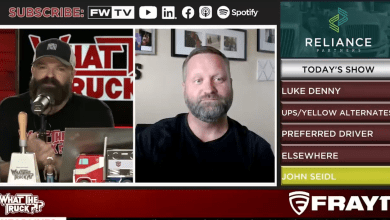
Reliance Partners’ VP of risk services breaks down what motor carriers need to know about FMCSA safety ratings.

The first meeting of the Federal Motor Carrier Safety Administration’s Truck Leasing Task Force (TLTF) discussed and drafted recommendations on Tuesday regarding limiting or eliminating the power a trucking company has over lease purchase agreements with drivers.

In this edition: The FMCSA has issued final guidance on the broker and agent divide and there are big doings in the West Coast labor talks.

A proposal by the Federal Motor Carrier Safety Administration to alter and expand reporting categories for crashes is drawing criticism from the Owner-Operator Independent Drivers Association, which argues the FMCSA should take stronger action to protect driver safety records.

“When appropriately managed, your records not only show who your drivers and employees are, but also that they are trained, qualified, properly taxed and work within the limits of the law,” said Daren Hansen of J. J. Keller & Associates, Inc.

J. J. Keller & Associates Inc. broke down what businesses need to know about the MCS-150, its common challenges and how to stay compliant.
SONAR ocean container booking data suggests that the predicted freight rebound in the second half of 2023 may be increasingly unlikely. Import and ocean container booking data is typically used as a leading indicator for future truckload volumes, as containers are offloaded in ports and transferred into intermodal or truckload orders.
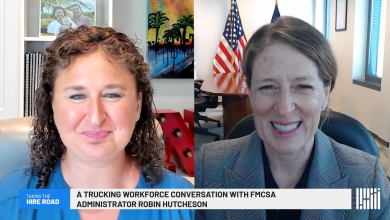
FMCSA Administrator Robin Hutcheson discusses efforts underway to make the trucking industry more diverse.

To view more FreightWaves infographics, click here

Trucking safety advocates are at odds with corporate-backed attempts at implementing a roadside safety exemption for autonomous trucks. For those unaware, current regulations require drivers to use three emergency reflective triangles, or at least six fusees or three liquid-burning road flares, if they stop on the road for reasons other than traffic.

“If there comes a time when you have a crash and attorneys or law enforcement start digging into your records and find falsifications, it’s all going to come to the surface,” said Brian Runnels, vice president of safety at Reliance Partners.

Settling multiple distractions surrounding TuSimple was Cheng Lu’s priority when he returned as CEO in November.

Industry insiders are accusing some ELD vendors of exploiting flaws in the Federal Motor Carrier Safety Administration’s technical specifications to let trucking companies and their drivers skirt hours-of-service rules.

Federal guidance from 2019 suggested driverless trucks could skip electronic logging devices. Will that hold up?