




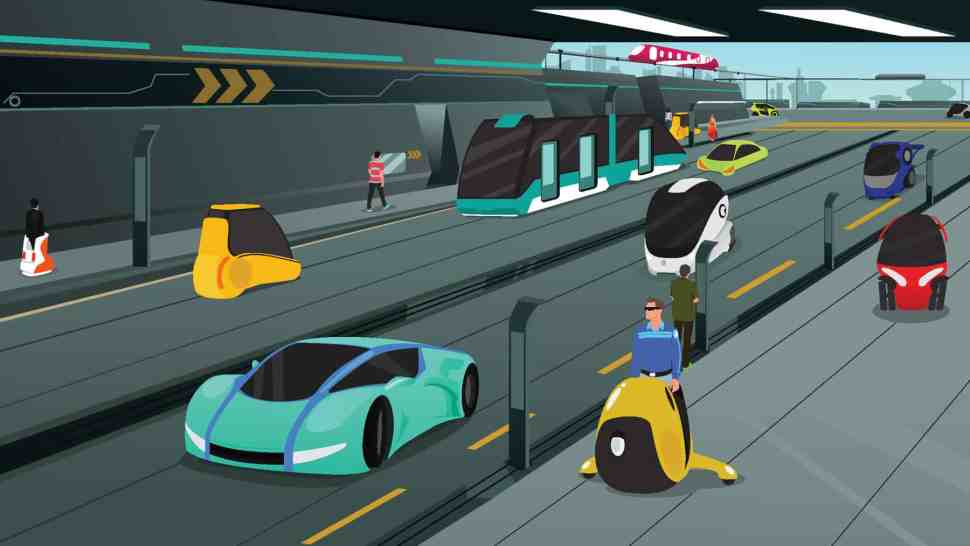
The world of transportation is changing and changing fast. After decades of little innovation, the past five years or so have ushered in a sea change and it will profoundly impact the way people and goods move, said Timothy Papandreau, strategic advisor and founder of City Innovate.
“The last 75 years of transportation, not much has changed, but the last five years, we’ve seen a lot,” he told an audience during a talk at the Movin’ On by Michelin Global Summit in Montreal last week. “We are a city planet and the reason is that close to half of the world’s population lives near a city and in the next 30 years, that will be close to three-quarters.”
City Innovate is startup designed to help urban areas take advantage of new technologies to improve their transport systems. Papandreau formerly worked at Google and Waymo before founding City Innovate.
While much of Papandreau’s speech focused on passenger movement, the ripple effect impacts freight movement at all levels.
The American Transportation Research Institute (ATRI) says that congestion on the nation’s roadways costs the trucking industry $63.4 billion a year. That cost arises from 996 million lost hours of industry productivity, the equivalent of 362,000 truck drivers sitting still for an entire year.
That freight congestion is only expected to worsen as more of the population moves closer to cities. Easing that, though, has become not just a freight problem, but a global problem that starts with removing the number of cars from the roadways.. According to Papandreau, a car is only used about 5% of the time, on average, while city buses run empty 60% of the time. The solution, he noted, is to find alternative ways for people to move – bikes, walking, ride-sharing services, and autonomous vehicles among them.
“If the technology can’t navigate in a city environment, it means the technology isn’t ready. We can’t expect a city to [change]; we have to design the technology to work in today’s cities so that we can get to the cities of tomorrow.”
Those last two points are being made possible by the growth in technology, data and APIs that make sharing data easier. The result has been the emergence of services such as Uber and Lyft.
“The next 10 years are going to be a big sea change in transportation,” Papandreau said, noting he expects more growth of a sharing system – ride sharing and vehicle sharing services – as well as electrification and automation.
The changes, especially with autonomous vehicles, will result in drivers shifting roles into more of “ambassadors” that assist commuters. There are concerns, Papandreau added, including how well automated technologies can navigate city streets.
“If the technology can’t navigate in a city environment, it means the technology isn’t ready,” he said. “We can’t expect a city to [change]; we have to design the technology to work in today’s cities so that we can get to the cities of tomorrow.”
Those cities of tomorrow, in Papandreau’s mind, are focused on “active mobility,” i.e. walking and biking. He believes that half of all trips will occur via active mobility in the future. “Think how many people will fly 6,000 miles to take a stroll in a city,” he said. “People want to do this.”
The change will be felt first in the middle and outer neighborhoods of cities, Papandreau believes, because inner city environments already offer many alternatives to driving now.
Even at that, challenges may slow the advancement of technologies such as Level 4/5 autonomous vehicles.
“I think we need local governments to let us test the vehicles,” Pamela Milligan, senior vice president of strategy and organization at mapping telematics company TomTom, said during a panel discussion that followed Papandreau’s talk. “But, you also need to have a global standard at some point. We don’t even have a standard plug [around the world], but if we want to get to Level 5 autonomy and take the vehicles everywhere, we need a global standard.”
Before a global standard is enacted, though, individual countries need to develop consistent standards, explained R.J. Scaringe, founder & CEO of electric vehicle company Rivian. Scaringe acknowledged that the lack of regulatory consistency and slow adoption of autonomous regulation on a state-by-state basis in the U.S. has allowed development of the technology, there still needs to be a more consistent framework.
“Today, you can’t sell a vehicle in the United States without a seatbelt but you can sell a vehicle with autonomous systems,” he noted. The challenge, Scaringe said, is that policy makers are dealing with a very complex topic and need to incorporate more industry experts into the discussion.
The growth of autonomous technologies also depends on transparency, a word many in industry cringe at.
“It’s not just about regulatory,” explained Frantz Saintellemy, president & COO of LeddardTech. “We, as an industry, need more transparency. What Uber does is very different than what Waymo does.”
Milligan thinks that some of that comes through partnerships, a key to making the overall autonomous ecosystem work. “We can’t do this alone,” she said. “We need to be working with the OEMs, the sensor companies.
“Cars need to talk to each other with data sharing so they know what is a temporary [road] change and what is not,” Milligan added.
Saintellemy thinks the deployment of 5G technology – with its increased capacity for speed and data storage – will significantly improve the ability of safety systems and autonomous technologies to operate effectively, leading to increased machine learning capabilities as vehicles share data on road situations through mapping updates in real-time with trailing vehicles, for example.
All of this ultimately leads back to Papandreau’s earlier talk on how the transport society is changing. These technological advances will drive the push to a shared asset model, Scaringe believes, where people will no longer purchase vehicles as they do now, but rather subscriptions where they receive access to a vehicle when they need it or receive a number of rides per month. The change, he said, will alter buying behaviors as people won’t buy makes or models as they do now, but rather make decisions based on data such as safety performance.
However it all turns out, the result will be a mobile society unlike anything we currently envision.
Brokerage Compliance Symposium
The day before F3. Every compliance issue you face - fraud exposure, carrier liability, FMCSA rules, cargo theft, insurance gaps - navigated by attorneys and operators defining best practices in a changing industry.
F3 Awards Dinner
The night before F3. FreightTech100 companies honored. FreightTech 25 and Shipper of Choice winners revealed live. Cocktail reception into dinner and live music - 300 industry leaders in one purpose-built room.
F3: Future of Freight Festival
Industry-defining keynotes, rapid-fire technology demos, and industry leaders networking in experiences across Chattanooga - plus the inaugural F3 Awards Dinner featuring the FreightTech and Shipper of Choice reveals.
The day before F3. Every compliance issue you face - fraud exposure, carrier liability, FMCSA rules, cargo theft, insurance gaps - navigated by attorneys and operators defining best practices in a changing industry.
The Signal at Chattanooga Choo Choo • Chattanooga, TN Register NowThe night before F3. FreightTech100 companies honored. FreightTech 25 and Shipper of Choice winners revealed live. Cocktail reception into dinner and live music - 300 industry leaders in one purpose-built room.
The Signal at Chattanooga Choo Choo • Chattanooga, TN Register NowIndustry-defining keynotes, rapid-fire technology demos, and industry leaders networking in experiences across Chattanooga - plus the inaugural F3 Awards Dinner featuring the FreightTech and Shipper of Choice reveals.
The Signal at Chattanooga Choo Choo • Chattanooga, TN Register Now