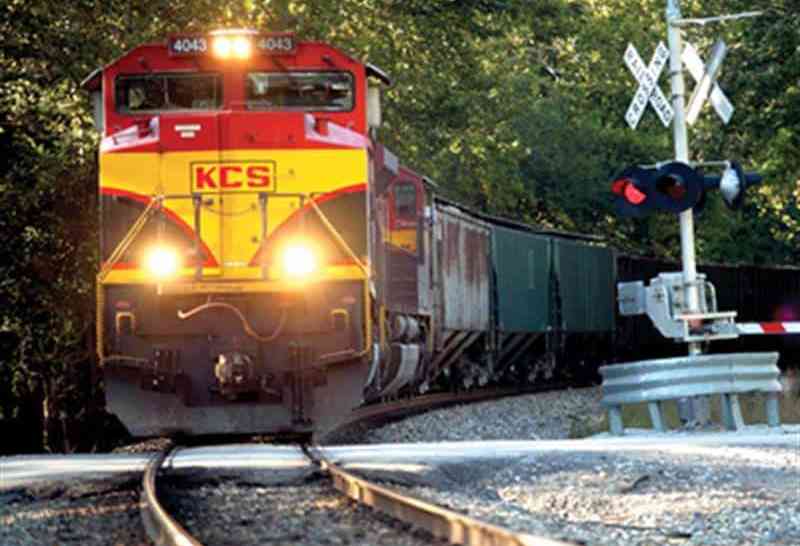
Here are some highlights from the earnings call of Kansas City Southern, which released earnings Friday morning that showed it missing its consensus earnings per share by 3 cts, at $1.30 per share, and a revenue miss of a bit more than $8 million. The company recorded revenue of $638.6 million in the first quarter of the year.
Although the answer wasn’t particularly enlightening, one of the highlights of the call was provided by analyst Bascome Majors of Susquehanna. According to a transcript of the earnings call, which Freightwaves also listened to, Majors asked CFO Mike Upchurch–filling in for President and CEO Pat Ottensmeyer, who missed the call due to the death of his mother–just how much tight market conditions in the trucking sector were boosting business at Kansas City Southern, and by extension, all class 1 railroads. Describing the current trucking market as “arguably unprecedented,” Majors noted that there is little evidence of a windfall to the rail sector as a result. “It just feels like some of the larger class ones have been slow to regain mobile share in the kind of market we’ve seen over the last, call it three to six months,” Majors asked. The response was provided by Brian Hancock, executive vice president and chief marketing officer. It implicitly rejected the idea that there had been no benefit, but addressed only KC Southern, without saying much more than standard talking points. “The things that our customers are telling us is rail is a great option, so you have to ask everybody else how it impacts them,” Hancock said. “They’re excited about rail as an option in the capacity constrained environment, and we feel very good about that.”
Hanging over all the operations of class 1 railroads is the Surface Transportation Board inquiry into congestion and slow performance that has bedeviled shippers for months. Addressing it almost immediately in the call, Upchurch said “the majority of our network is performing well.” Kansas City Southern has an enormous footprint into the Mexican market, which means that any congestion in Texas–particularly in the Union Pacific-dominated Houston market–affects KCS’ shipments south of the border. “Congestion in South Texas and Houston has had the most impact to operating performance during the quarter but are starting to show signs of improvement.” Upchurch said. “We do expect some lingering effects in the second quarter as fluidity in this region returns to normal.” Later in the call, Jeff Songer, executive VP and COO, said that KCS has been “pretty specific” in its communications with the STB that the south Texas and Houston areas has been a “choke point” for a lot of rail traffic. “I know we along with others in that area have been spending a lot of capex on capacities,” noting that KCS has particularly been spending money in its Laredo sector.

At other times during the call, there were specific references to KCS being able to capitalize on a tight trucking market. Hancock noted that KCS’ report showed “strength in lumber products due to a tightening truck capacity market.” Hancock also said at a separate point that as the Mexican peso gets stronger–though it weakened significantly Friday–it enables Mexican shippers to buy the more expensive rail option to move product to market. “It’s just a real benefit to us against the truck market,” Hancock said of the rising Mexican currency.
Trucking did come up in a discussion about pricing. Hancock said the company is “very comfortable” with the current pricing environment. Beyond the improvements in service that were referenced in discussion of the STB issues, Hancock said that “I think that people are feeling the effects of a capacity constrained truck environment which allows them to look at other options certainly in the intermodal space but also in some of the other places where you could use a rail car to move it a long distance and transload.” Goldman Sachs analyst Matt Reustle specifically said he had heard that price increases for the quarter were running about 3% ahead of last year. Upchurch said the company had seen “a little bit of acceleration in pricing around contract renewals” during the quarter, and that the first quarter is “an important data point” in projecting out prices through the year. Referring to the 3% figure, Upchurch said that is what KCS had been seeing for “the better part” of a year, but that in the first quarter, “our renewals did step up from that level,” to which Hancock said, “Yes, it’s higher than that.”
While other railroads have been talking about a tough winter as impacting earnings, KCS has needed to deal with a unique disruption: striking Mexican teachers on railroad tracks. The disruptions occurred off and on, with a particularly sharp period of them in early February that shut a Ford plant. Hancock said for now he did not see further delays, and if they did, they would be ended quickly. “The military has actually come in immediately and removed the teachers because of international commerce needs,” he said.
Some relevant numbers: average railroad velocity at 27.6 miles per hear was slightly more than the 27.3 of the fourth quarter, and a little less than the 27.8 of the first quarter of last year. Dwell time was 23.1 hours, down from 23.6 in the fourth quarter and less than the 23.3 of the corresponding quarter of 2017. The detailed earnings can be found here.
Brokerage Compliance Symposium
The day before F3. Every compliance issue you face - fraud exposure, carrier liability, FMCSA rules, cargo theft, insurance gaps - navigated by attorneys and operators defining best practices in a changing industry.
F3 Awards Dinner
The night before F3. FreightTech100 companies honored. FreightTech 25 and Shipper of Choice winners revealed live. Cocktail reception into dinner and live music - 300 industry leaders in one purpose-built room.
F3: Future of Freight Festival
Industry-defining keynotes, rapid-fire technology demos, and industry leaders networking in experiences across Chattanooga - plus the inaugural F3 Awards Dinner featuring the FreightTech and Shipper of Choice reveals.
The day before F3. Every compliance issue you face - fraud exposure, carrier liability, FMCSA rules, cargo theft, insurance gaps - navigated by attorneys and operators defining best practices in a changing industry.
The Signal at Chattanooga Choo Choo • Chattanooga, TN Register NowThe night before F3. FreightTech100 companies honored. FreightTech 25 and Shipper of Choice winners revealed live. Cocktail reception into dinner and live music - 300 industry leaders in one purpose-built room.
The Signal at Chattanooga Choo Choo • Chattanooga, TN Register NowIndustry-defining keynotes, rapid-fire technology demos, and industry leaders networking in experiences across Chattanooga - plus the inaugural F3 Awards Dinner featuring the FreightTech and Shipper of Choice reveals.
The Signal at Chattanooga Choo Choo • Chattanooga, TN Register Now