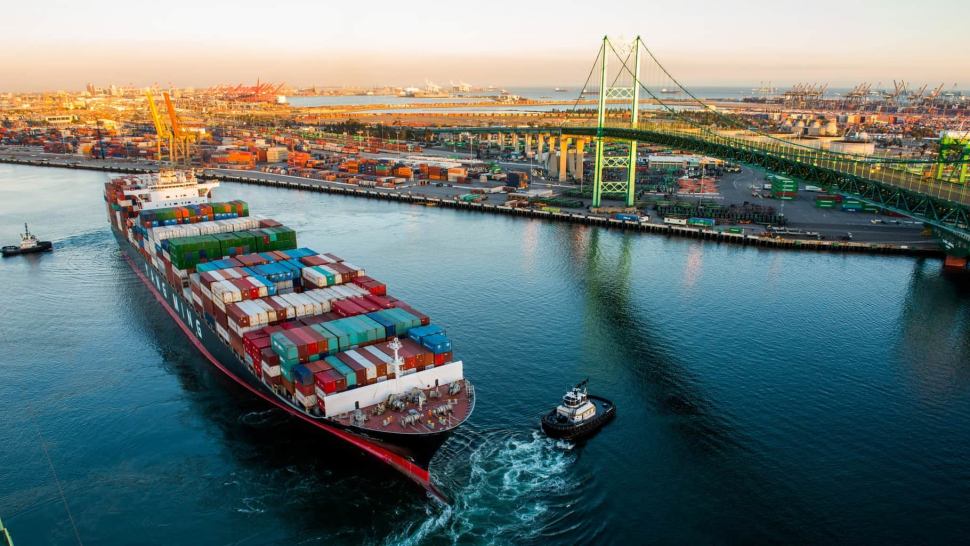
East Coast seaports captured nearly 49 percent of all U.S. 20-foot equivalent unit (TEU) container traffic in 2018, nearly a 47 percent gain over the past 10 years and more than 2.5 times the growth of West Coast ports during that time, according to data published on Thursday, July 18 by the real estate and logistics services giant JLL, Inc. (NYSE:JLL).
East Coast ports controlled 48.9 percent of all TEU share last year, up from 46 percent in 2014 and 43.5 percent in 2008, according to JLL’s annual study of North American seaports. The study did not break out traffic share by origin or destination. However, Walter Kemmsies, managing director, economist and chief strategist of the company’s ports, airport and global infrastructure unit and the report’s point person, said it is clear that the 2015 opening of the expanded Panama Canal, which has allowed much larger vessels to connect Asian origin points to East Coast ports, has played a major role in the growth of East Coast port share.
Kemmsies added that U.S. West Coast ports still receive the bulk of Asian ocean imports because of their location and their deepwater ports. However, in recent years East Coast ports such as Miami have deepened their harbors and channels, while ports in Charleston, South Carolina and Savannah, Georgia are nearing the completion of their own deepening projects. The ports of Newark/Elizabeth, New Jersey, Baltimore, Maryland and Norfolk, Virginia already have 50-foot harbor drafts, considered by many a requirement to handle the larger and heavier vessels that sail the seas and that are coming online
Prior to the expansion, the Panama Canal could only accommodate vessels with a 5,500-TEU maximum capacity. Today, ships with nearly three times that capacity sail through the Isthmus of Panama on their way to East Coast ports. Freight is then transported to distribution centers and finally to retailers east of the Mississippi, where two-thirds of the U.S. population resides.
In the past, larger ships with cargoes bound for the eastern half of the U.S. would call on West Coast ports and then the cargo would be trucked or placed on the rails for the journey east. The intermodal operation is considered faster but more expensive than an all-water route transiting the Panama Canal. However, running larger vessels through the canal is appealing to many beneficial cargo owners (BCO), for whom scheduling predictability is often more important than speed. For over a century, larger ships navigating an all-water route from Asia to the U.S. East Coast would have to sail around South America.
The report painted a somewhat bifurcated picture of available warehouse and distribution center space on both coasts. The vacancy rate at the Ports of Los Angeles and Long Beach, the country’s busiest seaport complex, sat at 1.5 and 1.9 percent, meaning space around the complex was and is almost impossible to lease. The Port of Vancouver in British Columbia had an even lower rate at 1.6 percent. The Port of Oakland was the only West Coast port surveyed with a 2018 vacancy rate of more than 5 percent, and that is due largely to significant property development at the port.
By contrast, the ports of Charleston and Baltimore had vacancy rates of 9.8 and 8.6 percent, respectively. Norfolk had a 5.9 percent vacancy rate, while Miami had a rate of 5.5 percent. Savannah had the lowest vacancy rate at 2.4 percent. That was followed by Jacksonville at 2.7 percent and Montreal, Canada at 3.4 percent.
In an email, Kemmsies wrote that there has been, and continues to be, a great deal of construction activity at East Coast ports in anticipation of more volume moving to those ports through the Panama Canal.
Brokerage Compliance Symposium
The day before F3. Every compliance issue you face - fraud exposure, carrier liability, FMCSA rules, cargo theft, insurance gaps - navigated by attorneys and operators defining best practices in a changing industry.
F3 Awards Dinner
The night before F3. FreightTech100 companies honored. FreightTech 25 and Shipper of Choice winners revealed live. Cocktail reception into dinner and live music - 300 industry leaders in one purpose-built room.
F3: Future of Freight Festival
Industry-defining keynotes, rapid-fire technology demos, and industry leaders networking in experiences across Chattanooga - plus the inaugural F3 Awards Dinner featuring the FreightTech and Shipper of Choice reveals.
The day before F3. Every compliance issue you face - fraud exposure, carrier liability, FMCSA rules, cargo theft, insurance gaps - navigated by attorneys and operators defining best practices in a changing industry.
The Signal at Chattanooga Choo Choo • Chattanooga, TN Register NowThe night before F3. FreightTech100 companies honored. FreightTech 25 and Shipper of Choice winners revealed live. Cocktail reception into dinner and live music - 300 industry leaders in one purpose-built room.
The Signal at Chattanooga Choo Choo • Chattanooga, TN Register NowIndustry-defining keynotes, rapid-fire technology demos, and industry leaders networking in experiences across Chattanooga - plus the inaugural F3 Awards Dinner featuring the FreightTech and Shipper of Choice reveals.
The Signal at Chattanooga Choo Choo • Chattanooga, TN Register Now