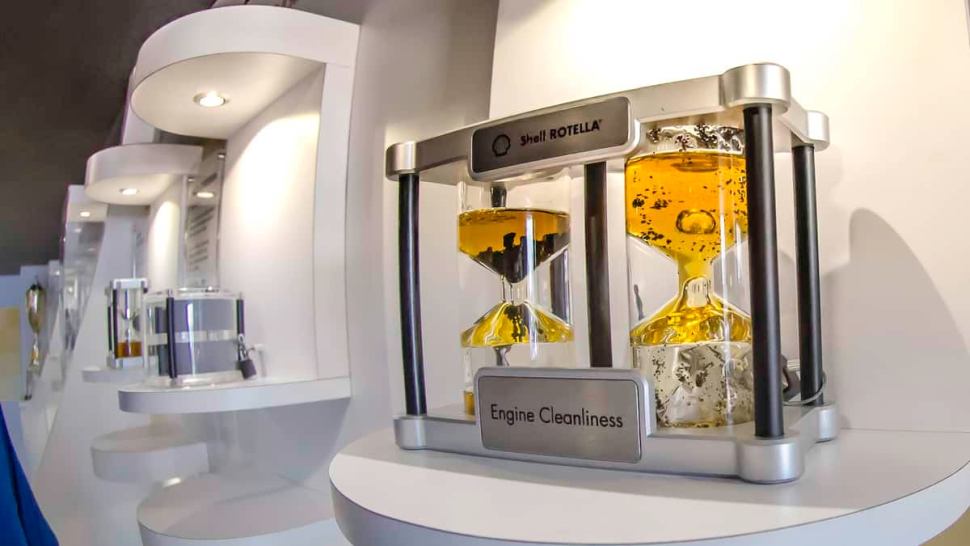
Whenever pollution regulations change for heavy trucks, lubricant makers head to the lab to figure out how to compensate for hotter-running engines and other variables.
Dan Arcy, global original equipment manufacturer technical manager at the Shell Technology Center in Houston, ticks off on his fingers a number of changes in the last two decades. The most recent came in 2016 to meet engine changes the industry adopted for 2017 models.

Arcy’s regular question to truck makers is, “Are you changing things that are going to require us to change our oils?”
Emissions-driven changes
For the federal Phase 2 Greenhouse Gas emission changes due for 2021, Arcy is confident the answer is “no.” It’s a “maybe” for 2024 and “all but certain” for 2027.
The last changes, which took the lubricants industry five years to prepare, are still being adopted by the trucking industry. Volvo Trucks (OTC: VLVLY), Daimler Trucks (OTC: DMLRY)and Navistar International (NYSE: NAV) now use oil that meets the American Petroleum Institute CK-4 or FA-4 standards or their oil standards for oil fills at the factory.
The two formulas handle higher engine temperatures without breaking down. Shell amassed more than 50 million miles of road tests before launching the lubricants.
Education mission
“We need to educate the industry on the number of different things including fuel economy that these lubricants can provide in terms of fuel savings,” Arcy said.
Partially synthetic lower viscosity 10W-30 and 5W-30 oils are supplanting the industry standard 15W-40 heavy-duty oil. The new formulas cost more but can bring up to 2 percent better fuel economy with longer intervals between changes.
Trucking companies that trade equipment after four years and 450,000 miles get the fuel efficiency from running a lighter viscosity lubricant and pass it along to second owners.
Freight ton efficiency
Arcy would like to see the trucking industry move from focusing on miles per gallon to measure freight ton efficiency – how much fuel it takes to move a ton of cargo. He thinks the lower weight of new Class 8 trucks combined with fuel efficiency gains could result in more freight being moved for the same amount of fuel.
The industry is beginning to embrace freight ton efficiency, said Mike Roeth, executive director of the North American Council for Freight Efficiency (NACFE).
“There are a lot of conditions with respect to mpg,” Roeth told FreightWaves. “Freight ton efficiency takes the payload away as a variable. It is a better measure of efficiency than just miles per gallon.”
The NACFE will use of the measurement in addition to mpg during its Run on Less competition in October.
Freight ton efficiency also considers emissions reductions, which freight executives are increasingly using as a measure of their job performance.
“A gallon of fuel not burned is less particulate matter and less carbon in the air,” Roeth said. “Hauling more freight with less gallons not only helps pay for itself but it helps fleets and CEOs with their clean air and overall sustainability goals.”
‘Old School’ preference
While achieving fuel savings might seem like a no-brainer, many truckers driving older equipment stick with Shell Rotella T415W-40 conventional oil.
“Old school drivers don’t like to be underpowered,” said Nick Olson, who works with large fleets as an outside parts sales representative for Rihm Kenworth in Albert Lea, Minnesota. Trucking fleets focus on miles per gallon as a component of total cost of ownership.
Added Brent Kiker, Rihm branch service manager: “Some of these trucks are over 800 horsepower and 2,500 feet of torque. The guys that know their trucks can get pretty good fuel mileage.”
Brokerage Compliance Symposium
The day before F3. Every compliance issue you face - fraud exposure, carrier liability, FMCSA rules, cargo theft, insurance gaps - navigated by attorneys and operators defining best practices in a changing industry.
F3 Awards Dinner
The night before F3. FreightTech100 companies honored. FreightTech 25 and Shipper of Choice winners revealed live. Cocktail reception into dinner and live music - 300 industry leaders in one purpose-built room.
F3: Future of Freight Festival
Industry-defining keynotes, rapid-fire technology demos, and industry leaders networking in experiences across Chattanooga - plus the inaugural F3 Awards Dinner featuring the FreightTech and Shipper of Choice reveals.
The day before F3. Every compliance issue you face - fraud exposure, carrier liability, FMCSA rules, cargo theft, insurance gaps - navigated by attorneys and operators defining best practices in a changing industry.
The Signal at Chattanooga Choo Choo • Chattanooga, TN Register NowThe night before F3. FreightTech100 companies honored. FreightTech 25 and Shipper of Choice winners revealed live. Cocktail reception into dinner and live music - 300 industry leaders in one purpose-built room.
The Signal at Chattanooga Choo Choo • Chattanooga, TN Register NowIndustry-defining keynotes, rapid-fire technology demos, and industry leaders networking in experiences across Chattanooga - plus the inaugural F3 Awards Dinner featuring the FreightTech and Shipper of Choice reveals.
The Signal at Chattanooga Choo Choo • Chattanooga, TN Register Now