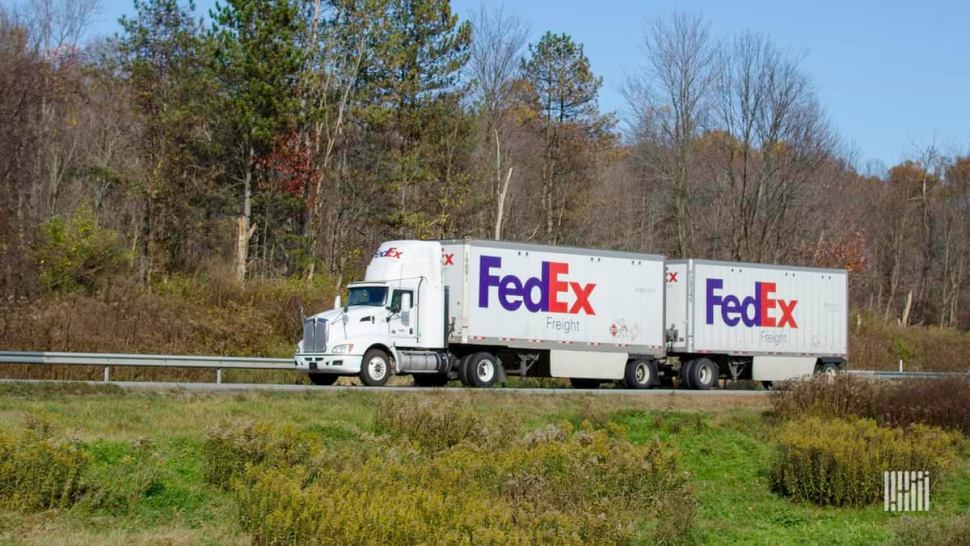
FedEx Freight, the less-than-truckload (LTL) unit of FedEx Corp. (NYSE:FDX), has imposed a $7 per-shipment surcharge on all shipments moving to, from and within California, the parent company said.
The new assessment, dubbed a “California Compliance Surcharge,” took effect Jan. 20. It is part of a slew of pricing adjustments at FedEx which went into force on that date. The company, which posted all of the new charges on its website, did not elaborate on the California surcharge other than to say it will be tacked on to “all other lawful charges” and will be collected from the payor of the charges. The company did not respond to a request for comment.
Transport companies serving California have been bracing for higher operating costs ever since Gov. Gavin Newsom signed the landmark AB5 bill into law last year. The law, which was scheduled to take effect Jan. 1 but has been stayed by the courts, makes it harder for companies to prove that workers are functioning as independent contractors and not as employees.
Transport companies which have long relied heavily on the independent contractor model because it is less costly than adding workers to the payroll are lobbying for an exemption from the law on grounds that state actions impacting transportation are preempted by the 1994 Federal Aviation Administration Authorization Act. The federal law overrides any state’s legislation that governs a carrier’s rates, routes and services. Opponents of the industry’s efforts to pre-empt AB5, notably organized labor, maintain the law covers employment issues and has no effect on a provider’s rates, routes and services.
FedEx Freight’s parent has long experience dealing with the employee classification issue in California. Its FedEx Ground unit, which has always used contractors to haul packages, in 2016 paid about $240 million to settle class-action suits in 20 states, including California, alleging the unit had control over the drivers’ workday yet classified them as independent owner-operators. The unit has since shifted to using an intermediary that employs and manages drivers who move its goods.
Besides the California surcharge, FedEx Freight has changed the weight and dimensional thresholds under which so-called minimum charges would apply. Before Monday, minimum charges applied to shipments exceeding 20,000 pounds or utilizing a linear length of 20 feet inside a trailer. That threshold has been narrowed to 15,000 pounds or utilizing a linear length of 15 feet, the company said.
The measure will likely subject more LTL shippers to minimum charges, which carriers have long used to gain pricing leverage because they typically supersede any discounted rates that have been negotiated under contract. For example, if a minimum charge on a parcel shipment is $8, and a shipper has a 25% discount on a parcel whose list price is $10, the higher minimum charge would take precedence over the discounted rate. The purpose of minimums is often contractually discounted rates less valuable to the shipper.
Most of the changes that took effect Monday are aimed at compensating FedEx for handling heavier and bulky shipments, which can be costly to process and handle, and, in the case of bulkier shipments, may generate less revenue for the carrier because they can occupy a disproportionate space inside a trailer. Perhaps the most significant change calls for “additional handling” surcharges to be imposed on all FedEx Express and FedEx Ground deliveries of shipments weighing more than 50 pounds. Before, the surcharge applied to shipments weighing 70 pounds or more.
Brokerage Compliance Symposium
The day before F3. Every compliance issue you face - fraud exposure, carrier liability, FMCSA rules, cargo theft, insurance gaps - navigated by attorneys and operators defining best practices in a changing industry.
F3 Awards Dinner
The night before F3. FreightTech100 companies honored. FreightTech 25 and Shipper of Choice winners revealed live. Cocktail reception into dinner and live music - 300 industry leaders in one purpose-built room.
F3: Future of Freight Festival
Industry-defining keynotes, rapid-fire technology demos, and industry leaders networking in experiences across Chattanooga - plus the inaugural F3 Awards Dinner featuring the FreightTech and Shipper of Choice reveals.
The day before F3. Every compliance issue you face - fraud exposure, carrier liability, FMCSA rules, cargo theft, insurance gaps - navigated by attorneys and operators defining best practices in a changing industry.
The Signal at Chattanooga Choo Choo • Chattanooga, TN Register NowThe night before F3. FreightTech100 companies honored. FreightTech 25 and Shipper of Choice winners revealed live. Cocktail reception into dinner and live music - 300 industry leaders in one purpose-built room.
The Signal at Chattanooga Choo Choo • Chattanooga, TN Register NowIndustry-defining keynotes, rapid-fire technology demos, and industry leaders networking in experiences across Chattanooga - plus the inaugural F3 Awards Dinner featuring the FreightTech and Shipper of Choice reveals.
The Signal at Chattanooga Choo Choo • Chattanooga, TN Register Now