




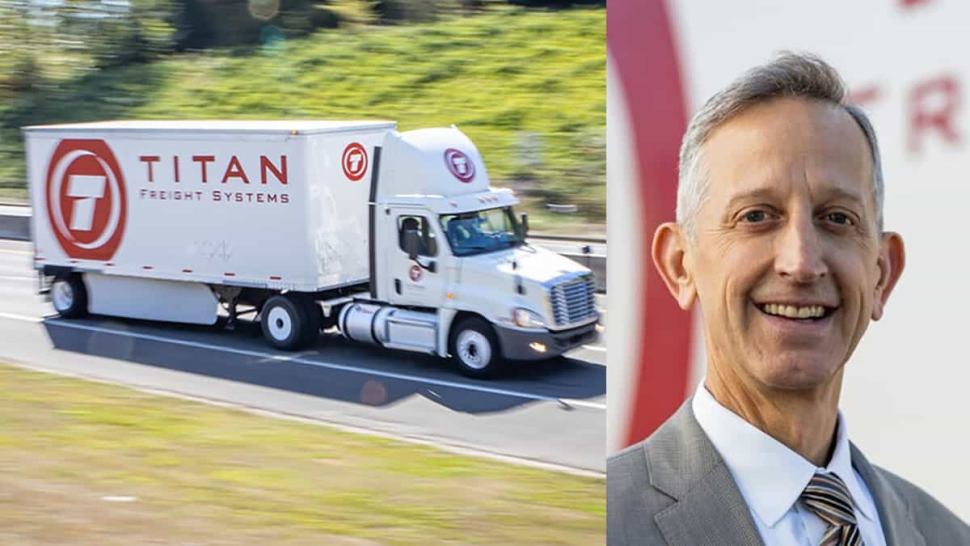
The Oregon Trucking Association opposes a state cap-and-trade bill to limit emissions from polluting industries. But Keith Wilson, the president of Titan Freight Systems, says regulation is necessary to accelerate the transition to clean fuel vehicles.
Keith Wilson is an outlier. In an industry that generally eschews regulatory solutions to the problem of greenhouse gas emissions, the president of Portland-based Titan Freight Systems is lobbying for a state bill that would put a price on carbon, likely raising fuel costs by around 15 cents per gallon.
The bill is hugely controversial in Oregon, where more than 1,000 people last week joined a trucking convoy and rally in the state capital protesting the climate legislation.
Wilson, by contrast, spoke at a rally earlier this week sponsored by an Oregon business group that advocates for climate change legislation.
FreightWaves talked to Wilson about why he supports the bill, the trucking industry’s general aversion to change and how society devalues carbon by giving it away for free. (Interview excerpts have been edited for length and clarity.)
FW: How does a cap-and-trade system fit into the Titan business model?
K.W.: We use technology as an enabler, a differentiator, which really leads to electric trucks and how we can lower the cost of ownership of this equipment.
Here’s an example: A few years ago our accident rate started to spike. Our damage costs tripled. So we added an AI camera safety system in January of last year. When the driver picks up the phone and starts texting, the AI sends an alert with a video and then lowers their safety score. We pay bonuses based on safety score, so the drivers never pick up phones anymore.
The result was zero accidents last year. So we need to get the word out to society that all these fatalities can be addressed.
We need to do the same with cap and trade. Technology is not something that our industry has generally grasped as a cutting-edge, first-mover approach. We’re still using this 100-year-old technology when we really need to change our core approach.
FW: Why is industry reluctant to embrace a new approach?
KW: In our business we try to hold on to old tech and old ways, not recognizing that something’s got to change. If there is not a cost to carbon, they’re not going to value it. Every time you give something away for free it’s abused. Right now we allow companies to emit carbon for free and so it’s abused.
FW: What about the argument that private-sector innovation will solve the greenhouse gas emissions problem without intervention from government?
KW: The issue is electric trucks will be extremely expensive. When this legislation takes effect in 2022, the equipment might be $200,000 per unit. My industry will say, “Why do I want to go from a $120K unit to $200K unit?” But if we can get cap-and-trade credits, if we can get public-private partnerships and move that truck from $200K down to $150K and my total cost of ownership can be within 18 months, they’ll do the math. They’ll start shifting over.
FW: The bill’s opponents say the hike in fuel prices will make it difficult to stay in business.
K.W.: Look, it will be like 15 cents per gallon of diesel. Fuel represents 10% of my overall expenses, so if I have a 3% increase in fuel and it only represents 10% of a line item, it’s not enough to be that alarmed with. It’s immaterial. And our customers have committed to helping us.
FW: Have you always been open to the idea of pricing carbon?
K.W.: We’ve always been open to the idea of trying to reduce carbon as much as we can. It’s one of our six critical vision items. In the last decade, our goal was to get to 7.5 miles per gallon. We didn’t meet that goal. We got to 7.2. All the changes we tried to do to the trucks, all the money we spent, and we barely moved the miles per gallon.
So we see cap and trade as that opportunity to stop measuring miles per gallon and start measuring in carbon reduction. Because when we measure our environmental stewardship in miles per gallon, it understands that we use fossil fuel. We’re trying to change that.
FW: Your stance puts you at odds with the Oregon Trucking Association, which opposes the bill.
K.W.: Jana Jarvis [OTA’s executive director] knows we have to address climate change. Her concern is there are no applications today. It’s the usual chicken or egg. They say: Electric trucks are years away. I say no, it’s not. I’ve visited the CARB pilot projects in California, and we’re within a year of having an application.
FW: On the topic of climate change, how do you change hearts and minds?
K.W.: Forty percent of the population still believes climate change is a hoax or due to natural causes. Or they just don’t know about it. Our industry, they’re good people. They are very caring and I respect their opinions. But it takes time to change people.
We have to value carbon. Once you value it, my industry is so resourceful, so smart, so hard-working, I guarantee they will find a way to reduce it.
Brokerage Compliance Symposium
The day before F3. Every compliance issue you face - fraud exposure, carrier liability, FMCSA rules, cargo theft, insurance gaps - navigated by attorneys and operators defining best practices in a changing industry.
F3 Awards Dinner
The night before F3. FreightTech100 companies honored. FreightTech 25 and Shipper of Choice winners revealed live. Cocktail reception into dinner and live music - 300 industry leaders in one purpose-built room.
F3: Future of Freight Festival
Industry-defining keynotes, rapid-fire technology demos, and industry leaders networking in experiences across Chattanooga - plus the inaugural F3 Awards Dinner featuring the FreightTech and Shipper of Choice reveals.
The day before F3. Every compliance issue you face - fraud exposure, carrier liability, FMCSA rules, cargo theft, insurance gaps - navigated by attorneys and operators defining best practices in a changing industry.
The Signal at Chattanooga Choo Choo • Chattanooga, TN Register NowThe night before F3. FreightTech100 companies honored. FreightTech 25 and Shipper of Choice winners revealed live. Cocktail reception into dinner and live music - 300 industry leaders in one purpose-built room.
The Signal at Chattanooga Choo Choo • Chattanooga, TN Register NowIndustry-defining keynotes, rapid-fire technology demos, and industry leaders networking in experiences across Chattanooga - plus the inaugural F3 Awards Dinner featuring the FreightTech and Shipper of Choice reveals.
The Signal at Chattanooga Choo Choo • Chattanooga, TN Register Now