




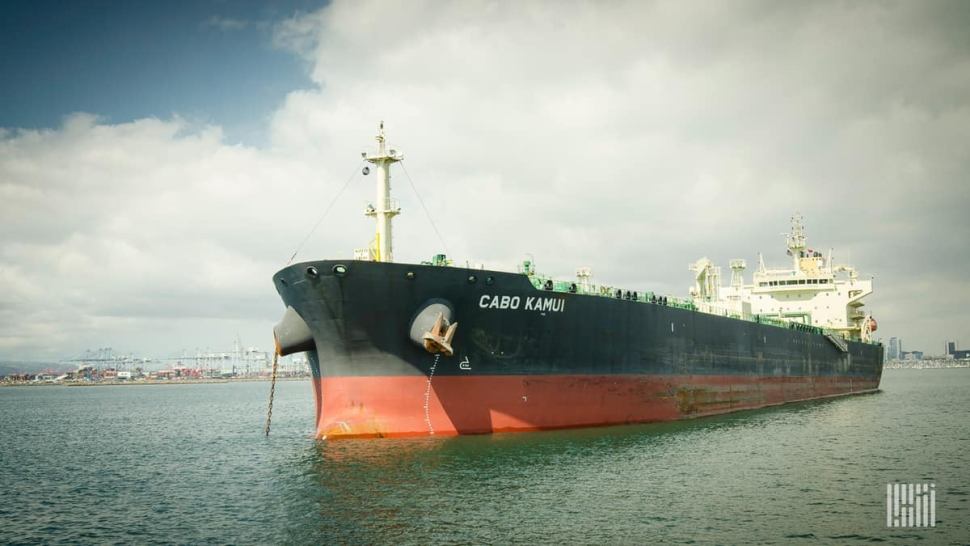
Oil market upheaval is likely behind a glut of oil tankers anchored off the Southern California coast that has raised red flags for the U.S. Coast Guard.
As of April 24, there were 27 vessels – 19 of them oil tankers – just outside the ports of Los Angeles and Long Beach. That’s triple the number of ships normally at anchorage, according to the Marine Exchange of Southern California.
The U.S. Coast Guard would not speculate on the reason for the buildup, but evaporating energy demand due to the coronavirus, coupled by the recent unprecedented plunge in crude oil prices, is rapidly overflowing land-based storage capacity. It has also led to the purchase of cheap oil by market speculators who have chartered tankers specifically for floating storage, which requires anchorage space.
Oil tankers at anchor off the coast of Southern California, April 23, 2020. Credit: U.S. Coast Guard
“Due to the unique nature of this situation, the Coast Guard is constantly evaluating and adapting our procedures to ensure the safety of the vessels at anchor and the protection of the surrounding environment,” said Marshall Newberry, a commander from the Coast Guard’s Sector Los Angeles/Long Beach.
A way the Coast Guard looks out for environmental damage at vessel anchorages is to conduct a fly-by (see video). For example, a sheen on the water indicates an oil leak, and trailing brown water can indicate the pumping out of raw sewage.
“One of the Coast Guard’s main missions is environmental safety, and because tankers have the potential for a spill, with the increased buildup we’re closely monitoring the situation to mitigate any environmental risk,” a Coast Guard spokesman told FreightWaves.
In addition to the 19 tankers, there were five cruise ships and two vehicle carriers at the anchorage according to the Marine Exchange, which acts as a maritime “air traffic control” for vessels arriving and departing the two ports. With anchorage space for 48 vessels, there is room to take on more. But Marine Exchange Executive Director Kip Louttit said he wasn’t sure what to expect.
“What I can say is that we’re responsible for anchorage management and everything within 25 miles,” Louttit told FreightWaves. “We just want to make sure there are no collisions, no groundings, the ships respond when we call them on the radio – all the proper protocols to make sure they’re doing what they’re supposed to.”
Brokerage Compliance Symposium
The day before F3. Every compliance issue you face - fraud exposure, carrier liability, FMCSA rules, cargo theft, insurance gaps - navigated by attorneys and operators defining best practices in a changing industry.
F3 Awards Dinner
The night before F3. FreightTech100 companies honored. FreightTech 25 and Shipper of Choice winners revealed live. Cocktail reception into dinner and live music - 300 industry leaders in one purpose-built room.
F3: Future of Freight Festival
Industry-defining keynotes, rapid-fire technology demos, and industry leaders networking in experiences across Chattanooga - plus the inaugural F3 Awards Dinner featuring the FreightTech and Shipper of Choice reveals.
The day before F3. Every compliance issue you face - fraud exposure, carrier liability, FMCSA rules, cargo theft, insurance gaps - navigated by attorneys and operators defining best practices in a changing industry.
The Signal at Chattanooga Choo Choo • Chattanooga, TN Register NowThe night before F3. FreightTech100 companies honored. FreightTech 25 and Shipper of Choice winners revealed live. Cocktail reception into dinner and live music - 300 industry leaders in one purpose-built room.
The Signal at Chattanooga Choo Choo • Chattanooga, TN Register NowIndustry-defining keynotes, rapid-fire technology demos, and industry leaders networking in experiences across Chattanooga - plus the inaugural F3 Awards Dinner featuring the FreightTech and Shipper of Choice reveals.
The Signal at Chattanooga Choo Choo • Chattanooga, TN Register Now