The success of the California Trucking Association’s ongoing action means that the law continues to be unenforceable in the Golden State
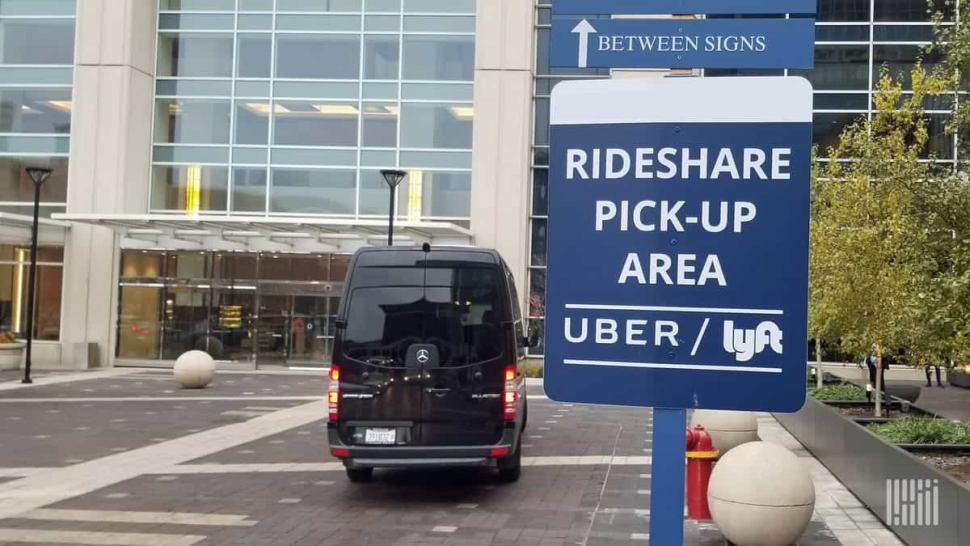
Uber and Lyft are now facing a requirement to reclassify their drivers as employees under the AB5 law, but this much-publicized court case will not have any impact on the trucking industry, at least for now.
The status of independent owner-operators under California’s AB5 law remains under the jurisdiction of a preliminary restraining order handed down earlier this year in a case brought by the California Trucking Association (CTA). That restraining order backed the CTA’s argument that the so-called F4A law, legislation from the 1990s that mostly governed aviation, blocked states from laws that would impact motor carriers involved in “the transportation of property,” according to the CTA’s summary of the law.
The next step in the CTA’s case is set for oral arguments to be heard in early September.
But while the CTA may ultimately prevail and its action results in a court case that keeps AB5 out of the use of independent owner-operators in California trucking, what happens with other post-AB5 court cases and legislative developments will continue to be watched closely by the state’s trucking industry.
At the heart of the dispute between the state and Uber/Lyft is the AB5 adoption of the so-called “B prong” lifted mostly verbatim from the ruling in the Dynamex case of 2018. That case involving the classification of drivers was resolved in favor of workers, and its three-pronged guidance for when a worker is actually an employee and not a contractor became the basis for AB5.
In particular, the B prong says that a worker can be classified as an independent contractor if that person “performs work that is outside the usual course of the hiring entity’s business.” That wording is in AB5 as well, so a trucking company hiring an independent owner-operator to complete trucking work would run smack into that definition.
So would a ride-sharing service like Uber or Lyft. AB5 went into effect on January 1, 2020, and that’s when a temporary injunction turned into a preliminary injunction keeping trucking out of the reach of the legislation. But the law started hitting various industries immediately, with workers from freelance writers to independent translators saying the legislation had destroyed their businesses.
Uber and Lyft did not reclassify its California drivers as employees. A suit filed by the state and several cities against the two ride-sharing companies ensued. In June, the governmental plaintiffs in the case sought a motion stopping the companies from continuing to classify the drivers as independent contractors, citing AB5 as the governing legislation.
Uber and Lyft wanted the court to put a stay on the state’s and cities’ legal action until a few things happened. First, Uber has a constitutional challenge to AB5 and resolution of that was argued as reason to slow the conversion of the drivers to employees. Second, Uber and Lyft led a successful drive to put an initiative on the November ballot that would exempt them from AB5. Finally, there is other AB5-related litigation making its way through the court systems.
The court rejected the argument. “None of Defendants’ pleas for further delay is persuasive,” California Superior Court Judge Ethan Schulman wrote in his decision.
His decision was particularly pointed in rejecting the request that AB5 effectively be put on hold for the two companies until after the November initiative. If the ride-sharing companies are violating state law now, “it is no answer to say that they should be given a pass to continue doing so to see if they can muster their considerable financial resources to persuade the voters to change the law in their favor,” Judge Schulman wrote. Even if the initiative passes, the state could still pursue an action against Uber and Lyft for violating AB5 prior to the voter-mandated change in the law.
But beyond that, the court’s ruling suggested a judicial resistance to accepting the arguments of Uber and Lyft that their drivers are not employees. In an email blast analysis of the ruling, the trucking-focused law firm of Scopelitis Garvin Light Hanson & Feary noted that the court found an “overwhelming likelihood” of the state and cities “prevailing on the claims that Uber and Lyft are violating AB5 by misclassifying its drivers as independent contractors.”
Scopelitis wrote, “Its conclusion was based entirely on analysis of the ‘B’ prong and the court’s determination that drivers perform work in the usual course of Uber’s and Lyft’s business.” The law firm’s analysis did not draw any conclusions on how the ruling might impact trucking, except to note that “fortunately, the trucking industry has thus far prevailed” in blocking AB5 implementation in the trucking sector through the injunction” that CTA’s lawsuit had produced.
But Scopelitis emphasized that the ruling overall “underscores the breadth and wide sweep of AB5 and its ‘B’ prong.”
More articles by John Kingston
Drilling Deep: sticking a stake into the heart of California’s AB% so far
CTA makes its case to keep injunction against AB5 in California
A second court puts a bit hit on imposing AB5 against the California trucking sector
Brokerage Compliance Symposium
The day before F3. Every compliance issue you face - fraud exposure, carrier liability, FMCSA rules, cargo theft, insurance gaps - navigated by attorneys and operators defining best practices in a changing industry.
F3 Awards Dinner
The night before F3. FreightTech100 companies honored. FreightTech 25 and Shipper of Choice winners revealed live. Cocktail reception into dinner and live music - 300 industry leaders in one purpose-built room.
F3: Future of Freight Festival
Industry-defining keynotes, rapid-fire technology demos, and industry leaders networking in experiences across Chattanooga - plus the inaugural F3 Awards Dinner featuring the FreightTech and Shipper of Choice reveals.
The day before F3. Every compliance issue you face - fraud exposure, carrier liability, FMCSA rules, cargo theft, insurance gaps - navigated by attorneys and operators defining best practices in a changing industry.
The Signal at Chattanooga Choo Choo • Chattanooga, TN Register NowThe night before F3. FreightTech100 companies honored. FreightTech 25 and Shipper of Choice winners revealed live. Cocktail reception into dinner and live music - 300 industry leaders in one purpose-built room.
The Signal at Chattanooga Choo Choo • Chattanooga, TN Register NowIndustry-defining keynotes, rapid-fire technology demos, and industry leaders networking in experiences across Chattanooga - plus the inaugural F3 Awards Dinner featuring the FreightTech and Shipper of Choice reveals.
The Signal at Chattanooga Choo Choo • Chattanooga, TN Register Now