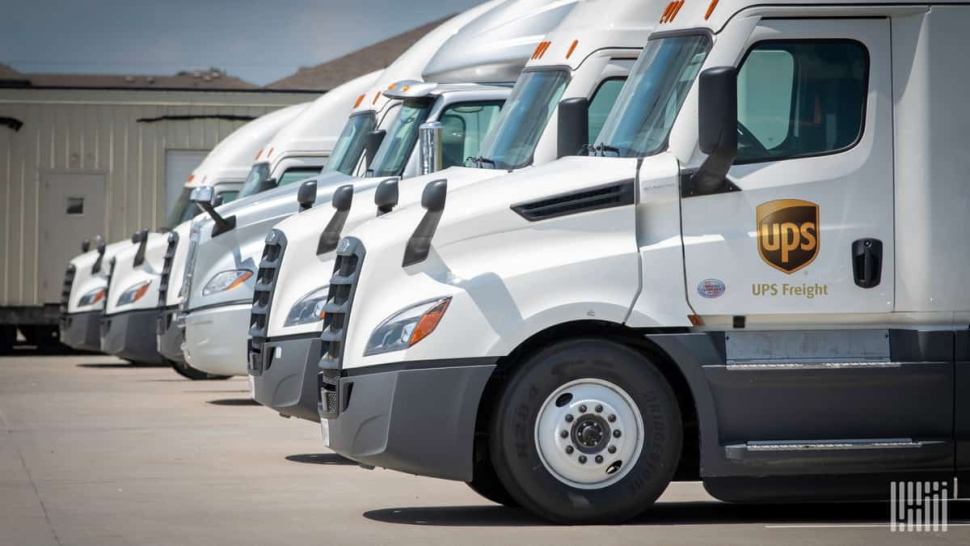
UPS Inc. (NYSE:UPS) CEO Carol Tomé has pulled the plug on the company’s often-difficult 15-year foray into the less-than-truckload business.
The Atlanta-based giant’s $800 million sale of UPS Freight to Canadian concern TFI International Inc. (NYSE and TSX: TFII), reflects Tomé’s belief that LTL was not, is not and would likely never be a strategic fit for the company. Nor would it have met her rigorous standards for return on invested capital (ROIC).
Though she has only been CEO since June, Tomé’s perspective is hardly that of a UPS newbie: She joined the company’s board in 2003, two years before UPS acquired Overnite Transportation Co. for $1.25 billion–a 46% premium to the previous day’s closing price–and rebranded it as UPS Freight. Tomé observed UPS’ early struggles to integrate Overnite and the limited synergies that would accrue over the following decade and a half. Once installed as CEO, she began pushing for UPS Freight to be moved out of the portfolio, according to a well-placed source.
UPS, an $80 billion company, never seemed serious about the LTL business, according to Satish Jindel, founder and president of consultancy ShipMatrix. UPS’ formidable IT investments never seemed to trickle down to LTL, a segment badly in need of digitization, Jindel said. Also, the bundling LTL and small-package services, which allowed UPS to offer low LTL rates in return for shippers’ small-package business, is less popular today than it was a decade or so ago, he said.
UPS Freight’s travails, and the subsequent sale by UPS for $400 million less than it paid in 2005, is not a reflection of the LTL industry as a whole, or even of UPS Freight, Jindel said. Rather, he said, it underscores what happens when a minnow is swallowed up by a whale and does not get the resources and attention it needs to compete with pure-play providers like Old Dominion Freight Line Inc. (NASDAQ:ODFL), Saia Inc. (NASDAQ:SAIA), Estes Freight Lines and XPO Logistics Inc. (NYSE:XPO), the latter of which will become as close to a pure-play LTL provider as possible once it spins off its logistics business later this year.
Speaking at a virtual meeting sponsored by LTL trade group SMC3, XPO Chairman and CEO Brad Jacobs said he understood UPS’ decision to focus on its core parcel business and to narrow its portfolio as a result. Jacobs remains bullish on the LTL outlook, especially as technology becomes more commonplace in driving down costs and inefficiencies.
The integration of Overnite into UPS was fraught from the start. The ink was barely dry on the transaction when UPS executives descended on Overnite’s Richmond, Virginia headquarters and began making changes. People around UPS and Overnite at the time said that UPS tried to apply its parcel-centric learnings on LTL operations, but soon found that the two businesses were very different. The operational integration moved slowly, and the cultural fit never fully came about. UPS Freight maintained its headquarters in Richmond, and the unit operated on a different wave length than the rest of UPS’ organization.
UPS had never separated UPS Freight’s results from its Supply Chain and Freight business unit, which includes its freight forwarding, customs brokerage, financial services and freight brokerage operations, the latter of which came from its $1.8 billion acquisition of Coyote Logistics in 2015. However, that pattern was broken in a presentation appearing Monday on the company’s website to explain the rationale behind the sale.
UPS Freight’s 2020 revenue is expected to decline to $3.14 billion from $3.26 billion in 2019, according to company projections. Adjusted operating profits are expected to be nearly cut in half to $39 million. Adjusted operating margins are expected to come in at 1.2% from 2.3% in 2019. Based on the projections, UPS Freight was running at around a 98% operating ratio (OR) — the ratio of revenues to expenses — and a number not to be proud of as it leaves very little profit from the revenue. By contrast, UPS Freight in 2014 was operating at an OR of 94%, according to Jindel.
UPS, which discloses its fourth-quarter and full-year results Feb. 2, declined comment beyond the website presentation and a press release announcing the deal. UPS shares were up 5% in mid-afternoon trading Monday. But that paled next to TFI’s shares, which were up 27%.
The sale, which will close during the second quarter, is expected to boost UPS’ overall operating margin and ROIC by about 20 basis points, it said in the online presentation. The transaction eliminates the need to pour capital into the unit and will enable UPS to pay down debt, it said.
There will be no impact on UPS Freight customers, who will use UPS’ ground-parcel network and receive LTL pricing in return, the company said. UPS and TFI have agreed to allow UPS Freight shippers to utilize UPS’ domestic small-package network for the next five years, UPS said. In a separate statement, TFI said its TForce Freight unit will continue managing UPS’ LTL distribution needs, and UPS will continue to provide freight volumes to TForce Freight for the five-year duration.
UPS Freight’s 14,500 full- and part-time employees, a roster that includes 11,500 unionized workers, will join TFI, UPS said. UPS will be responsible for historical pension assets and liabilities, while TFI will manage workers’ pension benefits after the deal closes, UPS said. The relationship between UPS Freight management and its members have been up and down since the once non-union Overnite workforce joined the Teamsters a couple of years after the acquisition. A 2018 contract dispute led UPS Freight to cut off customers’ shipments out of concern there wouldn’t be employees to pick up, process and deliver them. An agreement was eventually reached and the unit quickly resumed operations.
It is unclear what will happen to UPS Freight’s 197 facilities — 147 of which are owned — or its fleet of 6,340 tractors and 23,400 trailers. UPS Freight provides transborder services on both borders as well as Puerto Rico, the U.S. Virgin Islands and Guam.
UPS was not the first transport goliath to find the old Overnite a tough fit. Rail giant Union Pacific Corp. (NYSE:UNP) acquired Overnite in 1986 for $1.1 billion with the hope of bolting an LTL carrier on to its core business. The strategy never clicked and UP eventually spun off Overnite through an initial public offering in 2003 that raised $475 million.
Overnite, which was mostly a non-union carrier since its founding in 1935, became embroiled in arguably the most continuous labor dispute in trucking history. In October 1999, about 2,000 workers struck the carrier in 12 states with the goal of having all of Overnite’s 13,000 workers organized by the International Brotherhood of Teamsters, which represented a fraction of the carrier’s workers at the time. The company would not recognize the union, and the strike became long and often violent, with management drivers being shot at while on the highway. By August 2002, only 300 to 600 workers remained on strike and the Teamsters called off the strike without securing a contract. The three-year battle was chronicled in a documentary called “American Standoff.”
UPS eventually agreed to recognize the former Overnite workers as Teamster members in return for the union’s commitment not to oppose UPS’ plan to remove 44,000 Teamster employers from the union’s flagging Central States Pension Fund and to establish a joint UPS-Teamster fund. Teamster critics said the move ended up saving UPS billions of dollars but provided less-generous benefits than the workers had expected. UPS, in turn, paid $6.1 billion to cover its withdrawal liabilities.
Brokerage Compliance Symposium
The day before F3. Every compliance issue you face - fraud exposure, carrier liability, FMCSA rules, cargo theft, insurance gaps - navigated by attorneys and operators defining best practices in a changing industry.
F3 Awards Dinner
The night before F3. FreightTech100 companies honored. FreightTech 25 and Shipper of Choice winners revealed live. Cocktail reception into dinner and live music - 300 industry leaders in one purpose-built room.
F3: Future of Freight Festival
Industry-defining keynotes, rapid-fire technology demos, and industry leaders networking in experiences across Chattanooga - plus the inaugural F3 Awards Dinner featuring the FreightTech and Shipper of Choice reveals.
The day before F3. Every compliance issue you face - fraud exposure, carrier liability, FMCSA rules, cargo theft, insurance gaps - navigated by attorneys and operators defining best practices in a changing industry.
The Signal at Chattanooga Choo Choo • Chattanooga, TN Register NowThe night before F3. FreightTech100 companies honored. FreightTech 25 and Shipper of Choice winners revealed live. Cocktail reception into dinner and live music - 300 industry leaders in one purpose-built room.
The Signal at Chattanooga Choo Choo • Chattanooga, TN Register NowIndustry-defining keynotes, rapid-fire technology demos, and industry leaders networking in experiences across Chattanooga - plus the inaugural F3 Awards Dinner featuring the FreightTech and Shipper of Choice reveals.
The Signal at Chattanooga Choo Choo • Chattanooga, TN Register Now