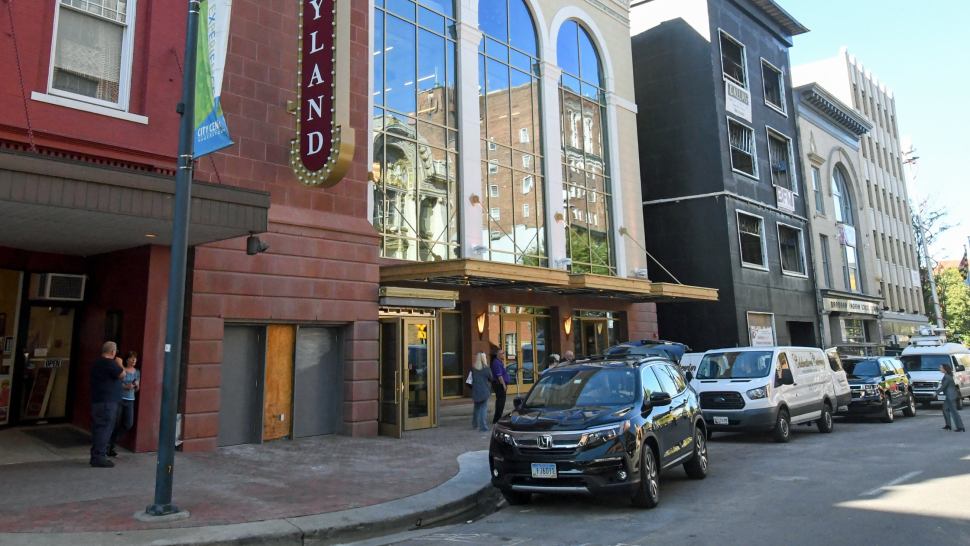
Nestled between several mountain ranges and with a population of about 44,000, the city of Hagerstown, Maryland, doesn’t come to mind as a hot spot for U.S. logistics warehousing. It probably should, however.
Near Interstates 70 and 81, 71 miles from Washington and 75 miles from Baltimore, Hagerstown fits comfortably within the country’s fourth-largest metropolitan statistical area (MSA), which extends north into Delaware and south into the nation’s capital’s expansive northern Virginia suburbs. Hagerstown is close enough to support the supply chain needs of a high-density regional population but far enough away to avoid the exorbitant rents of bigger markets.
For its small size, Hagerstown, which is located in the western part of the state, has become a busy place. Net absorption — the sum of occupied space minus vacated space — stood at 1.3 million square feet by the end of 2021, according to data from Colliers International Group Inc. (NASDAQ: CIGI), a real estate service firm. About 1.9 million square feet is under construction, the bulk of which being two projects that total 1.55 million square feet.
Hagerstown’s vacancy rate sits at 6.2%, down from 7% at the end of 2020 and way down from 9.5% at the end of 2018, according to Colliers data. The average asking rent at the end of 2021 was $5.21 per square foot, down from $5.47 per square foot in the third quarter. The sequential drop was due to the lack of quality space found in the market, Colliers said.
New construction, which always commands a higher price, is in the upper $5-per-square-foot range, according to the firm’s estimates. The “development pipeline should be active” throughout 2022, Colliers said. The firm hasn’t made any 2022 projections for net absorption but expects the final figures to be significant.
Hagerstown is one of the so-called tertiary markets — another is Winchester, Virginia, 75 miles from Washington and only about 50 miles from Hagerstown on I-81 — that will move to the forefront of logistics warehousing interest as demand for land increases and first-tier markets like New York/New Jersey, Southern California, Chicago, Seattle and Baltimore-Washington cope with vacancy rates of 3% or lower, and the corresponding sky-high rents.
Even secondary markets like Louisville, Kentucky; Columbus, Ohio; Indianapolis; and Providence, Rhode Island, are starting to take on primary-market characteristics in pricing and land availability. That opens up opportunities for third-tier markets like Hagerstown and Winchester where developers a decade ago might not have considered putting down roots.
The one immediate constraint in Hagerstown is a shortage of big-box facilities–700,000 to 1 million square feet–that e-commerce retailers crave. Finding big-box space is a nationwide problem, and the Maryland city is no exception. What’s readily available in the market today are buildings between 10,000 and 30,000 square feet, said Brian Siegel, senior vice president, Maryland for Colliers.
That the rents on new construction in Hagerstown are pushing $6 per square foot speaks to the market’s appeal as a warehouse location and to the demand for property for nonindustrial use, which in turn could constrain warehouse supply. In 2019, as developers and occupiers fed up with rents above $7 per square foot in the New York/New Jersey market or in the Lehigh Valley, Pennsylvania, region began to look elsewhere, Hagerstown rents were around $4.25 a square foot.
The rent escalation in Hagerstown is unlikely to dent demand for third-tier markets that have available land and excellent interstate highway access. Last week, Prologis Inc. (NYSE: PLD), the world’s largest developer and operator of logistics real estate, predicted that warehouse capacity will need to increase over time by at least 15% just to keep up with inventory stocking needs and to build resilience against supply chain disruptions. In the 2022 version of the great land grab, developers and occupiers will increasingly take any suitable property they can get, price almost be damned.
“Everybody is chasing quality industrial land,” said Kris Bjorsen, executive managing director and lead of the Retail Industrial Task Force at real estate services firm JLL Inc. (NYSE: JLL)
No slam-dunk
Just because land is plentiful, is well-situated to highways and is relatively affordable doesn’t automatically make it suitable for development and occupancy. Available land is generally not a challenge, Bjorsen said. A much higher priority, he said, is access to a good-size, high-volume, high-quality and sustainable labor force.
Tertiary markets will typically be located at least 60 miles from major markets, so it is essential that an on-site workforce, or enough labor in the surrounding area, is present, Bjorsen said.
A site near a major university would be an ideal choice because there is a consistent pool of physically able students with flexible schedules who are looking to earn extra money, he said.
Still, developers will need to confront several realities that are inherent in smaller markets. One is that there may not be sufficient population in the immediate area and that what high-caliber labor exists may have already been hoovered up by other industries as the market’s industrial base expands. “Hagerstown is unrecognizable just from 10 years ago,” Siegel said.
Hagerstown’s unemployment rate hovers around 4%, according to Bureau of Labor Statistics data, roughly paralleling the national average. “There is no infinite supply of labor anywhere,” said Siegel of Colliers.
Another challenge is building water and sewer infrastructure adequate to support warehouse operations in a market that may lack the network of its larger brethren. Then there is the issue of getting a project in front of civic leaders and the general populace well in advance so they can digest it and can have any concerns aired and addressed, said Bjorsen. A large-scale warehouse project is not the order of the day for smaller communities, and many residents may be uncomfortable with the prospects of any lifestyle disruptions, he added.
Brokerage Compliance Symposium
The day before F3. Every compliance issue you face - fraud exposure, carrier liability, FMCSA rules, cargo theft, insurance gaps - navigated by attorneys and operators defining best practices in a changing industry.
F3 Awards Dinner
The night before F3. FreightTech100 companies honored. FreightTech 25 and Shipper of Choice winners revealed live. Cocktail reception into dinner and live music - 300 industry leaders in one purpose-built room.
F3: Future of Freight Festival
Industry-defining keynotes, rapid-fire technology demos, and industry leaders networking in experiences across Chattanooga - plus the inaugural F3 Awards Dinner featuring the FreightTech and Shipper of Choice reveals.
The day before F3. Every compliance issue you face - fraud exposure, carrier liability, FMCSA rules, cargo theft, insurance gaps - navigated by attorneys and operators defining best practices in a changing industry.
The Signal at Chattanooga Choo Choo • Chattanooga, TN Register NowThe night before F3. FreightTech100 companies honored. FreightTech 25 and Shipper of Choice winners revealed live. Cocktail reception into dinner and live music - 300 industry leaders in one purpose-built room.
The Signal at Chattanooga Choo Choo • Chattanooga, TN Register NowIndustry-defining keynotes, rapid-fire technology demos, and industry leaders networking in experiences across Chattanooga - plus the inaugural F3 Awards Dinner featuring the FreightTech and Shipper of Choice reveals.
The Signal at Chattanooga Choo Choo • Chattanooga, TN Register Now