




Some companies talk about their sustainability efforts; some even do something about it. Few are working as hard as RLS Logistics, though, when it comes to being a sustainable partner for the environment all while doing so in a business-friendly way.
“For me, it’s taking a global look at all the technologies companies can implement,” explains Tony Leo, CEO & president of the Warehousing Group. “I don’t think it’s any one thing.”
That approach has manifested itself in several projects for the New Jersey-based company. RLS has 6 cold-storage warehouses – 4 in New Jersey, one in Pennsylvania and one in Utah.
Like many organizations, RLS has adopted an LED lighting program, with all interior and exterior lighting at all facilities now LED equipped with motion sensors so they turn off when there is no motion detected. That really is just the beginning, though. At RLS, sustainability extends to solar energy, advanced refrigerant technologies, and even specialized racking systems.
“It’s really when you combine all these technologies and initiatives together [that you see the big picture],” notes Leo. “There are certain things that just make sense.”
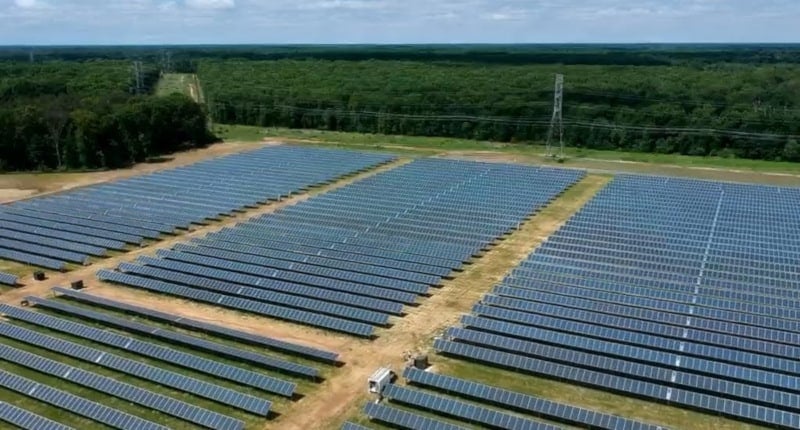
Solar farms are one of them. RLS has just completed its fourth solar project, installing a solar farm at its Newfield, NJ, cold-storage warehouse. It is working on its fifth project in Delanco, NJ.
“The solar is just supplementing what we are getting from the grid,” Leo explains. “On days where we’re not generating enough [power], we just pull power from the street.”
Newfield is expected to receive about 90% of its required energy from solar power. In Delanco, RLS is aiming for 100% solar power. Newfield is a 255,000 sq.-ft. facility. The solar farm features 3.9 million watts of solar panels that is expected to generate over 5.7 million kilowatt hours of AC electricity.
In New Jersey, Leo says, the state offers something called “net metering,” which means excess power from the company’s solar panels is fed back into the grid. This can help lower electric costs during long stretches of sunny weather, although RLS prefers to view costs of the program on a 12-month basis.
In the Northeast, weather can be fickle and stretches of overcast conditions can persist for days, especially in the winter. In those cases, the Newfield warehouse simply pulls more electricity from the grid to ensure the power needs.
Outside RLS facilities is not the only place where energy-efficient solutions are taking place. Inside is where you will find some of the more advanced solutions being used in North America, and it starts with the refrigerant being used.
Most cold-storage facilities utilize HFC or ammonia-based solutions to maintain temperatures, but RLS is switching to a new option at its Delanco facility.
“When we got into this industry 30 years ago, most of the refrigerants were chlorofluorocarbons (commonly known as CFC or Freon), and now most of the industry uses HCFC,” Leo says. “Worldwide, there is a slow phase out of the different HCFCs that are out there.”
At Delanco, RLS is going with a CO2-based refrigeration system, which has been used in many facilities in Europe for years. In North America, many of the warehouses are decades old, so changing to a CO2-based system can be costly and not something many warehouses have done yet.
“When we look at our industry, we have a choice,” Leo points out. “The challenge for us is the HFCs are slowly being phased out; the ammonia solutions [are heavily regulated and come with safety concerns] and New Jersey is especially harsh on ammonia. The CO2 technology has been used in Europe for a while now, but it’s been slow to [gain momentum in the U.S].”
Leo says very few cold-storage warehouses in the U.S. utilize CO2 despite its built-in advantages over the other options – namely it has no environmental impact. The cost of the CO2 system was “on par” with competitive systems, Leo notes, but it runs more efficiently, is less costly to purchase CO2, and is not as heavily regulated.

RLS also tapped European knowledge for another of its unique features inside its Delanco facility – mobile racking. The mobile racking moves along rails – similar to an accordion – that opens up as operators approach to collect pallets of goods.
“The result is you get a lot more density of product, but you also get more access to it,” Leo explains. “You get more yield (pallets) in that footprint, and because the footprint is smaller, you use less energy.
“In the U.K., they use mobile racking like we use 2-deep racking,” he adds.
Mobile racking is semi-automated and that is one solution RLS is looking at expanding as it faces a worker shortage. Similar to the truck driver shortage, the warehouse building boom has led to a shortage in workers.
“It’s a step in the direction of automation,” Leo says. “Labor is getting tougher and tougher to find. In time, our industry is going to be more automated.”
The executive doesn’t think warehouses will become fully automated, though, leaving plenty of room for personnel in the future, but the job of a warehouse worker is going to become more specialized, and introducing mobile racking is a small step in the process.
“As we get automated a little at a time, [introducing technologies slowly] gets the people more educated on operating them” Leo says. “I think it is going to mean more jobs and more higher paying jobs because people are going to have to run these machines.”
Leo believes that the trouble with automation in U.S. warehouses is that very few of them specialize in only one thing. “Normally automation means one of two things – it can do a few things very well, but the minute you go outside the norm, [robots] can’t do it anymore,” he points out.”
For RLS Logistics, each step in the journey – solar farms, CO2, mobile racking – is just one more step forward as it seeks to revolutionize the cold-storage supply chain.
Brokerage Compliance Symposium
The day before F3. Every compliance issue you face - fraud exposure, carrier liability, FMCSA rules, cargo theft, insurance gaps - navigated by attorneys and operators defining best practices in a changing industry.
F3 Awards Dinner
The night before F3. FreightTech100 companies honored. FreightTech 25 and Shipper of Choice winners revealed live. Cocktail reception into dinner and live music - 300 industry leaders in one purpose-built room.
F3: Future of Freight Festival
Industry-defining keynotes, rapid-fire technology demos, and industry leaders networking in experiences across Chattanooga - plus the inaugural F3 Awards Dinner featuring the FreightTech and Shipper of Choice reveals.
The day before F3. Every compliance issue you face - fraud exposure, carrier liability, FMCSA rules, cargo theft, insurance gaps - navigated by attorneys and operators defining best practices in a changing industry.
The Signal at Chattanooga Choo Choo • Chattanooga, TN Register NowThe night before F3. FreightTech100 companies honored. FreightTech 25 and Shipper of Choice winners revealed live. Cocktail reception into dinner and live music - 300 industry leaders in one purpose-built room.
The Signal at Chattanooga Choo Choo • Chattanooga, TN Register NowIndustry-defining keynotes, rapid-fire technology demos, and industry leaders networking in experiences across Chattanooga - plus the inaugural F3 Awards Dinner featuring the FreightTech and Shipper of Choice reveals.
The Signal at Chattanooga Choo Choo • Chattanooga, TN Register Now