

If you’re a fleet operator and you’re looking to evaluate fuel options that may help lower lifecycle carbon intensity, you don’t have to commit to a single alternative fuel overnight. The smarter play, according to Dave Slade, principal biofuels scientist at Chevron, is building flexibility into your fuel strategy and leaning on the right resources to guide those decisions.
Chevron’s portfolio of conventional and renewable fuel options spans petroleum diesel, biodiesel, renewable diesel, compressed natural gas (CNG), renewable natural gas (RNG), and lubricants. Slade notes that range allows Chevron to provide tailored fuel options to support its customers.
“Chevron offers lubricants and a broad suite of fuel solutions,” Slade said. “We’ve worked with many customers to help them navigate strategic fuel decisions, and we are available to help you explore your options.”
The company has also built a network of collaborators across the fleet, rail, marine, and heavy equipment industries, including Cummins, which manufactures the X15N natural gas engine, and Optimus Technologies, which manufactures aftermarket fuel-system technology that can enable B100 use in appropriate applications.
“The strategic advantage of having diversity in your fuel supply boils down to flexibility, especially for companies that have some kind of lower carbon intensity goal,” Slade said. “That flexibility is what allows fleets to access different fuel options in the marketplace depending on price, availability, or even time of year.”
“Choosing the right fuel is like choosing the right tool for the job,” Slade said. “It depends on your equipment, location, goals, and budget. All of these things play a part in which fuel is going to be the right fit for your operation.”
How do you know you’re getting quality fuel?
Not all fuel is created equal, according to Slade. Quality is the number one concern he hears from customers.
“We know your equipment is expensive. We know keeping that equipment operational with minimal downtime is a priority,” Slade said. “Quality is a crucial point when we’re talking about fuels, particularly renewable diesel and biodiesel.”
Poorly processed biodiesel or renewable diesel and potentially cause fuel filter plugging or poor cold weather performance, he explained. Whether a fuel meets its respective ASTM fuel specification may not be the only quality consideration. Additional considerations may be needed to determine whether a fuel is appropriate for specific weather, equipment, storage, and operating conditions. Fleet operators should carefully consider whether a fuel is formulated for their operating conditions.
“Don’t assume it’s made for cold weather. Always ask upfront or work with a provider that can help evaluate those considerations,” Slade said.
Chevron strives to apply fuel quality practices intended to meet or exceed applicable specifications and to support customer needs. And if issues arise, Chevron may offer fuel testing resources to help customers evaluate potential root causes.
What is CNG fuel, and why are fleets paying attention?
Compressed natural gas (CNG) is a fuel option gaining traction. CNG can enable the reduction of lifecycle greenhouse gas (GHG) emissions and certain regulated air pollutants, including NOx and particulate matter, compared with diesel in certain engine applications; actual emissions outcomes depend on multiple factors, including vehicle type, duty cycle, engine calibration, and operating conditions.
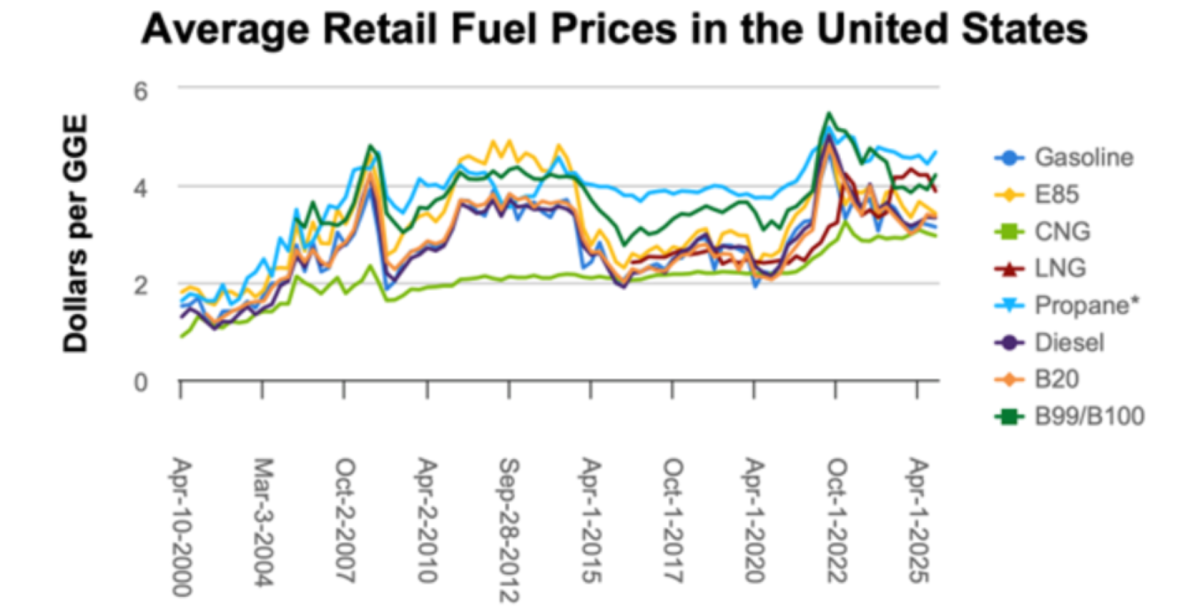
Beyond the potential emissions advantage, CNG may offer fleets an opportunity that’s harder to find in the fuel market: price stability. According to the U.S. Department of Energy’s Alternative Fuel Price Report, CNG has experienced periods of lower retail price volatility compared to most petroleum fuels.
Where other fuel types have seen significant price swings in response to global supply disruptions and commodity cycles, CNG pricing has historically shown more stable pricing patterns than petroleum diesel according to publicly available from the Alternative Fuels Data Center.
That kind of historical price stability may help fleet operators evaluate fuel-budget scenarios with more predictability.
[Average Retail Fuel Prices in the United States, source: U.S. Department of Energy Alternative Fuel Price Report, afdc.energy.gov/fuels/prices]
The upfront costs of converting a fleet of vehicles to natural gas is a consideration for fleet operators. Natural gas vehicles require specific engines, which means a change in equipment. But Slade explained that Chevron has sought to help address certain adoption barriers.
“To make it easier, many of our customers start by purchasing a few natural gas trucks to test the benefits without committing to a full fleet conversion,” Slade said. “This allows them to evaluate potential fuel-cost and vehicle performance differences while maintaining flexibility.”
Starting small, testing in real-world conditions, and scaling based on results is an approach that’s consistent with how Chevron is supporting its customers’ transition efforts and it’s where Chevron’s collaboration with Cummins becomes especially relevant.
Chevron’s X15N demo program
Chevron and Cummins have collaborated in connection with customer education and demonstration efforts involving the Cummins X15N natural gas engine. It’s the first 15-liter natural gas engine designed to deliver diesel-like horsepower, torque, and range for heavy-duty applications.
But the engine is only one piece of the equation. Hexagon Agility, a developer of fuel systems for heavy-duty vehicles, created a fuel storage system specifically for CNG-fueled trucks. Hexagon Agility is a key collaborator in supporting evaluation of CNG for certain long-haul and regional fleet applications.
The demo program itself is designed to help reduce uncertainty involved in evaluating the cost per mile or comparing CNG prices against current fuel spend. Chevron has acquired three Class 8 tandem-axle Peterbilt day cabs equipped with the X15N engine and Hexagon Agility fuel storage systems. Fleet operators may be eligible to borrow a truck for up to 18 calendar days and Chevron provides a fueling card to cover the cost of CNG from Chevron or Beyond6 stations during the trial.
“Fleets can test this equipment for up to 18 days to get a feel for the truck and their refueling options before deciding to make a purchase,” Slade said.
Brian Peterson, Chevron Renewable Fuels National Sales Manager, has described the program as an opportunity for fleets to experience the performance of CNG technology firsthand. The demo trucks will use Chevron Delo 600 ADF ultra-low ash heavy-duty engine oil. In 2023, Cummins approved Delo 600 ADF for use in certain natural gas engines. Fleet operators should consult current OEM recommendations and specifications when selecting lubricants.
Because Delo 600 ADF meets specifications for both diesel and natural gas applications, some fleets may be able to use a single lubricant across eligible equipment, subject to OEM specifications and operating requirements. This may simplify inventory management for some fixed fleets.
Chevron currently operates approximately 60 CNG fueling stations across the United States. Eligible fleets must currently operate Class 8 trucks consuming at least 100,000 gallons of diesel fuel per year and be located within 10 miles of a Chevron or Beyond6 CNG station. Interested operators can contact their Chevron representative for complete program details and eligibility requirements.
If you’re a fleet operator and you’re looking to explore the potential fuel cost advantage of CNG, participate in the X15N demo program, or learn more about biodiesel blends from B20 to B100, the first step is connecting with a representative. Visit regi.com/products/other-products/fuels-and-lubricants or reach out to learn more about the X15N demo program.
DISCLAIMER: Environmental, operational, and cost outcomes vary based on fuel source, vehicle type, duty cycle, route, weather, maintenance practices, fueling access, fuel pricing, and applicable lifecycle accounting. Demo program participation, fueling-card availability, trial duration, and eligibility are subject to program terms, vehicle and station availability, and applicable agreements. This article contains forward-looking statements. These statements are based on current expectations and involve risks and uncertainties. Actual results may differ materially from those expressed or implied in such statements. Chevron and its collaborators undertake no obligation to update these statements after the date of publication.
Brokerage Compliance Symposium
The day before F3. Every compliance issue you face - fraud exposure, carrier liability, FMCSA rules, cargo theft, insurance gaps - navigated by attorneys and operators defining best practices in a changing industry.
F3 Awards Dinner
The night before F3. FreightTech100 companies honored. FreightTech 25 and Shipper of Choice winners revealed live. Cocktail reception into dinner and live music - 300 industry leaders in one purpose-built room.
F3: Future of Freight Festival
Industry-defining keynotes, rapid-fire technology demos, and industry leaders networking in experiences across Chattanooga - plus the inaugural F3 Awards Dinner featuring the FreightTech and Shipper of Choice reveals.
The day before F3. Every compliance issue you face - fraud exposure, carrier liability, FMCSA rules, cargo theft, insurance gaps - navigated by attorneys and operators defining best practices in a changing industry.
The Signal at Chattanooga Choo Choo • Chattanooga, TN Register NowThe night before F3. FreightTech100 companies honored. FreightTech 25 and Shipper of Choice winners revealed live. Cocktail reception into dinner and live music - 300 industry leaders in one purpose-built room.
The Signal at Chattanooga Choo Choo • Chattanooga, TN Register NowIndustry-defining keynotes, rapid-fire technology demos, and industry leaders networking in experiences across Chattanooga - plus the inaugural F3 Awards Dinner featuring the FreightTech and Shipper of Choice reveals.
The Signal at Chattanooga Choo Choo • Chattanooga, TN Register Now