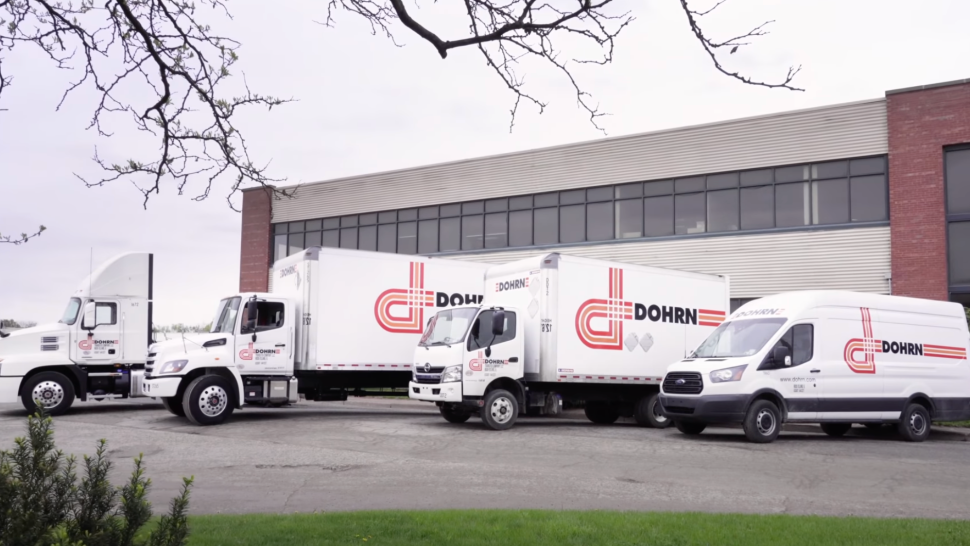
Insurance premiums keep climbing across trucking. Unfortunately for carriers, they cannot opt out of the trend. What a fleet can control is the experience data sitting underneath its own renewal.
For Dohrn, a Midwest LTL carrier with about 2,000 employees, that data now comes from AI cameras. The company finished converting its fleet to dual-facing event recorders roughly a year ago. Accidents have fallen almost 20% since.
Robert Howard, president and CEO of Dohrn, told FreightWaves that nobody outside the building forced the decision. Insurers are not the ones pushing hardest on fleet insurance costs. Instead, carriers themselves are.
“No, it’s definitely us pushing it,” Howard said in an interview at Samsara Beyond in June. “I mean, the insurance costs are skyrocketing, there’s no question about that, but it’s all based on experience.”
Who’s Actually Pushing on Fleet Insurance Costs
Dohrn is a standalone subsidiary of Chuck Hammel’s Pitt Ohio Transportation Group, which acquired the carrier in 2014, the year Howard joined. It runs about 25 terminals from Indianapolis to Nebraska and Minnesota down to Missouri, with 1,100 drivers, 900 trucks and 1,800 trailers.
Howard treats the insurance line as an output to help with insurance costs.
“What we want to do is be as safe as we can and use technology that we can implement, such as the event recorders and the AI and everything else that we add to newer equipment, to make us as safe as possible,” he said. “And that in turn helps us keep the insurance costs down.”
Claims resolution is the secondary yet tangible benefit. Video is taking the guesswork out of the fight-or-settle decision.
“Definitely if you know what’s happened, if you’re at fault, we settle it and we move on,” Howard said. “But the ideal for us is to be as safe as possible.”
Customers run the same evaluation. Safety now sits next to price in Dohrn’s RFP conversations, alongside sustainability.
The Paradigm Shift Cameras Introduced
Dohrn’s relationship with Samsara started in 2016 as a compliance purchase. The ELD mandate was coming, the carrier needed a provider, and Samsara CEO and Co-Founder Sanjit Biswas came out to the facility to pitch the product himself.
“So it started with the ELD mandate, and that was really about compliance, and that worked great for us,” Howard said.
What followed changed the operation more than the mandate. Trailer trackers gave a carrier that spots heavily its first live picture of the fleet. Outward-facing cameras ended the practice of reconstructing crashes from memory or limited photos taken by forward-thinking drivers at the scene.
“For the first time we could see what happened when there was a critical accident,” Howard said. “And we found, more times than not, that gave us the ability to exonerate our drivers.”
Dual-facing cameras were the harder sell, and Dohrn passed on them initially.
“They were so new, a lot of drivers were really cautious about that, we were cautious as a business,” Howard said.
Results from the outward-facing rollout eventually settled it. Dohrn upgraded a couple of years ago and completed the transition across the full fleet, acquisitions included, about a year ago.
“That was a paradigm shift for us and culturally a big change,” Howard said.
The payoff showed up in the loss record. “And we’ve seen tremendous improvement, almost 20% reduction on our accidents,” he said.
Three Companies, One Tech Stack
The camera conversion overlapped with a harder project. Dohrn acquired Sutton Transport, a carrier roughly 70% its size, along with US Special Delivery, nearly doubling the business and spending 18 months folding three companies into one. Both arrived running their own technology.
“We’re running two companies together, different technology, shipments aren’t connected the same way,” Howard said. “So our early decision for us was we’ll change all of those providers, get out of the contracts, and then put everything on Samsara and all of our other TMS operations.”
That meant contract exits and a physical retrofit across the acquired fleets.
“We had to retrofit the entire fleet, pull all of their trackers out, put new equipment in,” Howard said. “But definitely worth it.”
Coaching Before the Event, Not After
The change Howard keeps returning to is timing. Coaching used to be a response to something that already happened.
“Pre-2015 or 2016, it would just be an event that happened, then you coach the driver,” he said. “We’re thinking about it way differently now. What’s the driver safety score? How fast are they driving? Are they having harsh brakes?”
Driver incentives moved with the data. Dohrn still pays a bonus for clean inspections, but the scoring has shifted.
“The biggest part of that is the Samsara dashboard and the gamification that they provide,” Howard said
The Ride-Along Fleets Don’t Need to Staff
The Samsara product Howard flagged hardest at Beyond, AI-powered ride-alongs, solves a staffing problem via technology. Structured ride-alongs at 30, 60, 90 and 120 days are common at large carriers but out of reach for midsize ones.
“We don’t have the scale to be able to constantly, as a new driver comes on, on 30 day, 60 day, 90 day, 120 day, go back and do a ride-along,” Howard said. “So now with Samsara’s technology, we have the potential to do the ride-along, sit down, have good information our coaches put together in a way that’s going to be constructive, and then make sure the new driver is driving to the standards that Dohrn has.”
He also singled out Samsara AI Multicam with Bird’s Eye View for their box trucks and non-CDL equipment, which can stitch together four views into one feed.
“The way that Samsara’s been able to connect those, stitch them together, and give the driver a bird’s-eye view, and then layer AI on top of it to make decisions if a pedestrian gets close, just incredible technology,” he said.
Modeling regulatory exposure remains the gap. Fleets want dashboards that project how one event would move their CSA scores.
“CSA is a huge thing for us, and we want to make sure we maintain really good scores, very important,” Howard said. “But I think that we’re at this current point getting an overview of the fleet, but there is opportunity there for sure.”
Down to the Specific Fault Code
Maintenance is the next line item. Predictive fault code analysis moves the decision upstream of the failure.
“It’s incredible to get down to the specific fault code and what the risk is if you don’t fix the item right then,” Howard said, citing Biswas’ keynote claim that an unreplaced part carries a quantifiable failure risk for the next component. “Those are things that could really change the way we look at fleet maintenance.”
Warranty recovery is a quieter win for a shop working across multiple OEMs.
“Right now we spend a lot of time, if there’s a defect on a tractor, going back tracking warranty, getting that collected, but Samsara is in position to help us make that even easier,” Howard said.
The longer play is a preventive maintenance cycle that stops being a calendar.
“I definitely think that’s the future,” Howard said. “There are pieces of equipment that we’re going to pull in early and go and get the PM done, but I do think that as more and more data is provided by carriers or providers like Samsara, we’ll be able to see that, make different decisions, and maybe the PM becomes more dynamic.”
Dohrn keeps drivers in the same truck about 90% of the time, which turns DVIR accuracy into a shared problem the moment a tractor gets slip-seated. Howard sees that category of unanticipated benefit as the real story.
“Things we didn’t think of before, such as that, are starting to really kind of come to light, and we’re making different decisions as a result,” he said.
Brokerage Compliance Symposium
The day before F3. Every compliance issue you face - fraud exposure, carrier liability, FMCSA rules, cargo theft, insurance gaps - navigated by attorneys and operators defining best practices in a changing industry.
F3 Awards Dinner
The night before F3. FreightTech100 companies honored. FreightTech 25 and Shipper of Choice winners revealed live. Cocktail reception into dinner and live music - 300 industry leaders in one purpose-built room.
F3: Future of Freight Festival
Industry-defining keynotes, rapid-fire technology demos, and industry leaders networking in experiences across Chattanooga - plus the inaugural F3 Awards Dinner featuring the FreightTech and Shipper of Choice reveals.
The day before F3. Every compliance issue you face - fraud exposure, carrier liability, FMCSA rules, cargo theft, insurance gaps - navigated by attorneys and operators defining best practices in a changing industry.
The Signal at Chattanooga Choo Choo • Chattanooga, TN Register NowThe night before F3. FreightTech100 companies honored. FreightTech 25 and Shipper of Choice winners revealed live. Cocktail reception into dinner and live music - 300 industry leaders in one purpose-built room.
The Signal at Chattanooga Choo Choo • Chattanooga, TN Register NowIndustry-defining keynotes, rapid-fire technology demos, and industry leaders networking in experiences across Chattanooga - plus the inaugural F3 Awards Dinner featuring the FreightTech and Shipper of Choice reveals.
The Signal at Chattanooga Choo Choo • Chattanooga, TN Register Now