A legal battle now underway over the records of America’s truck drivers is being described very differently depending on who is doing the describing. The U.S. Department of Transportation calls it a “radical” effort by state attorneys general to shield dangerous drivers from the law. The states call it an unlawful federal seizure of the private data of 17 million people. Both descriptions are advocacy. The purpose here is to explain, as neutrally as possible, what is actually being fought over and why the states are challenging it, so that a driver whose own record is in that database can understand what is at stake.
What Actually Happened
The dispute centers on the Commercial Driver’s License Information System, known as CDLIS. Congress established it in 1986 under the Commercial Motor Vehicle Safety Act to give states a secure way to share information about CDL applicants, chiefly to make sure a driver cannot hold licenses in multiple states or escape a disqualification by crossing a state line. It is operated by the American Association of Motor Vehicle Administrators, or AAMVA, a nonprofit whose members are the state licensing agencies, under contract with FMCSA since 1988. The database contains sensitive personal information, including names, dates of birth, driver’s license numbers, and Social Security numbers, for the roughly 17 million people who hold commercial licenses.
According to the states’ complaint, on August 11, 2026, FMCSA demanded that AAMVA turn over the full database, every driver’s records going back five years, by August 17, or face termination of AAMVA’s federal contracts and more than $10 million in federal funding. The states further allege that the Department of Homeland Security issued a separate immigration-enforcement subpoena to AAMVA for the same records with the same deadline, which the states characterize in their filing as coordinated with FMCSA.
The states also describe a sequence leading up to the demand. AAMVA, caught between the federal demand and the objections of many of its member states, proposed on August 14 to let its board consider an opt-in or opt-out choice, allowing each state to decide whether to authorize the transmission of its own data. According to the complaint, FMCSA rejected that proposal on August 11 as “unacceptable.” Facing the threat of losing its federal contracts, which the states say could shut CDLIS down entirely, AAMVA told the states it would comply and turn over the records on or around August 17. That is what prompted the coalition to file suit on August 13 in the U.S. District Court for the Eastern District of Virginia and to seek an emergency order blocking the transfer.
Twenty-one states and the District of Columbia are named in the suit against DOT, FMCSA, and AAMVA, and a coalition of 22 states and D.C. filed a companion suit against DHS over the parallel subpoena. The participating states include Illinois, California, New York, New Jersey, Washington, Massachusetts, Michigan, Colorado, Arizona, Nevada, Oregon, Virginia, Maryland, Minnesota, and others, along with Pennsylvania.
The Federal Government’s Position
The Department of Transportation has stated its case forcefully, and it rests on safety and enforcement.
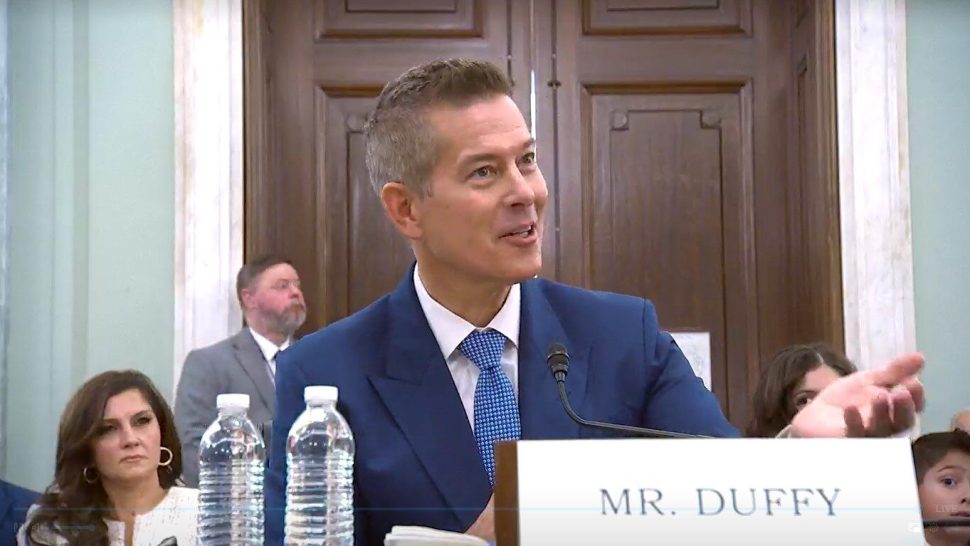
DOT frames the data request as necessary to keep unsafe and unqualified drivers off the road, and specifically to identify commercial drivers who obtained licenses improperly. In its August 13 statement, Secretary Sean Duffy said, “Every administration since 1988 has had access to this basic database, so let’s be clear on what this ridiculous lawsuit is really all about. These radical state AGs want to make it harder for my Department to enforce the rules of the road and easier for dangerous illegal immigrant truck drivers to operate a big rig.” He added, “We will fight this lawsuit tooth and nail to prevent more senseless crashes by unqualified drivers.”
DOT tied the demand to a broader enforcement campaign it has run since an April 2025 executive order on the trucking industry. The department says that effort has revoked more than 30,000 improperly issued commercial licenses, removed nearly 10,000 fraudulent or unqualified CDL training providers from the federal registry, placed more than 26,000 operators out of service under English language proficiency standards, and closed what it calls the non-domiciled CDL loophole. The department has connected the data demand to the August 12, 2025 crash on Florida’s Turnpike, a three-fatality collision that DOT attributes to an undocumented driver operating with an improperly issued license.
DOT’s legal position, as stated in its release, is that AAMVA “is contractually and legally obligated to furnish the requested records at FMCSA’s direction, with federal protection against state-level liability.” In other words, the federal government argues it has always had access to this database, that AAMVA is required to comply with FMCSA’s direction, and that the states cannot hold AAMVA liable for complying.
Why the States Are Challenging It
This is the part the political framing tends to skip, and it is the reason the lawsuit exists, so it is worth laying out in full. The states’ challenge does not rest on a single argument but on several distinct legal and practical objections.
The first is ownership and consent. The states argue that they, not the federal government, own the driver data stored in CDLIS, and that they placed it in the shared system for a specific, limited purpose, checking licensing status across states, under agreements that bar broader disclosure. Their position is that CDLIS was built as a state-to-state information-sharing tool, and that the statute creating it contains no provision allowing the federal government to demand a bulk transfer of all state records as a condition of participation. As Illinois Attorney General Kwame Raoul put it, “This database was created 40 years ago so states could share information with each other to stop unsafe drivers from operating commercial vehicles, and the federal government’s decision to ransack that database puts the whole system in jeopardy.”
The second is the contracts. The complaint alleges that several states, including Illinois, California, Maine, and the District of Columbia, have contracts with AAMVA that expressly prohibit disclosure of confidential driver data without the state’s authorization and require compliance with state and federal privacy law. The states say no contracting state has authorized the release, and that the contracts “flatly bar” it. This is the basis for a breach-of-contract claim against AAMVA specifically.
The third is privacy law. The states argue that a bulk handover of 17 million people’s Social Security numbers, birth dates, and license numbers, without individual justification or privacy safeguards, would violate the confidentiality protections that states pledged to those drivers, and potentially federal privacy statutes governing how driver data can be used and shared.
The fourth is the manner of the demand. A significant part of the states’ objection is not only what was demanded but how. They characterize the funding threat, comply or lose your contracts and more than $10 million, as coercion, and the alleged coordination between FMCSA’s demand and the DHS immigration subpoena as an attempt to route around the legal limits on each. The states argue an agency cannot use a funding ultimatum to compel a private contractor to do what the agency could not lawfully order directly.
The fifth is the practical consequence. The complaint argues that the demand puts AAMVA in an impossible position: comply and breach its agreements with the states, or refuse and have its federal contracts terminated, which would shut down CDLIS and leave states unable to issue commercial licenses or verify them across state lines, potentially costing states hundreds of millions in federal highway funds. The states argue that a bulk disclosure would also damage public trust and could deter people from applying for CDLs, which cuts against the safety purpose the system exists to serve.
The remedy the states are seeking is not a permanent bar on all federal access to driver information. It is an emergency order stopping this particular bulk transfer while the courts decide whether the demand is lawful. AAMVA has informed the coalition it will not produce the records by the deadline while the matter is being litigated.
Cutting Through the Framing
Because this story has been assigned political labels from both directions, it helps to separate what is genuinely contested from what is not.
It is not seriously disputed that the federal government has long had a relationship with CDLIS and some access to it. DOT’s claim that “every administration since 1988 has had access to this basic database” refers to that longstanding relationship. What the states dispute is whether routine access for interstate license verification is the same thing as a right to compel a one-time bulk transfer of all 17 million records for a five-year period to support an immigration enforcement campaign. The federal government treats those as continuous. The states treat them as fundamentally different in kind and scale. That distinction, ordinary operational access versus a mass data transfer, is the actual heart of the legal fight, and a court will have to resolve it.
It is also worth being precise about what the lawsuit does and does not say. The states’ filing is a challenge to the legality of the data demand and the process used to make it. It is a set of allegations, not proven facts, and the federal government disputes them. Likewise, DOT’s characterization of the states’ motives, that they want to shield dangerous drivers, is an assertion, not an established fact, and the states reject it. A reader is not required to accept either side’s characterization of the other’s motives in order to understand the underlying legal question, which is narrower and more concrete than the rhetoric surrounding it: does the federal government have the legal authority to compel this specific bulk transfer of state-owned driver records, and does the way it made the demand comply with the law?
What It Means for Drivers
For the individual CDL holder, the immediate practical effect is limited, but the stakes are real and worth understanding.
Your personal information, including your Social Security number, is in CDLIS, and this lawsuit is fundamentally about who can access the full set of those records and under what conditions. If you hold a commercial license, you are one of the 17 million people whose data is at the center of this. That alone is a reason to follow it, regardless of where you land on the politics.
In the near term, nothing about your license changes because of the lawsuit itself. CDLIS continues to operate, your license remains valid, and the interstate verification the system performs continues. The emergency order the states are seeking is aimed at freezing the bulk transfer while the case proceeds, which means the immediate question is procedural: whether the data moves now or waits for a court ruling.
The longer-term significance is larger than any one driver’s file. The case will test a genuinely unsettled question about the boundary between federal authority and state control over driver data, and its outcome could shape how driver information is shared, protected, and used for years. It also sits at the intersection of two forces this platform has covered repeatedly: the aggressive FMCSA enforcement posture of the past two years, and the growing use of data systems to police the industry. However it is resolved, it will say something about how much control any individual driver, or any state, retains over the personal information that a commercial license requires them to hand over.
Why It Matters
The federal government says it needs bulk access to 17 million drivers’ records to keep unqualified and unlawfully licensed operators off the road, while 22 states say the demand is an unlawful, coercive seizure of private data they own and pledged to protect, and both positions are now in the hands of a federal court. For every CDL holder in the country, the case will help settle a question that has never been squarely answered, which is who ultimately controls the personal information behind a commercial license, and what the government must prove before it can compel that information to be handed over in bulk.
Brokerage Compliance Symposium
The day before F3. Every compliance issue you face - fraud exposure, carrier liability, FMCSA rules, cargo theft, insurance gaps - navigated by attorneys and operators defining best practices in a changing industry.
F3 Awards Dinner
The night before F3. FreightTech100 companies honored. FreightTech 25 and Shipper of Choice winners revealed live. Cocktail reception into dinner and live music - 300 industry leaders in one purpose-built room.
F3: Future of Freight Festival
Industry-defining keynotes, rapid-fire technology demos, and industry leaders networking in experiences across Chattanooga - plus the inaugural F3 Awards Dinner featuring the FreightTech and Shipper of Choice reveals.
The day before F3. Every compliance issue you face - fraud exposure, carrier liability, FMCSA rules, cargo theft, insurance gaps - navigated by attorneys and operators defining best practices in a changing industry.
The Signal at Chattanooga Choo Choo • Chattanooga, TN Register NowThe night before F3. FreightTech100 companies honored. FreightTech 25 and Shipper of Choice winners revealed live. Cocktail reception into dinner and live music - 300 industry leaders in one purpose-built room.
The Signal at Chattanooga Choo Choo • Chattanooga, TN Register NowIndustry-defining keynotes, rapid-fire technology demos, and industry leaders networking in experiences across Chattanooga - plus the inaugural F3 Awards Dinner featuring the FreightTech and Shipper of Choice reveals.
The Signal at Chattanooga Choo Choo • Chattanooga, TN Register Now