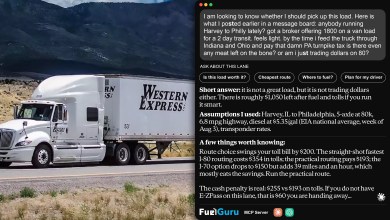

AI agents can find the load. MapUp helps them determine its profitability
Autopilot dispatchers rank freight by posted rate because nobody gave them the arithmetic. MapUp’s new MCP server prices a lane’s fuel, tolls and time in seconds.

Autopilot dispatchers rank freight by posted rate because nobody gave them the arithmetic. MapUp’s new MCP server prices a lane’s fuel, tolls and time in seconds.
Continental brings a national dealer footprint and decades of tire expertise. myMechanic brings the software that turns a phone chain into a tracked digital event.
Oil in the power distribution box can knock out lights, wipers, brakes and engine power on 5,919 new Kenworths and Peterbilts. Most failures give no warning.
A Business That Did Not Exist Yet In 1997, if a fleet needed a repair, the truck went to a shop. That was the entire menu. That was the year Bob Dickinson started what became Dickinson Fleet Services out of a small operation in Indianapolis, and his grandsons Kyle and Kevin Coltrain grew up around […]
Congress is fast-tracking a bipartisan DEF relief bill. The half in the press release stops trucks from derating to 5 mph over a false sensor code. The half you have to read the text to find suspends the 2027 emissions rule for 10 years
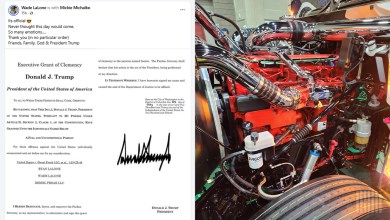
The pardons ended nine ordeals. The mandate that created them is still on the books, still in the field, and still pointed at the trucks that move America’s military freight.
For any owner-operator who has ever been stranded on the shoulder of an interstate at 5 miles per hour because a sensor decided the diesel exhaust fluid system had a problem, the announcement PACCAR made on July 6, 2026 will read like overdue relief. The company is rolling out updated software for trucks equipped with […]
On July 3, 2026, President Trump pardoned early a dozen people who were convicted under the Clean Air Act for tampering with diesel emissions, months after the Justice Department stopped prosecuting diesel cases entirely. The technology is still bolted to every truck on the road, and nobody in Washington wants to discuss the “what now” of who pays for it.
A claim is circulating that stops you mid-scroll: a California small fleet can now buy a Tesla Semi for as little as $50,000. The Tesla Semi carries a $290,000 sticker. The post lays out how two California incentive programs stack to knock $240,000 off that price, leaving a net cost of roughly $50,000, which it […]
(The views expressed here are solely those of the author and do not necessarily represent the views of FreightWaves or its affiliates.) Snap-on Incorporated just bought Diesel Laptops for $100 million in cash. The deal closed on June 8, 2026. The move gives Snap-on a stronger foothold in the world of big truck and heavy […]
How maintenance frequency maps to violation patterns, and why the carriers stretching their service intervals are the same ones showing up with brake and hub seal failures at roadside.
Pre-trip inspections are the first line of defense against mechanical failure on the highway. For most of the industry, they are a 30-second checkbox exercise completed in the cab. That gap between regulation and reality is showing up in courtrooms.
FreightWaves SONAR will launch its first virtual Driver App Shortage Hackathon on June 15-22 to address the lack of software built primarily for truck drivers.
Why This Matters More Than It Did Two Years Ago Trucking insurance is expensive and getting more so. According to ATRI’s 2025 Analysis of the Operational Costs of Trucking, insurance premiums hit a record 10.2 cents per mile in 2024, following a 12.5 percent increase in 2023 and an additional 3 percent rise in 2024. […]
On October 17, 2025, President Trump signed a proclamation under Section 232 of the Trade Expansion Act of 1962, imposing a 25% tariff on imported medium and heavy-duty trucks and truck parts — Class 3 through Class 8 vehicles, engines, transmissions, tires, chassis components. It took effect November 1. For USMCA-compliant parts out of Mexico […]
This article is not an argument for or against autonomous trucks. It is not a prediction about what the freight market looks like in 2035, and it is not an endorsement of any technology company’s safety record or business model. It is a set of questions that the industry — carriers, drivers, regulators, first responders, […]
Walk a truck dealer lot right now and you will see something you have not seen in years: inventory. Real inventory. Trucks lined up. Choices. And prices that look — compared to where used equipment was in 2022 and 2023 — like someone left the door open. That is not an accident. That is the […]
Every year, roughly the same time, the Commercial Vehicle Safety Alliance runs its International Roadcheck. Three days. Thousands of inspectors. Tens of thousands of trucks. The dates get announced months in advance, the focus areas get published, and somehow, fleets still get caught off guard.
The maintenance cost story in trucking has been quietly telling the truth about the freight recession in a way that spot rates and load volumes never fully captured. When freight slows down, trucks run fewer miles, which means fewer service events per truck per month. The Q4 2025 Decisiv/TMC Parts and Labor Service Benchmark Report […]
If you have spent any time in trucking Facebook groups, diesel forums, or on X this week, you have probably seen some version of this story: The EPA removed DEF requirements. The DOJ said deletes are legal. DPF is going away. The whole emissions system is getting scrapped. Trump said you can modify your truck. […]
The difference between what a driver should catch on the pre-trip and what a PM program should catch before the truck ever leaves the shop tells two completely different stories about where the failure lives
The deal is straightforward. Shell Rotella and Truck Parking Club are running a promotion called “Night on Us.” Drivers who get a qualifying Shell Rotella T5 Synthetic Blend or T6 Full Synthetic oil change — at a minimum of 11 gallons — at a participating service location can submit their receipt at rotella.com/nightonus and receive […]
If you are watching your shop bills, you may have noticed the fourth quarter of 2025 was slightly less brutal than the third. That is not an accident, and it is not because your trucks got more reliable. There is a real reason the numbers moved the way they did, and understanding that reason tells […]
A bill moving through the House of Representatives right now would establish the first federal framework for putting fully autonomous heavy-duty trucks on public roads. The SELF DRIVE Act of 2026 — formally H.R. 7390, introduced February 5 by Rep. Bob Latta of Ohio — is being framed by its supporters as a necessary step […]
Small carriers and owner operators are not just fighting market conditions. They’re fighting the messaging. Every week, from the moment a DOT number gets applied for to the day a carrier tries to scale beyond their first truck, there is a constant stream of outreach, advertising, promises, and pitches flooding in from every direction. Fuel […]
For decades, insurance was the one thing you couldn’t fake your way past to start a trucking company. That’s no longer true. As instant-issue coverage and $300 authority fees make it easier than ever to place 80,000 pounds on public highways without verification, a scalable, pre-authority risk-control model could restore the gate the industry lost without adding a single federal employee to the payroll.
My investigation found 76 Risk Retention Groups insure nearly 30,000 motor carriers linked to more than 6,300 fatal crashes, all without state guaranty fund protection for crash victims. The findings come as reports indicate that major insurers, including Chubb and AmTrust, are exiting the Chicago trucking market, funneling high-risk carriers into RRGs that have already incurred $199 million in unpaid losses and multiple insolvencies.
Less than 1% of insurer-carrier relationships are tied to 6% of the crashes and fatalities in America. The scorecard shows exactly who. The fix isn’t just regulation. It’s insurers taking ownership of their books and investing in risk-control professionals who actually know trucking.
GenLogs provides a visual, objective source of truth. You can put your eyes on what a carrier is actually doing: where they’ve been, when they last hauled freight, whether they ever hauled freight, and for whom. Instead of asking carriers what they claim to do, GenLogs shows you what they actually do.
When a driver or carrier challenges bad data through FMCSA’s DataQs system, the appeal often goes right back to the same officer who issued the violation. That’s about to change. The Motor Carrier Safety Screening Modernization Act finally brings independent review to the challenge process, and that’s the real game changer buried in this bill.
A viral dashcam video and a puzzling lawsuit showcase what the trucking industry has known for decades: Distraction kills, and for CDL holders, it kills careers too.
If you got an email from FMCSA this week telling you to prepare for Motus, you might have rolled your eyes. Another promise to modernize. We’ve heard this song before. This one actually matters.
The freight industry moved $14 trillion in goods last year. It cannot function without trust, trust that the carrier picking up your load is who they claim to be, trust that the broker paying you will actually pay, and trust that the load you accepted exists. That trust has been systematically exploited for decades. At its root, every form of freight fraud, chameleon carriers, double brokering, cargo theft, identity spoofing, comes down to one question: Are you who you say you are?
Dartanyan Gasanov, co-owner of Westfield Transport, is scheduled to stand trial on March 2, 2026, in Springfield, Massachusetts, on federal charges related to the June 2019 crash that killed seven Jarheads Motorcycle Club members. He reportedly rejected a no-time plea agreement and chose to fight the charges at trial. Meanwhile, the driver who killed seven people was acquitted, remains free under an immigration supervision order, and becomes eligible to petition for his license back in June 2026.
The conversation around Right to Repair has been floating around trucking for years, but it’s usually talked about in vague terms. More access. More fairness. More competition. What Owner-Operator Independent Drivers Association (OOIDA) is pushing for right now is much more specific — and much more urgent. At its core, this is about who controls […]
A five-year-old Maine boy was dragged nearly 300 feet and run over by his own school bus after his arm became trapped in the closing doors. The NTSB investigation comes as national data shows approximately 16 children die annually in school bus loading zones, a number that has persisted for decades despite available technology to prevent such tragedies.
A 35-year-old Mexican national working for an Arizona-based trucking company was arrested at the border after allegedly targeting middle school girls and multiple women during a single night in Ellensburg, Washington. The case fits a disturbing pattern the FBI has tracked since 2004 through its Highway Serial Killings Initiative, which has linked more than 850 murders to long-haul truck drivers and currently tracks 450 active suspects.
Starting January 1, 2027, new heavy-duty diesel engines will hit the road. And when engines change, oil has to change with them. That’s the entire story. Under upcoming EPA regulations, heavy-duty diesel engines must achieve significant emissions reductions: an 80% decrease in nitrogen oxides (NOx) and a 50% cut in particulate matter. Furthermore, these rules […]
Your truck isn’t just a piece of equipment. It’s your office. Your income. Your schedule. Your leverage. And the moment a DPF light or engine fault shows up on the dash, all of that can grind to a halt. That reality is exactly why this recent episode of The Long Haul hit home for so […]
When new trucks became impossible to source, fleets had to push assets past a million miles. The ones that survived did one thing right: they greased.
When a November 2025 draft memo from the Department of Transportation surfaced promising a groundbreaking “data-driven severity matrix” to catch chameleon carriers, it raised uncomfortable questions about ARCHI (Application Review and Chameleon Investigation), built with $3.5 million in congressional funding in 2012-2013. Is this bureaucratic amnesia, rebranding of an underperforming system, or evidence that FMCSA’s chameleon detection infrastructure has been quietly abandoned?
The first real cold snap of the season is when a lot of truckers remember something they already knew: winter doesn’t care how busy you are, how many miles you need this week, or how tight freight already feels. Winter finds every shortcut you’ve taken. It finds every part you ignored. It finds every ounce […]
The first real winter as an owner-operator feels a lot like your first year running your own business — the weather just exposes what you didn’t prepare for. Cold doesn’t care how motivated you are, how nice your truck is, or how solid your dispatcher sounds on the phone. When the temps fall below freezing, […]
If you’re an owner-operator or small fleet owner staring down the barrel of an engine problem, you already know the feeling—an uneasy mix of fear, frustration, and that sinking question in your gut:
In today’s market, a check engine light can be more than an inconvenience — it can be a trap. Here’s why code clearing without real diagnosis is one of the most dangerous shortcuts a shop can take on your equipment.
There’s a quiet, ugly truth behind many of the owner-operator breakdowns you see these days: DPF systems and emissions enforcement have bled carriers dry for years. The semiconductor chips, the sensors, the regeneration cycles—they’re not just technical burdens. They’re capital killers. Now, a new bill—the “Diesel Truck Liberation Act”—is pushing back against the EPA’s reach, […]
Walk into any diesel shop today and you’ll see it plain as day — bays full of trucks, fewer techs on the floor, and longer wait times that stretch into weeks instead of days. For a small carrier, that’s not just an inconvenience, that’s revenue bleeding out while your truck sits idle.
Consistently heavy freight doesn’t just risk a DOT ticket — it slowly eats away at your truck’s suspension, brakes, and cooling system until potentially one day you’re sidelined with a repair bill.
Your trailer doesn’t have to blow a tire or drop a landing gear to ruin your week — sometimes it’s as simple as a drip from the roof or a weak wall panel that lets in water. Those small oversights are what turn profitable freight into expensive claims and can cost you the shipper’s trust for good.
You’re rolling through Arkansas, just crossed the state line, and boom—your check engine light hits, your coolant temp spikes, and the power falls out of the pedal. You limp it to the shoulder, hazard lights flashing. You’re not just down—you’re at the mercy of a roadside repair vendor you’ve never met, in a city you […]
Some trucks are just cursed. That’s just the fact. Used trucks are especially a dice roll. You know the one — every time it goes in for a PM, something new gets discovered. Transmission slipping. Electrical gremlins. DPF acting up. And as soon as you think you’re back on the road making money, bam—check engine […]
The U.S. International Trade Commission has ruled in favor of Motive, rejecting Samsara’s claims of patent infringement.
If you run refrigerated freight, you already know reefer maintenance isn’t optional—it’s mission-critical. But there’s one number that quietly determines the health, resale value, and future liability of your trailer more than any other: reefer hours. So many carriers only look at year, brand, or cosmetic condition when buying or selling a reefer trailer. But […]
The Federal Motor Carrier Safety Administration on Wednesday removed three more electronic logging devices from its registered list, giving affected fleets until Nov. 3 to swap out the non-compliant systems before facing enforcement action.
If you run trucks for a living, your maintenance records are more than paperwork. They’re your defense in a DOT audit and your bargaining chip when it’s time to trade or sell equipment. Yet too many carriers treat documentation like an afterthought—tossing receipts in a shoebox or relying on memory. That works right up until […]
Your DPF and DOC don’t fail overnight—they fail slowly, one idle session and one short trip at a time. Some think emissions system issues are bad luck or bad engineering, but the truth is these systems are extremely sensitive to how the truck is operated day in and day out. The difference between a truck […]
Preventative maintenance is one of those areas where carriers either run a disciplined system or they run themselves into breakdowns that bleed cash. Too often, maintenance is treated like a disruption instead of a controllable part of operations. A truck goes into the shop and revenue stops. Loads are missed. Customers are frustrated. But here’s […]
If you’re running trucks and not pulling oil samples, you’re missing a critical opportunity to catch something before it becomes a bigger issue. Oil samples are one of the cheapest, most reliable ways to see inside your engine without tearing it apart. Too many small fleet owners and operators look at oil changes as a […]
A transmission doesn’t just wake up one day and blow itself out. It wears down in silence. It warns you in whispers—until the whisper becomes a breakdown. Slipping gears. Delayed shifts. Rattles, vibrations, burnt fluid, rising temps—these are all clues. And if you catch them early enough, you save thousands. But if you wait until […]
Tires are one of the biggest operating expenses for any trucking company, but some carriers don’t treat them like the diagnostic tool they are. They see tread loss as the cost of doing business, when in reality, tires are trying to tell you what’s wrong with your truck. Every wear pattern—feathering, cupping, shoulder wear—has a […]
Brake problems don’t start at the roadside—they start in the yard with poor maintenance. One of the most overlooked pieces of a truck’s braking system is the slack adjuster. Many small fleets and drivers either ignore it completely or, worse, adjust it at the wrong time. The result is uneven braking, premature wear, out-of-service violations, […]
Every truck you purchase comes with an OEM maintenance schedule. Most ELDs you install has the ability to track miles, engine hours, and time. Yet some small fleets never connect those two together. Instead, they leave maintenance up to memory, paperwork, or worse—driver recall. That’s how critical service intervals get skipped, warranties get voided, and […]
Motive Technologies closed a $150 million funding round led by Kleiner Perkins this week, positioning the AI-powered platform for aggressive expansion beyond its dashcam origins. What started as fleet management in 2015 has evolved into an integrated operations platform spanning driver safety, fuel cards, workforce management, and fraud detection, serving nearly 100,000 customers with AI capabilities that achieve up to 80% collision reductions.
The FMCSA is quietly revamping its National Consumer Complaint Database (NCCDB), aiming to transform it from a bureaucratic black hole into a real-time system for identifying unsafe carriers, shady brokers, coercive shippers and repeat fraud offenders.
Freight fraud and cargo theft have reached crisis levels, but recent FMCSA identity verification measures are chipping away at fraudulent registrations. Proactive enforcement and innovative tech solutions are starting to protect our supply chains.
The entire market shifts when carriers start saying “no” to contracted freight. Rising tender rejection rates signal tightening capacity and often precede spot rate hikes, while falling rates point to softening demand.
According to reports, nearly 4% of drivers on U.S. highways don’t have valid CDLs, and that’s just the tip of the iceberg. With licensing standards fractured across states and risky drivers slipping through the cracks, here is how fleets can get ahead of driver risk before it costs them a verdict, a fatality or the whole business.
From nuclear verdicts to unqualified drivers behind the wheel, this article dives into the latest Texas bill that could restrict what juries hear after a crash and what that means for fleets, families and front-line accountability in trucking.
On Monday, the FMCSA revoked eight electronic logging devices tied to Gorilla Fleet Safety LLC, citing failure to meet federal technical standards. Fleets now face a 60-day deadline to replace noncompliant systems or risk violations.
Meet Bubba, the AI-powered voice assistant designed specifically for drivers. Bubba finds loads, negotiates rates, vets brokers and manages documents while protecting drivers’ profits and time. After decades of everyone but drivers using AI, Bubba finally brings real-world driver-first solutions that let you stay focused on the road while maximizing your margins. Learn why Bubba might just be the smartest, toughest, “Say no to Cheap Freight” dispatcher you’ll ever have.
At Motive’s Vision 25 Summit, fleet leaders saw firsthand how AI-powered tools can transform safety, efficiency and driver culture. With new AI features like Motive AI Coach, real-time fatigue detection, fraud prevention and natural language analytics, Motive emphasized that technology should serve, not replace the people behind the wheel. Real-world success stories and a major courtroom win against Omnitracs reinforced that Motive’s future isn’t just built on innovation, but on trust, transparency and tangible results for fleets ready to lead the next era of trucking.
A proposed California law, Assembly Bill 1331, could upend how trucking fleets monitor drivers by prohibiting dashcam and GPS surveillance during off-duty periods, even inside the vehicle. If passed, the bill would redefine off-duty time as private, creating costly compliance challenges and raising concerns about safety, theft prevention, and liability. With $500 penalties per violation and the potential for lawsuits, fleets operating in California, and nationwide, may need to rethink how they balance privacy with operational oversight.
Fuel is one of the largest expenses for trucking fleets, making conservation strategies essential for long-term profitability. By leveraging technology such as fleet fuel cards, AI-powered route optimization, and real-time driver monitoring, fleets can reduce waste, improve efficiency, and prevent fuel fraud. Implementing preventative maintenance, minimizing idling, and optimizing routes are key to ensuring every gallon is used effectively. With fluctuating diesel prices and tightening margins, adopting a data-driven fuel management approach is necessary for survival in today’s trucking industry.
CVSA enforcement blitzes like International Roadcheck, Operation Safe Driver Week, and Brake Safety Week can make or break a fleet’s compliance record. Failing an inspection means out-of-service violations, increased ISS scores, and higher insurance costs. The key to staying ahead? Proactive fleet technology. AI-powered dashcams, electronic DVIRs, predictive maintenance systems, and compliance automation help fleets avoid costly violations. With FMCSA safety ratings on the line, adopting these tools ensures that fleets remain inspection-ready year-round because trucking compliance isn’t seasonal.
A CDL is just a license. What separates top fleets from struggling ones is how they qualify, select, and retain drivers who fit their operations. A one-size-fits-all hiring approach leads to turnover, compliance risks, and operational inefficiencies. Successful fleets go beyond FMCSA minimums, assessing experience, cultural fit, and skill set alignment to ensure long-term success.
Leveraging technology for applicant tracking, telematics-based risk assessment, and continuous compliance monitoring, fleets can reduce costly hiring mistakes and build a stable, safety-first workforce. Hiring the right drivers is about protecting your business and driving long-term profitability.
Truck dispatching is about maximizing efficiency, reducing downtime, and ensuring compliance. The best dispatchers are logistics strategists, connecting drivers with freight, optimizing routes, and handling regulatory and admin tasks so carriers can focus on the road.
With freight markets fluctuating and compliance requirements tightening, owner-operators and small fleets are increasingly turning to dispatching services to stay competitive. The right dispatcher can boost earnings, minimize deadhead miles, and streamline back-office operations. But with so many services available, how do you know which one adds value and which one just takes a cut?
This guide breaks down the role of dispatching services, the benefits of outsourcing logistics, and how to find a dispatcher who actually improves your bottom line.
Spot freight is the wild card of trucking that offers flexibility, fast solutions, and sometimes, unexpected windfalls. But is it a viable long-term strategy, or just a short-term fix for supply chain disruptions?
This article breaks down how spot freight works, what determines its pricing, and why shippers turn to it instead of contract freight. While it provides an immediate solution for last-minute loads and market shifts, it also comes with financial unpredictability. Learn how businesses can strategically use spot freight to complement their shipping strategy while maximizing opportunities and minimizing risks.
The trucking industry is under attack from rising insurance costs, cargo theft, and nuclear verdicts. Now, fraudulent staged accidents have emerged as another costly threat, orchestrated by criminal networks to exploit insurance claims and extract massive settlements. Cases like “Operation Sideswipe” in New Orleans and similar schemes in New York have cost the industry hundreds of millions of dollars.
Adding to the crisis is third-party litigation financing (TPLF), where private investors bankroll lawsuits, driving up the frequency of multi-million-dollar verdicts against carriers. However, fleets are fighting back with AI-powered dashcams from companies like Motive, providing real-time visibility, GPS tracking, and data-backed defenses against fraudulent claims.
This article talks about how dashcams are shifting the landscape, preventing staged accidents, disproving false liability claims, and helping carriers build defensible compliance programs. Read on to learn how visibility, data, and technology can protect your fleet from fraud and exposure.
The truck parking debate is always on fire but it’s heating up. While drivers struggle to find safe, available spaces after long shifts, services like Truck Parking Club, and Freight Ninja offer paid alternatives, but at what cost? Should drivers have to pay for parking, or should free options remain the standard?
This article examines the realities of truck parking from both sides, how technology is improving access and awareness but also introducing new costs for truckers already being fleeced. With margins already tight, drivers shouldn’t be nickel-and-dimed, but businesses providing secure, well-maintained lots deserve fair compensation. The key isn’t eliminating paid parking but ensuring it remains a choice, not an unavoidable expense.
From dynamic pricing models to carrier-sponsored parking, the industry has room for solutions that benefit everyone. Read on to explore the possible compromises and why a balanced approach is crucial for the future of truck parking.
Driver stress is a fleet-wide risk that impacts safety, fuel costs, maintenance, and retention. Studies show that stressed drivers are more likely to engage in risky behaviors, suffer from fatigue, and leave the industry entirely, costing fleets thousands in turnover and accident claims.
AI-powered dashcams, predictive maintenance, and real-time telematics offer fleets a proactive approach to reducing driver stress and improving well-being. By integrating safety coaching, fatigue monitoring, and wellness programs, fleets can lower accident rates, cut operational costs, and build a culture that values drivers as assets, not liabilities.
Compliance might be about avoiding fines but it’s more about protecting your fleet, securing business, and staying in business. A poor FMCSA safety rating can lead to lost revenue, higher insurance premiums, and even an Unsatisfactory Rating and shutdown. With new Safety Measurement System (SMS) changes ahead, fleets must actively manage their compliance records to avoid increased scrutiny.
Staying ahead of FMCSA regulations is the only way to ensure long-term profitability and operational stability.
Fleet safety and compliance is about protecting lives, reducing liability, and ensuring long-term success. As legal risks grow and operational demands increase, fleets are turning to technology for smarter, more proactive solutions.
From AI-powered dashcams and predictive maintenance to advanced telematics and cargo monitoring, modern trucking tools provide real-time insights that prevent accidents, optimize efficiency, and improve compliance. Fleets that invest in these technologies reduce costs, minimize downtime, and stay ahead of evolving regulations. The question isn’t whether to adopt these tools—it’s how soon they can be implemented to future-proof operations.
Fleet dashcams have become essential for modern trucking operations, but selecting the right system is about capability. Don’t get caught up with the price. The right cam pays for itself. While basic dashcams provide simple video recording, AI-powered systems with cloud storage, real-time coaching, and fleet integration offer proactive safety solutions that reduce accidents and liability.
From stand-alone SD card models to advanced fleet management suites like Motive, Samsara, and Netradyne, the right choice depends on a fleet’s long-term goals. Investing in scalable, AI-driven technology can improve driver behavior, streamline compliance, and enhance overall operational efficiency, making safety an asset, not just an expense.
On Monday, advanced transportation management software provider Alvys announced the launch of its integrated marketplace, which consolidates multiple load boards directly within its TMS platform.