Why it matters: Rising U.S.-Mexico freight demand is colliding with a shrinking pool of B-1 drivers that could push trucking rates higher, lengthen border crossing delays and force shippers to rethink how they move freight through gateways such as Laredo, Texas.
A shortage of B-1 visa drivers is tightening U.S.-Mexico trucking capacity and contributing to freight backlogs in Nuevo Laredo, Mexico, as cross-border demand continues to grow, according to Uber Freight.
Zeid Houssami, senior vice president at Uber Freight, said increased enforcement involving B-1 drivers has escalated since earlier this year, reducing the pool of drivers available to move northbound freight from Mexico into the U.S.
“There’s a fundamental driver shortage right now in the market, as it relates to northbound cargo,” Houssami told FreightWaves.
The capacity squeeze comes as northbound freight demand continues to outpace southbound volumes, creating an imbalance that has become increasingly difficult for carriers to manage.
“There are tremendous backlogs of cargo right now forming in Nuevo Laredo,” Houssami said. “Carriers are being opportunistic. They’re using this market as an opportunity to maximize their margins as much as possible.”
Houssami said carriers are using revenue management strategies to determine which customers receive limited capacity.
The problem isn’t a shortage of trucking equipment, he said.
“For every driver, there’s something like nine trailers available,” Houssami said. “There’s plenty of actual capacity to put freight in. It’s a matter of just actually transporting it across the border.”
SONAR data shows north, south imbalance in Laredo capacity
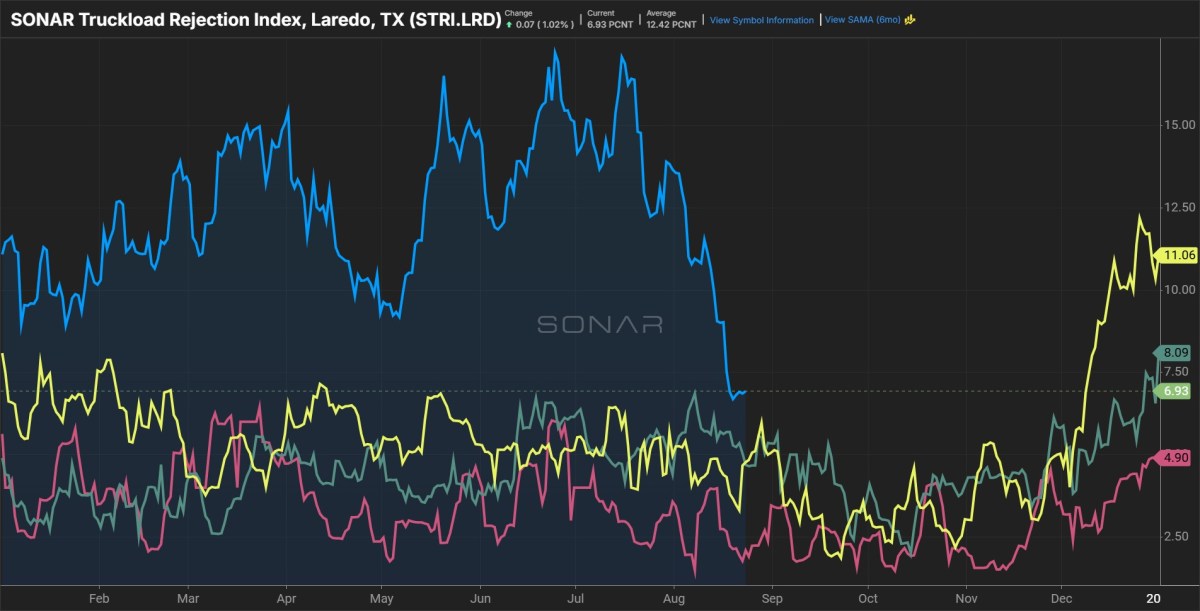
FreightWaves SONAR data suggests domestic truckload capacity originating in Laredo has loosened in recent weeks, even as cross-border B-1 driver availability remains constrained.
Laredo’s tender rejection rate fell from 12.24% on July 24 to 6.93% on Aug. 24, approaching balanced market conditions. The divergence suggests the capacity problem may be concentrated in the cross-border segment needed to move freight from Mexico into the U.S., rather than a broader shortage of trucks available to haul freight north from Laredo.
Uber Freight recently cited Federal Motor Carrier Safety Administration data showing the number of active Mexican-domiciled southern border carriers declined 6.3% between Dec. 26 and June 26. The company said stricter cabotage enforcement and English-language proficiency requirements are likely contributing to the decline.
Houssami said carriers are also reporting that B-1 visa renewals have become more difficult and that some drivers are reluctant to cross into the U.S. because of increased scrutiny of their previous operations.
At the same time, demand for cross-border freight remains strong.
Uber Freight said the value of trade moving through Port Laredo increased 19.36% year over year in May, while produce exports through Laredo rose 8% during the second quarter.
“When you couple that with a driver shortage, you see rate levels shooting through the roof,” Houssami said, adding that spot-market rates are significantly outpacing contract rates.
Mexican carriers look south for new drivers
Mexican trucking companies are responding to the driver shortage by recruiting farther south in Mexico, Houssami said.
Carriers are relocating recruits to training academies where they can improve their English proficiency and learn the requirements necessary to operate as B-1 drivers.
“They’re recruiting drivers from the south of Mexico, relocating them into different academies and developing their English skills, educating them on B-1 requirements and really giving them the training and tools that they need to become B-1 qualified drivers,” Houssami said.
The strategy represents a longer-term investment rather than an immediate solution to the capacity shortage.
Houssami said one of the biggest questions for the remainder of 2026 will be how quickly Mexican carriers can bring that new supply of qualified drivers into the market.
“I think that’s going to be a wild card,” he said.
Transloading offers alternative to B-1 capacity
Uber Freight is also encouraging shippers to reconsider how freight moves through Laredo.
In its Aug. 13 cross-border market update, the company described B-1 capacity as a “structural” constraint and said the existing driver pool is no longer capable of absorbing market growth. Export loads in Nuevo Laredo are increasingly being delayed while waiting for northbound B-1 drivers, according to the company.
One alternative is transloading freight in Laredo.
Under that model, a Mexican driver moves the shipment to the border, where the freight is transferred into another trailer and hauled north by a U.S. driver. That effectively allows shippers to tap a much larger driver pool rather than waiting for B-1 capacity.
Uber Freight said transloading can decouple export movements from the availability of northbound B-1 drivers, potentially preventing freight from becoming stranded at the border.
Houssami said the cost of transloading can be roughly comparable to direct B-1 service depending on the lane, but adoption has been slower than Uber Freight expected.
The biggest obstacle is risk.
Transloading requires additional handling as freight is unloaded, staged and reloaded, increasing potential exposure to cargo damage and theft.
“We expected that to be more widely adopted throughout the industry,” Houssami said. “It really hasn’t been.”
Some shippers instead appear willing to tolerate delays in Laredo while waiting for direct capacity.
Higher-value shipments are one exception. Houssami said some customers are using transloading when the working-capital cost of leaving expensive freight sitting at the border outweighs concerns about additional handling.
“For those shippers, speed is more important than cost,” he said.
Nearshoring investments slow amid trade uncertainty
The B-1 driver shortage isn’t the only uncertainty confronting cross-border supply chains.
Uber Freight said shippers continue to navigate changing tariff policies, potential rules-of-origin changes and uncertainty surrounding the future of the United States-Mexico-Canada Agreement. Despite those concerns, the company’s network data shows freight volumes remain steady across North America.
Houssami said tariff volatility has become almost routine for many businesses, but uncertainty over the future U.S.-Mexico trade relationship appears to be affecting longer-term investment decisions.
“We’ve definitely seen a slowdown with some of the nearshoring efforts that we saw over the last five years,” Houssami said.
Several Uber Freight customers have indicated they are slowing manufacturing expansions in Mexico until there is greater clarity about future trade rules, he said.
Houssami doesn’t expect the B-1 capacity problem to disappear soon, particularly if demand remains strong and the U.S. maintains stringent visa requirements.
“It’s probably going to get worse before it gets better,” he said.
For shippers, Uber Freight recommends improving volume forecasts, using spot-market capacity to supplement contract carriers when necessary and considering transloading to access capacity that doesn’t depend on B-1 drivers.
“Contract rates are not always getting prioritized, and tender acceptances are low,” Houssami said.
Despite the challenges, Uber Freight hasn’t seen a significant decline in overall Mexico freight demand. Houssami said the company’s cross-border portfolio remains strong, while an earlier shift of some freight from over-the-road trucking to intermodal appears to have stabilized.
The constraint remains getting enough drivers to move growing volumes across the border.
Brokerage Compliance Symposium
The day before F3. Every compliance issue you face - fraud exposure, carrier liability, FMCSA rules, cargo theft, insurance gaps - navigated by attorneys and operators defining best practices in a changing industry.
F3 Awards Dinner
The night before F3. FreightTech100 companies honored. FreightTech 25 and Shipper of Choice winners revealed live. Cocktail reception into dinner and live music - 300 industry leaders in one purpose-built room.
F3: Future of Freight Festival
Industry-defining keynotes, rapid-fire technology demos, and industry leaders networking in experiences across Chattanooga - plus the inaugural F3 Awards Dinner featuring the FreightTech and Shipper of Choice reveals.
The day before F3. Every compliance issue you face - fraud exposure, carrier liability, FMCSA rules, cargo theft, insurance gaps - navigated by attorneys and operators defining best practices in a changing industry.
The Signal at Chattanooga Choo Choo • Chattanooga, TN Register NowThe night before F3. FreightTech100 companies honored. FreightTech 25 and Shipper of Choice winners revealed live. Cocktail reception into dinner and live music - 300 industry leaders in one purpose-built room.
The Signal at Chattanooga Choo Choo • Chattanooga, TN Register NowIndustry-defining keynotes, rapid-fire technology demos, and industry leaders networking in experiences across Chattanooga - plus the inaugural F3 Awards Dinner featuring the FreightTech and Shipper of Choice reveals.
The Signal at Chattanooga Choo Choo • Chattanooga, TN Register Now