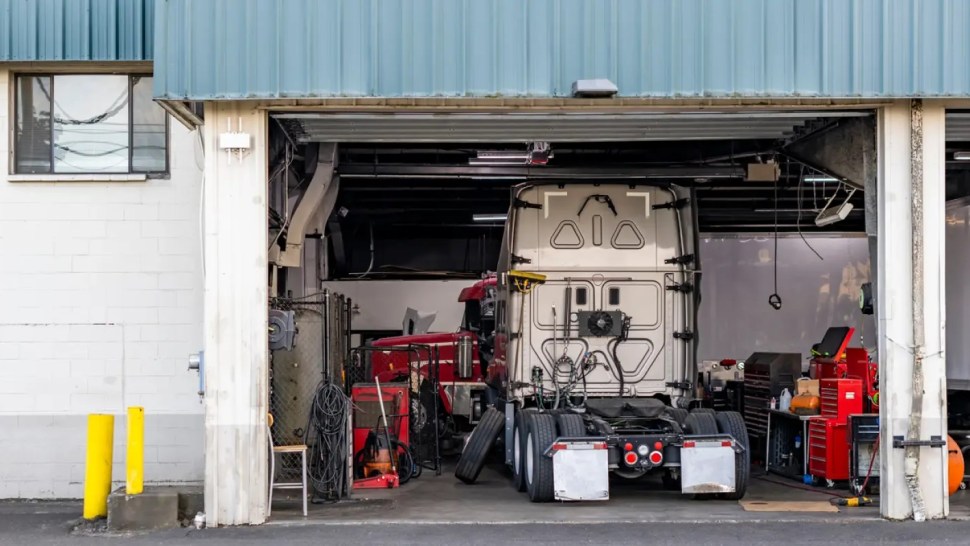
There are two records every fleet that runs its own shop has: what was reported by the truck on the road, and what gets written up by the technician in the bay. An evergreen challenge is that these records don’t always match. Motive built its newest product on the premise that closing that gap is the cheapest way left to hold down fleet repair costs.
The company recently announced Motive Maintenance to tackle this. It’s an AI-powered system that pulls fault codes, inspection defects, work orders and repair spend into the same platform that already holds its customers’ telematics and fuel card data.
Rising carrier costs are behind the timing. Carriers’ average marginal cost reached $2.336 per mile in 2025, the highest in the history of the report, according to the American Transportation Research Institute’s 2026 Analysis of the Operational Costs of Trucking. Maintenance and repair climbed 8.6% year over year in that dataset, an additional 2 cents per mile, and the category is up 45% since 2019, according to Fleet Maintenance. Only tolls, up 13.2%, rose faster last year. Non-fuel costs hit $1.854 per mile, breaking the $1.78 record the Motive report cites from 2024. Fuel is the number carriers argue about, and maintenance is the one compounding underneath it.
That pressure originates in the parts market. Parts costs rose 3.7% year over year in the fourth quarter of 2025 while labor slipped 0.4%, according to the most recent Decisiv/TMC Parts & Labor Service Benchmark Report. Parts are up 23.8% since early 2020 in the same dataset.
The Motive report puts the average annual repair and maintenance bill for a heavy-duty truck in the United States at $16,192, a number built on ATRI’s 2024 figures. That baseline is already stale by a year of 8.6% growth.
Motive’s own research, conducted with FreightWaves Research in the second quarter of 2026, drilled down on where fleets are feeling the squeeze. Rising maintenance and repair costs ranked as the leading operational challenge for 80% of respondents, with driver recruitment and retention at 60% and fuel cost management and fraud prevention at 50% among the other major concerns. Only 13% described their fleet technology systems as well-integrated and sharing data automatically across platforms.
“In general when you look at what is top of mind for fleets, it’s very clear that maintenance is coming out as the top topic primarily because of rising repair costs,” said Sriteja Kolluri, who leads the maintenance product at Motive, in an interview with FreightWaves. “One of the important data points there is how many of them have well-integrated systems that actually communicate data automatically. That answer is only 13%, which means a huge number of fleets have disconnected systems or spreadsheets that they use and they don’t talk to each other.”
Where Fleet Repair Costs Actually Hide
The money disappears in the gap between planned work and emergency work. Reactive repairs run three to nine times the cost of planned preventive maintenance, according to the Decisiv/TMC service benchmark data. FleetNet America breakdown data was also cited in the report.
Kolluri gave an example of the top end of that range using a 1,000-truck fleet.
“If you actually calculate that for a fleet with a thousand vehicles, with almost $760 a day and almost 8 to 9 days of breakdown per vehicle, that’s almost $4 million that they spend in downtime,” he said.
Those inputs come from that FleetNet America and TMC roadside maintenance data: 8.7 days of unplanned downtime per vehicle per year, at $448 to $760 per day in lost productivity.
From Cryptic Fault Code to Work Order
Before this release, a critical fault code produced an alert in one system, and the shop work got scheduled in another.
“You have a vehicle that’s on the road which has broken down, or there’s a critical fault code that has just occurred. Today, before this release, that data is just an alert that goes to the fleet manager,” Kolluri said. “With this, what happens is that alert basically translates into a work order that the maintenance shop can actually prioritize. So that’s basically the bridge that we’re building here.”
The translation of fault codes matters just as much as the routing. A fault code arrives as a string only a technician can read, and Motive’s diagnostics convert it into plain language with a severity ranking attached. Now a description, instead of a code, determines whether a truck comes in today or later.
Kolluri drew a distinction on the Motive Card, the company’s fleet fuel card. It does not pay the repair bill.
“The Motive Card basically gives you the fuel spend data. Then with work orders you’re actually capturing the maintenance data as well. So both put together basically gives you your accurate cost per mile per asset,” he said.
The Prediction Problem Is an Integration Problem
Two-thirds of respondents, 67%, said they struggle to predict which vehicles are at risk of failure or unplanned downtime. That’s the single most-cited pain point in the study. The adoption data shows how far the maintenance tooling lags the problem. AI-driven driver safety monitoring is in production at 88% of the fleets that answered the question, while predictive or condition-based maintenance sits at 20% adoption, with 60% not using it at all. Lack of internal expertise or IT resources was the most-cited barrier to getting more value out of AI, at 33%.
Manual work fills the space the integrations leave open. Roughly 29% of respondents estimated their teams spend 11 to 20 hours a week re-keying telematics data into maintenance software, reconciling fuel transactions and updating inspection records, and another 29% said they have never tracked the number at all.
“The data already exists out there. [DVIR] inspections exist, fault codes exist, your schedules exist, but nobody’s actually bringing all that information together and giving you a complete picture of your fleet health,” Kolluri said. “It’s difficult for fleets to do health monitoring when you have to download all this data from different systems and do VLOOKUPs and whatnot.”
TCO Was Always Tribal Knowledge
The visibility problem hits hardest when determining the total cost of ownership. Difficulty tracking true per-vehicle cost of ownership affected 67% of respondents, and a single dashboard showing per-vehicle TCO across every spend category was the top requested fix at 40%. More than half, 53%, said lowering total maintenance and repair costs per vehicle would do more for profitability over the next 12 to 24 months than any other change.
Without that number, the repair-or-replace decision runs on tribal knowledge and a service manager’s memory.
“When a vehicle breaks down, do I need to replace it or do I need to repair it. This is again another important piece that comes in with the TCO visibility coming in. 67% of the fleets actually are not able to bring this data together in time,” Kolluri said.
Maintenance is Motive’s seventh product on the platform, and it is available now in the United States and Canada. Motive’s 2026 ROI report put the average vehicle uptime gain across respondents at 18%.
For the fleets buying it, the test is whether the paper trail changes the invoice.
“Before Motive Maintenance, what happened on the road and what happened in the shop were two separate records,” said Luke Crawley, fleet manager at H&R Agri-Power. “Rather than paying emergency rates when something fails, we’ll be able to fix issues early, run higher uptime, save hundreds of hours a week, and spend far less to keep our fleet moving.”
Brokerage Compliance Symposium
The day before F3. Every compliance issue you face - fraud exposure, carrier liability, FMCSA rules, cargo theft, insurance gaps - navigated by attorneys and operators defining best practices in a changing industry.
F3 Awards Dinner
The night before F3. FreightTech100 companies honored. FreightTech 25 and Shipper of Choice winners revealed live. Cocktail reception into dinner and live music - 300 industry leaders in one purpose-built room.
F3: Future of Freight Festival
Industry-defining keynotes, rapid-fire technology demos, and industry leaders networking in experiences across Chattanooga - plus the inaugural F3 Awards Dinner featuring the FreightTech and Shipper of Choice reveals.
The day before F3. Every compliance issue you face - fraud exposure, carrier liability, FMCSA rules, cargo theft, insurance gaps - navigated by attorneys and operators defining best practices in a changing industry.
The Signal at Chattanooga Choo Choo • Chattanooga, TN Register NowThe night before F3. FreightTech100 companies honored. FreightTech 25 and Shipper of Choice winners revealed live. Cocktail reception into dinner and live music - 300 industry leaders in one purpose-built room.
The Signal at Chattanooga Choo Choo • Chattanooga, TN Register NowIndustry-defining keynotes, rapid-fire technology demos, and industry leaders networking in experiences across Chattanooga - plus the inaugural F3 Awards Dinner featuring the FreightTech and Shipper of Choice reveals.
The Signal at Chattanooga Choo Choo • Chattanooga, TN Register Now