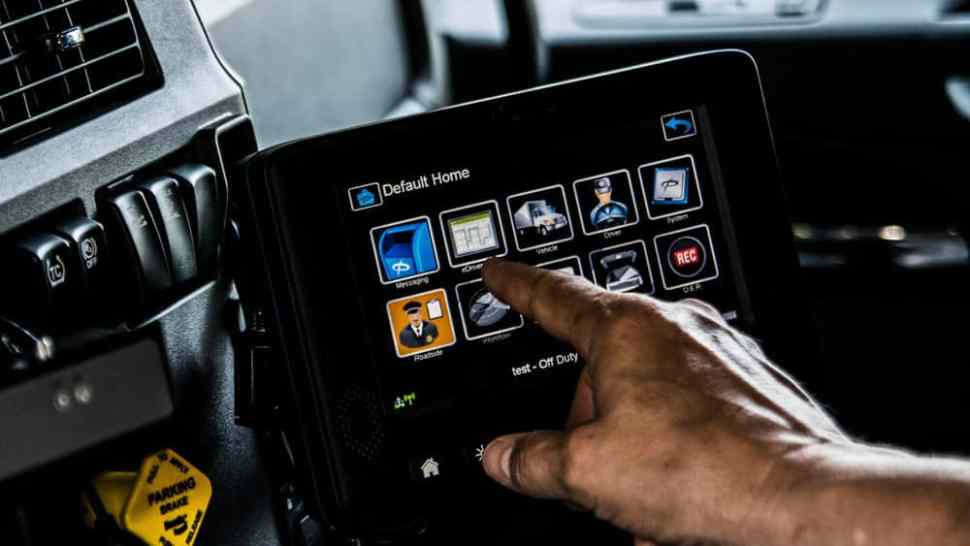

Ask carriers what’s changed about trucking compliance lately, and you’ll likely hear about the accumulation of new rules that change faster than most back offices can absorb them. David Vincent has had a front-row seat to that accumulation. He’s co-founder of Visionary Ventures, the technology company that built and operates Dotra Compliance, a platform designed to serve as what Vincent calls a virtual compliance department.
FreightWaves sat down with Vincent to talk through where carriers are losing ground and where a software layer can realistically help. He laid out a picture of an industry squeezed from multiple directions at once, including a faster enforcement, a Supreme Court ruling that rewrote how brokers vet carriers, and a volume of paperwork that outpaces small compliance departments.
The current compliance environment, Vincent says, feels more difficult than it used to because it is. Carriers have been dealt a stretch of regulatory change that would challenge any safety department.
“In the last 18 months alone, carriers have absorbed English proficiency becoming an out-of-service violation, revoked ELDs, a non-domiciled CDL crackdown, a new FMCSA registration system and a Supreme Court ruling that changed how brokers choose carriers,” Vincent said. None of that replaces the baseline workload that never stops, including medical cards, MVRs, testing, inspections, and filings.
The disparity in who can absorb that load, according to Vincent, comes down to headcount rather than intent.
“A large carrier has a safety department, while a 10-truck fleet has the owner,” Vincent said. “The volume of change is the same for both, and that’s the gap we built Dotra to close.”

The data backs up the sense that enforcement has intensified. Roadside inspections, Vincent says, fell to about 2.6 million in 2020 and passed 3.1 million in 2025, with more than 23.5 percent of trucks inspected placed out of service.
Part of that climb is a pandemic-era rebound, but Vincent pointed to something more deliberate behind the numbers: “The bigger driver is policy, with enforcement focused on things that stop a truck on the spot, like English proficiency, revoked ELDs and driver qualification,” he said.
What makes a violation expensive is rarely the citation itself.
“An out-of-service order parks a truck and a load,” Vincent said. “Violations feed safety scores, which brokers, shippers and insurers all screen on. And most carriers who get hurt aren’t cutting corners. They missed a date nobody was watching.”
That last point has taken on new weight since May, when the U.S. Supreme Court ruled 9-0 in Montgomery v. Caribe Transport II that freight brokers can be sued under state law for negligently selecting an unsafe carrier.
Vincent says the ruling has changed what compliance is actually for: “It means compliance is now how you get loads, not just how you avoid fines.”
The carrier at the center of that case carried a conditional safety rating along with problems in driver qualification, hours of service, and maintenance, all things a broker could have checked.
With the legal shield brokers used to lean on gone, Vincent says that buying behavior has already shifted.
“Brokers are checking,” Vincent said. “They’re asking for safety records and compliance documents before tendering freight, and they’ll pass on carriers who can’t produce them.”
There’s no uniform definition yet of what “safe enough” means from a broker’s perspective, which Vincent says is part of the problem. “The broker association has even asked FMCSA to write a federal standard for what a safe carrier looks like,” he said. “Until that exists, every broker sets their own bar, and a clean, documented compliance record is the surest way to clear it.”
If brokers are screening harder, the next question is where carriers are most likely to come up short. According to Vincent, it’s rarely a single document causing trouble.
“Most carriers are struggling with the volume [of documents],” Vincent said. “Between driver files, medical cards, MVRs, testing records, inspections, registrations and filings, it’s hard to keep everything in order. And even a carrier who does still has to remember to check what needs updating.”
The items most likely to slip, Vincent says, are the ones without a built-in reminder, such as the annual MVR review, the annual Clearinghouse query, random testing rates, the biennial MCS-150 update, and annual inspections.
Hiring is the single riskiest moment in a driver’s file, according to Vincent, and fleet size tracks closely with exposure.
“The riskiest moment is hiring, when a driver file gets built in a rush and a pre-employment test or previous-employer check gets missed,” Vincent said. “By size, it’s fleets of roughly 1 to 50 trucks, where compliance is one person’s side job.”
That “side job” dynamic is exactly where legacy tracking methods fall apart. Filed information doesn’t do anything for you unprompted.

“A spreadsheet only works if someone remembers to open it,” Vincent said. “It doesn’t warn you, it doesn’t know a rule changed, and when the person who keeps it is out or leaves, the system leaves with them.”
When something does slip, the fallout tends to land all at once rather than trickle in.
“The cost shows up all at once: a driver placed out of service, a late load, a broker asking questions, or two days of digging through binders for an auditor,” Vincent said. “And after Montgomery, a carrier who can’t produce clean records quickly may not get the load at all.”
A Virtual Compliance Department
Dotra’s answer to that fragility is a platform Vincent describes as a “virtual compliance department,” meant to do the thinking, not just the filing.
“It means Dotra does the work a compliance person does, not just the filing,” Vincent said. “A reminder app only reminds you about what you already knew to enter. A document locker stores files but doesn’t read them. Both assume you already know every rule that applies to you.”
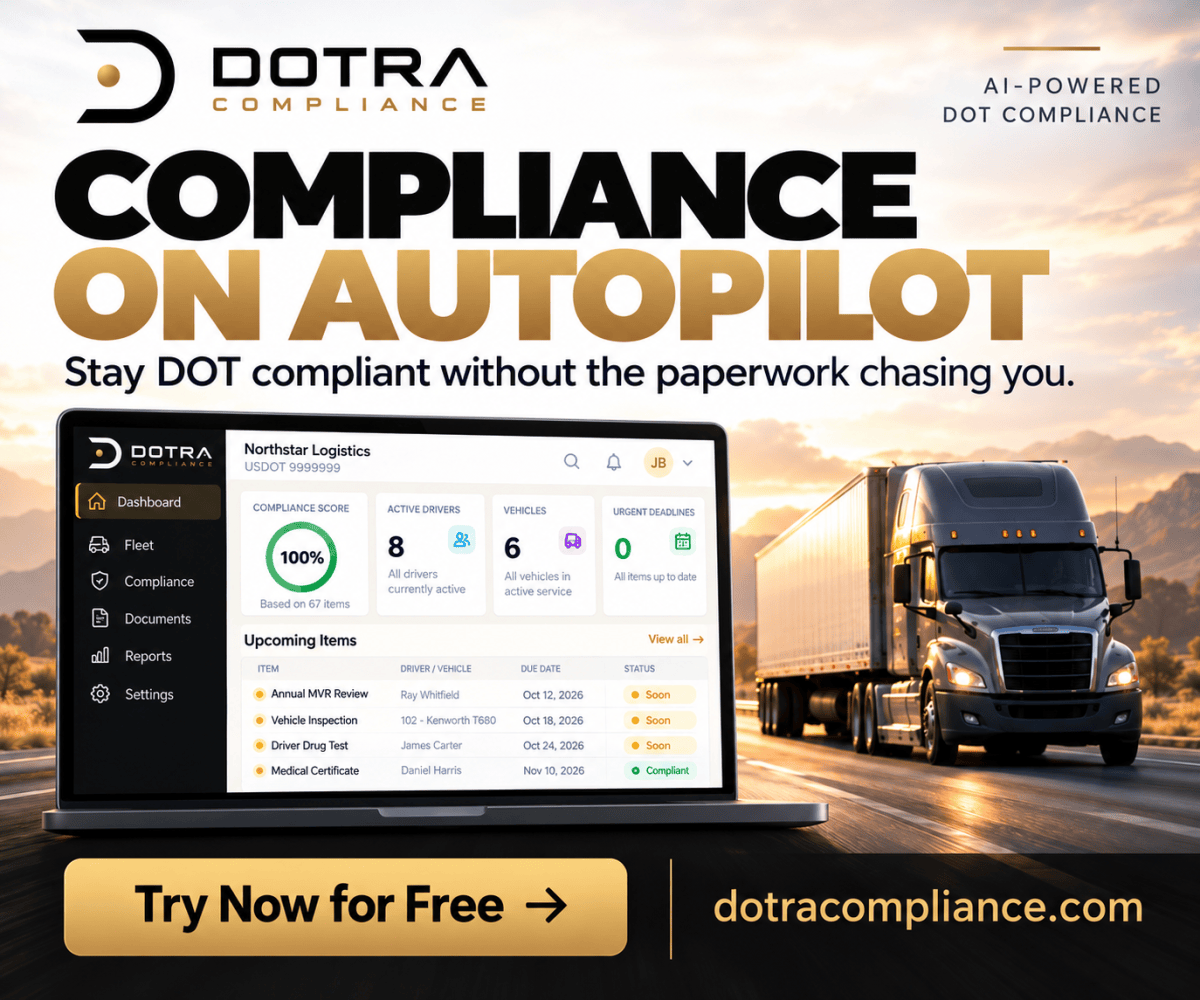
The platform starts by mapping an operation (whether that’s a for-hire or private fleet, CDL or non-CDL, which states it runs in) and builds a requirement list from there, tracking every deadline, reading incoming documents and watching a carrier’s FMCSA safety data for changes. “It’s what a full-time safety manager does, at a price a 5-truck fleet can afford,” Vincent said.
Day to day, the mechanics are built to remove friction rather than hand a carrier a new system to babysit.
“A document comes in, either uploaded by the office or photographed by a driver who scans a QR code, with no app or login,” Vincent said. Dotra reads the file, pulls the relevant dates, and files it under the right driver or vehicle, turning every date into a tracked deadline with escalating email and text alerts as it approaches—replacing, as Vincent put it, the work of “keying dates into spreadsheets, checking SAFER by hand, tracking annual reviews from memory, digging through binders when a broker asks, and reading FMCSA notices to see whether they apply.”
Document-reading capability pays off most during onboarding, when a new customer is migrating years of paper records into the system.
“A new carrier might have a few hundred documents across drivers and trucks, and typing every date from each one is where most people give up,” Vincent said. Once a fleet is running, the priority shifts from speed to precision, since a platform is only as useful as the data it holds. “After setup, it’s about accuracy: a mistyped expiration date is worse than none, because it gives you false confidence,” he said.
Proof in Practice: The Motus Transition
Vincent points to FMCSA’s rollout of Motus, the agency’s new registration system, as a concrete example of what regulatory intelligence is supposed to catch before it becomes a crisis. Motus replaced the previous patchwork of portals for USDOT numbers, authority, and biennial updates with a single system that required carriers to confirm a handful of account details to move over cleanly. Miss any of it, Vincent says, “and you could be locked out of managing your own USDOT number.”
Most small carriers heard about the transition secondhand, if at all. Dotra’s customers got something more specific.
“Dotra customers got it as an alert with a step-by-step checklist,” Vincent said. “That’s the point of regulatory intelligence: the rule is the same for everyone, but it reaches you as a checklist instead of a surprise.”
Audit-Ready, Not Audit-Scrambling
Few moments expose a weak compliance program faster than an audit notice or a broker’s vetting request, and Vincent says that’s exactly the scenario Dotra is built to defuse. “It turns audit prep from a project into a download,” he said.
Without a system in place, an audit notice typically kicks off a scramble.
“In Dotra, the gaps show up on the dashboard every day, so most are fixed long before anyone asks,” Vincent said.
When a broker or auditor does come calling, the platform generates a readiness packet directly from records the carrier has already been maintaining. According to Vincent, that capability matters more now than it used to.
“Brokers now need to show they vetted the carriers they hire, and a carrier who can hand over a clean packet the same day makes that easy for them,” Vincent said.
Non-CDL Fleets
One misconception Vincent said Dotra runs into constantly involves operators who assume federal compliance is strictly a CDL problem.
“A landscaper or contractor running pickups with trailers assumes no CDL means no DOT,” Vincent said. “But federal rules start at 10,001 pounds in interstate commerce, and a one-ton pickup towing an equipment trailer crosses that easily.”
Once that threshold is crossed, Vincent says, most of the core requirements apply regardless of license class, including a USDOT number, driver files, DOT medical cards, hours-of-service rules, and annual inspections. Drug and alcohol testing generally remains tied to CDL drivers specifically.
To serve that segment, Dotra built a separate onboarding path that generates a requirement list suited to a private, non-CDL fleet rather than a trucking company’s checklist.
“It’s a big part of why we call Dotra transportation compliance, not just trucking compliance,” Vincent said.
Whether it’s a 200-truck carrier bracing for a broker’s vetting request or a three-truck landscaping outfit, the rules aren’t written differently for small operations. Dotra is pairing AI-driven document reading with deadline tracking and regulatory monitoring to give any fleet, regardless of size, the kind of compliance posture that used to require a dedicated department. Increasingly, that dedication to compliance decides whether a broker picks up the phone at all.
Click here to learn more about Dotra Compliance.
Brokerage Compliance Symposium
The day before F3. Every compliance issue you face - fraud exposure, carrier liability, FMCSA rules, cargo theft, insurance gaps - navigated by attorneys and operators defining best practices in a changing industry.
F3 Awards Dinner
The night before F3. FreightTech100 companies honored. FreightTech 25 and Shipper of Choice winners revealed live. Cocktail reception into dinner and live music - 300 industry leaders in one purpose-built room.
F3: Future of Freight Festival
Industry-defining keynotes, rapid-fire technology demos, and industry leaders networking in experiences across Chattanooga - plus the inaugural F3 Awards Dinner featuring the FreightTech and Shipper of Choice reveals.
The day before F3. Every compliance issue you face - fraud exposure, carrier liability, FMCSA rules, cargo theft, insurance gaps - navigated by attorneys and operators defining best practices in a changing industry.
The Signal at Chattanooga Choo Choo • Chattanooga, TN Register NowThe night before F3. FreightTech100 companies honored. FreightTech 25 and Shipper of Choice winners revealed live. Cocktail reception into dinner and live music - 300 industry leaders in one purpose-built room.
The Signal at Chattanooga Choo Choo • Chattanooga, TN Register NowIndustry-defining keynotes, rapid-fire technology demos, and industry leaders networking in experiences across Chattanooga - plus the inaugural F3 Awards Dinner featuring the FreightTech and Shipper of Choice reveals.
The Signal at Chattanooga Choo Choo • Chattanooga, TN Register Now