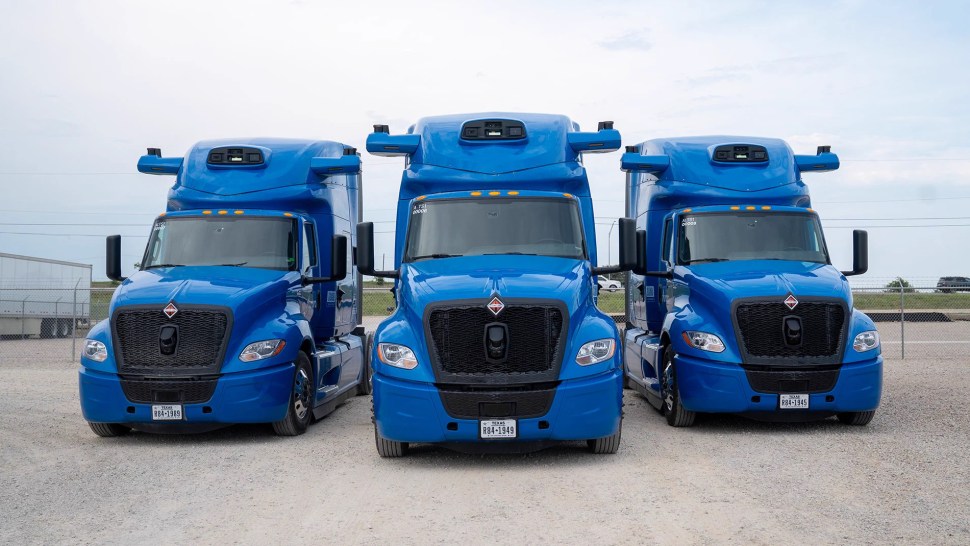
Aurora Innovation signed a nonbinding memorandum of understanding Monday under which Charger Logistics intends to buy up to 500 Aurora Driver-powered trucks, with deliveries over 2027 and 2028. The deal builds on a contract Charger signed in July to start driverless hauls between Dallas and Laredo, Texas.
Under a final agreement, Charger would own the trucks and pay Aurora for the driving through its Driver as a Service model. Carrier-owned fleets are central to Aurora’s plan to run more than 30,000 driverless trucks by 2030.
Aurora now expects to pass 200 driverless trucks by the end of February, with its production ramp about six weeks behind plan. It still expects more than 1,000 by the end of 2027. In April, Hirschbach Motor Lines signed a nonbinding MOU to own 500 Aurora trucks under the same ownership model.
Charger’s president tied the larger order to its first months running autonomous trucks on the border lane.
“Since launching autonomous operations along the Laredo corridor, we’ve realized immediate operational benefits that point to a clear path to scaling,” said Andy Khera, president of Charger Logistics. “Aurora’s plans to open long-haul, high-volume routes position us to scale geographically while we integrate autonomy from our TMS to the road, building a resilient and autonomous ecosystem for our customers.”
How Driver as a Service changes ownership
Charger’s July agreement is a Transport as a Service deal, according to Aurora’s third-quarter shareholder letter. Under that model, Aurora owns and operates the trucks and charges about $2 per mile, including a fuel surcharge.
Under Driver as a Service, the carrier buys the truck and pays Aurora for the driving. That brings Aurora 85 cents or more per mile, on trucks Aurora expects to run about 250,000 miles a year.
The letter calls the Charger deal “a potential multi-year revenue stream in the hundreds of millions of dollars.” Neither company disclosed Charger’s per-mile rate.
Aurora made the case for carrier ownership in the release.
“Owning the physical asset is the logical choice for our customers: it makes today’s operations more efficient and enables carriers to grow their business, keeping them competitive,” said Zac Andreoni, vice president of business development at Aurora.
The Charger deal is not yet binding
The cautionary statement in Aurora’s release lists the risk that the Charger MOU may not lead to a final agreement and binding orders “on the anticipated timeframe or at all.” In September, Aurora pushed back its own target for breakeven gross margin on a run-rate basis to the first half of 2027, at about 500 trucks, from the end of 2026.
Werner Enterprises, another Aurora customer, was still negotiating economic terms in September. Daragh Mahon, Werner’s executive vice president and chief information officer, addressed the cost on a customer panel at Aurora’s Analyst and Investor Day in Dallas on Sept. 23.
“And I will be quite honest that we have a gap. We’ve got to figure this out,” Mahon said.
Aurora ranks No. 4 on FreightTech 25
The MOU landed the same day FreightWaves named Aurora No. 4 on the 2027 FreightTech 25, revealed at the F3 Awards Dinner in Chattanooga, Tennessee. Aurora previously ranked No. 2 on the 2026 list.
Four autonomous trucking companies made this year’s list, up from three last year: Aurora, Kodiak AI at No. 12, Torc Robotics at No. 19, and Waabi at No. 20.
Charger’s fleet and routes
Charger Logistics, a privately held, asset-based carrier, operates across the U.S. and Mexico. Its U.S. unit, Charger Logistics USA, lists 481 power units and 542 drivers in its Federal Motor Carrier Safety Administration registration, last updated in October 2025. The 500 Aurora trucks would exceed that count.
Charger plans to run the Aurora trucks on current and new high-volume routes near the border and across the country.
“With the launch of our second-generation hardware and trucks, Aurora is ready to support our customers’ ambitions to grow their networks and move more freight with driverless trucks,” Andreoni said.
Why it matters: The deal would move the cost of owning driverless trucks from Aurora to the carrier. If the deal completes and the MOU fulfilled, Charger would take on more trucks than its U.S. unit runs today.
F3: Future of Freight Festival
Industry-defining keynotes, rapid-fire technology demos, and industry leaders networking in experiences across Chattanooga - plus the inaugural F3 Awards Dinner featuring the FreightTech and Shipper of Choice reveals.
Industry-defining keynotes, rapid-fire technology demos, and industry leaders networking in experiences across Chattanooga - plus the inaugural F3 Awards Dinner featuring the FreightTech and Shipper of Choice reveals.
The Signal at Chattanooga Choo Choo • Chattanooga, TN Register Now