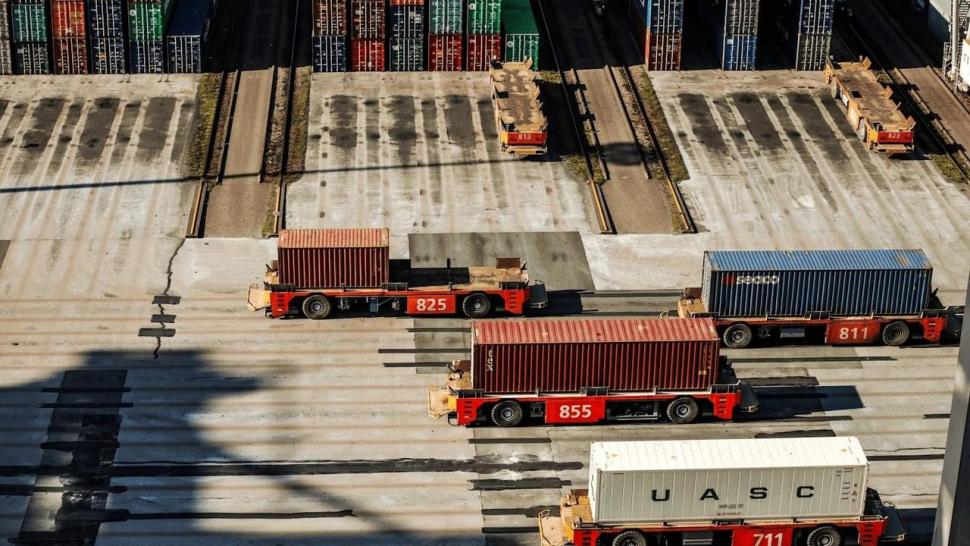
Venti Technologies’ driverless container trucks have worked PSA’s port in Singapore for nearly three years. Traffic there runs in one big loop, so the trucks never had to back up.
U.S. rail yards are less forgiving. Venti says a Class I intermodal railroad plans to run more than 130 Venti trucks across eight sites by 2027. First, the Boston-based company had to teach its trucks two skills Singapore never required, founder and CEO Heidi Wyle told FreightWaves.
Backing an articulated rig is among trucking’s most challenging maneuvers, FreightWaves noted when Outrider added autonomous trailer backing to its distribution-yard tractors in 2022.
“So now when we came to the US, we had to teach our big 60-foot-long tractor-trailer vehicles how to back up,” Wyle said. “So you know we have videos of them actually backing up with 4-inch clearance on either side.”
Where the trucks fit in an intermodal yard
At an intermodal terminal, hostlers bring containers trackside or to the storage area. That trackside shuttle is the work the railroad wants Venti’s trucks to take on, Wyle said. She put monthly driver turnover in some places at around 20%.
“If you ask where is it that people don’t want to be, it’s in Texas in July, right?” Wyle said. “So basically what they want us to do is to be trackside with the trains and have the vehicles do the unloading and the short hauls to get to the long hauls or the other wherever else they’re going to go.”
The company’s Oct. 1 release says the trucks will load, move, and unload containers during live yard operations with nobody in the cab and no dedicated lanes. It does not say whether human hostlers will keep working beside them at the U.S. sites.
The trucks also have to cross live track on their own.
“Our vehicle now sees trains,” Wyle said. “It’s just like you or I. They would see trains, you know, they would see the sign come down. We see lights, red lights, green lights just like humans do.”
Six weeks into a three-month pilot
The railroad deal grew out of a proof of concept scheduled for three months, Wyle said. Six weeks in, the railroad told Venti it had hit all the metrics. It then took two vehicles before committing to a larger rollout.
Venti signed a long-term agreement with the railroad in July, starting at two of its busiest U.S. intermodal facilities, according to the company’s July 8 release. That release projected “100-plus” trucks by 2027. The October release raised the figure to more than 130 and said the fleet could pass 600 by the end of the decade.
But the U.S. fleet has not started work. Neither company has named the railroad or disclosed terms. Venti announced a $28.8 million Series A in March 2023, led by LG Technology Ventures.
Nearly three years without a driver in Singapore
Wyle co-founded Venti in 2018 with Daniela Rus, director of MIT’s Computer Science and Artificial Intelligence Laboratory. Their first idea was slow-speed robotaxis for senior communities. Wyle dropped it quickly.
“That was a very bad market because they don’t have a lot of money and what they have they don’t want to part with,” she said.
PSA, which runs over 70 deepsea, rail, and inland terminals according to its January release, pulled Venti into logistics around 2020, Wyle said. The two mapped PSA’s Singapore port and developed the system there, and the fleet grew from one truck to two, four, and eight. Venti now runs a 30-truck driverless fleet in Asia, Wyle said.
At PSA Singapore, those trucks work beside about 1,200 human-driven trucks, according to the Oct. 1 release. The company says its fleet has logged more than 500,000 autonomous miles and moved more than 360,000 containers.
Rebuilding the intermodal yard
The larger payoff, Wyle said, is predictability. In intermodal yards today, chassis get dropped wherever there is room, and owners sometimes send drones to find them, she said.
“What’s interesting is when you think about it for a minute, autonomy, our trucks are going to be exactly at a place exactly when they’re supposed to be there,” she said. “And so it enables a complete redo of all of those yards and the core supply chain.”
The railroad wants to start that work, she said.
“One of the things they want to do is actually start rebuilding the supply chain yards so that they’re less chaotic and more controlled,” Wyle said.
Why it matters: Venti’s trucks have run without drivers in Singapore for nearly three years. The company is now moving to test this technology in US yards, part of a growing group of autonomous technology providers targeting areas outside of middle mile and long haul applications.