Covenant Logistics Group CEO David Parker expects truckload contract rates to increase by double digits in 2027 as trucking companies contend with rising operating expenses, tightening driver capacity and continued federal enforcement of safety regulations.
Speaking during the Chattanooga, Tennessee-based carrier’s third-quarter earnings call with analysts Friday, Parker said carriers will need additional rate increases to offset inflation in driver compensation, equipment, insurance and other operating costs.
“We’re going to continue to raise rates,” Parker said during the call. “We have to because of the cost.”
When an analyst asked whether the company expected another year of double-digit contract rate increases in 2027, Parker replied, “That’s my expectations.”
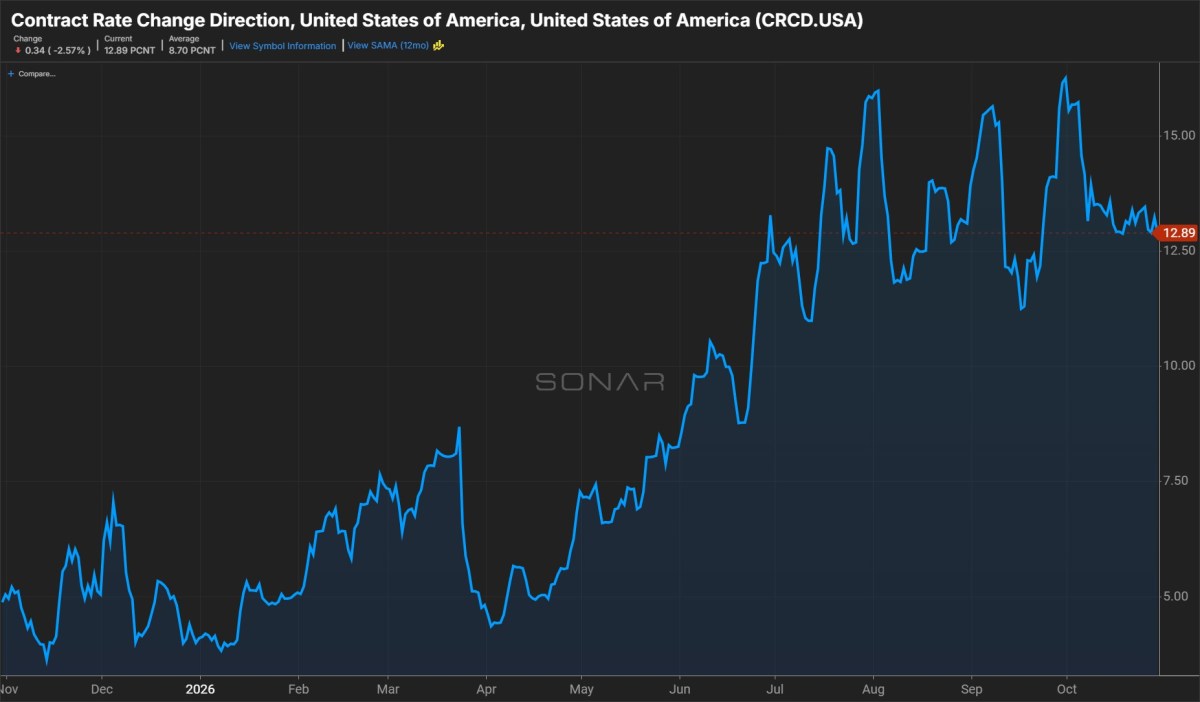
As of Thursday, shippers who reset their truckload contracts in recent months are paying about 12.8% more than the rates they replaced, according to SONAR’s Contract Rate Change Direction index (CRCD.USA). The rate is up from 4.1% during the same period in 2025.
Covenant Logistics Group’s (NYSE: CVLG) third-quarter results showed total revenue increasing 19.2% year over year to $353.9 million, while adjusted earnings per share rose to 50 cents from 44 cents a year earlier.
One of the most significant developments discussed during Friday’s call was Covenant’s transition away from traditional one-way expedited trucking toward multiyear committed capacity agreements.
Parker said approximately 25% of the company’s expedited trucks were operating under dedicated arrangements at the beginning of 2026. He expects that percentage to reach approximately 75% to 80% by the end of the year.
At the end of September, approximately 58% of Covenant’s expedited tractors were operating under committed capacity agreements, compared with about 40% at the end of the second quarter.
Parker said growing demand for high-security transportation, including technology-related shipments and equipment associated with data centers, is helping drive the transition.
“Technology loads have just been exploding,” Parker said.
Some customers are signing contracts lasting two to four years, providing Covenant with more predictable revenue and greater protection against fluctuations in freight volumes, according to Parker.
Unlike traditional expedited trucking, which historically emphasized maximizing miles and equipment utilization, the new arrangements often compensate Covenant for maintaining secure capacity even when trucks are waiting for shipments.
Some specialized operations may run approximately 3,000 miles per week, compared with 5,000 miles per week in the company’s traditional expedited network.
Parker said certain dedicated expedited contracts could eventually see operating ratios in the 80s, although he emphasized that those margins would apply to individual operations rather than the entire expedited segment.
Covenant executives said demand for specialized freight services remains strong, but finding qualified team drivers is becoming increasingly difficult.
Management said recruiting and training drivers capable of handling high-security freight requires additional time and resources, limiting how quickly the company can expand its specialized operations.
Management emphasized that its ability to capitalize on the demand depends on successfully recruiting qualified drivers, repositioning equipment and maintaining customer service.
The transition has already created operational challenges.
During the third quarter, Covenant reported an 8.9% reduction in its average truckload tractor fleet, which fell to 2,186 units from 2,400 a year earlier.
Truckload freight revenue excluding fuel surcharges declined 3.4% to $166 million, even as average freight revenue per total mile increased 19.8% to $3.03.
Covenant’s managed freight segment remained a major contributor to third-quarter earnings.
Managed freight revenue increased 68.4% to $121.6 million from $72.2 million a year earlier, while adjusted segment operating income rose approximately 133% to $7.1 million.
Management attributed the improvement to brokerage operations acquired during the fourth quarter of 2025, higher customer rates and improved availability of third-party carrier capacity.
Executives said the brokerage market experienced significant margin compression during the second quarter as spot freight rates increased rapidly.
However, conditions improved during the third quarter as purchased transportation costs eased while previously negotiated customer rate increases remained in place.
Management cautioned that the unusually strong third-quarter brokerage margins may not be sustainable every quarter.
Parker addressed the impact of federal trucking regulations on driver availability and freight capacity.
Responding to questions from analysts, Parker said he believes the Federal Motor Carrier Safety Administration remains committed to enforcement involving driver training schools, commercial driver’s licenses and electronic logging devices.
He said he had spoken with FMCSA officials the previous day and did not believe the agency was retreating from its enforcement priorities.
“We have been working closely with FMCSA, and we think they’re doing a great job,” Parker said.
Parker predicted that regulators would eventually require third-party certification of ELD providers as part of efforts to address falsified driver hours-of-service records.
He also said 30% of trucks using ELDs may be operating with manipulated records.
“I think it’s a gigantic number,” Parker said.
Parker said he expects continued enforcement to remove additional trucking capacity from the market, particularly in team-driver operations.
Looking beyond the fourth quarter, Covenant executives said the company’s long-term strategy will continue emphasizing specialized transportation, dedicated freight, brokerage and warehousing.
President Paul Bunn said the carrier intends to avoid pursuing low-margin, commoditized freight and instead focus on customers willing to support acceptable returns on invested capital.
“Number one, we’re going to be focused on safety and execution and not chasing stuff,” Bunn said.
The company also expects continued organic growth in its managed freight and warehousing segments, while remaining open to acquisitions and share repurchases depending on market conditions.
Covenant ended the third quarter with approximately $283.9 million in net indebtedness and an adjusted leverage ratio of about 2.1 times.
Management said it expects leverage to improve over the coming quarters as the company generates additional cash flow.
For the fourth quarter, Covenant anticipates a modest sequential increase in adjusted earnings per share, supported by improving truckload margins, partially offset by a smaller contribution from its 49% investment in transport enterprise leasing.
Longer term, executives said the combination of higher freight rates, more specialized contracts and reduced exposure to traditional over-the-road operations should strengthen the company’s profitability.
Covenant Logistics Q3 2026 financial and operating performance
The following table compares the third quarters of 2026 and 2025.
| Metric | Q3 2026 | Q3 2025 | YoY change |
|---|---|---|---|
| Total revenue | $353.9M | $296.9M | +19.2% |
| Truckload total revenue | $204.6M | $199.7M | +2.5% |
| Freight revenue excluding fuel (companywide) | $315.1M | $268.8M | +17.2% |
| Truckload revenue per total mile* | $3.03 | $2.53 | +19.8% |
| Truckload revenue per tractor per week* | $5,778 | $5,445 | +6.1% |
| Managed Freight revenue | $121.6M | $72.2M | +68.4% |
| Managed Freight adjusted operating income | $7.08M | $3.04M | +133.3% |
| Expedited freight revenue excluding fuel | $70.6M | $80.2M | -12.0% |
| Expedited adjusted operating income | $4.16M | $5.14M | -19.0% |
| Adjusted earnings per share | $0.50 | $0.44 | +13.6% |
Why it matters: Double-digit contract rate increases could signal a significant shift in trucking market pricing power after years of weak freight rates and pressure on carrier profitability.