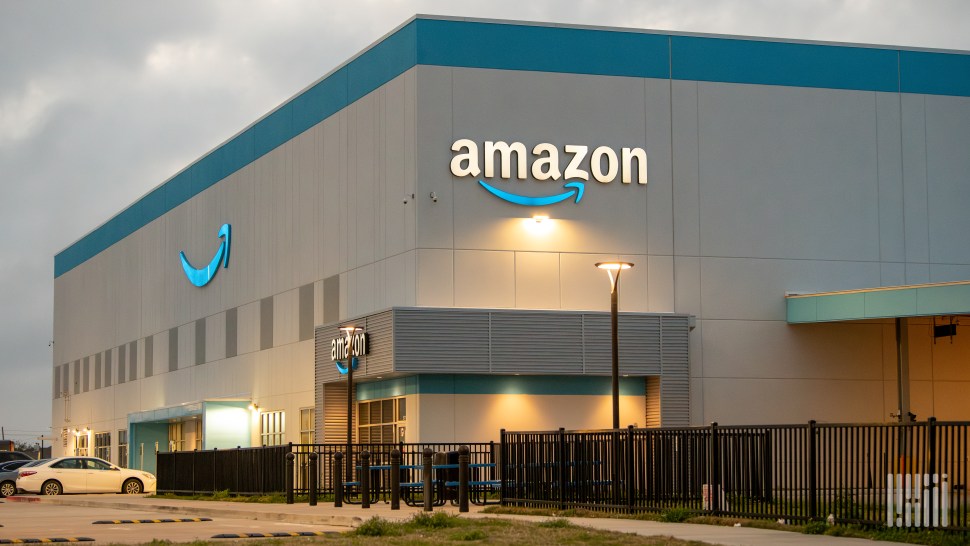
The Teamsters are claiming victory for a group of “W-2” drivers at an Amazon facility in Indiana who sought representation by the union.
But as with the entire Amazon-Teamsters relationship, it’s complicated.
In its prepared statement announcing the “march” on the company to demand it bargain for a contract, the Teamsters said it had unionized Transportation Operations Management (TOM) workers at the OIL9 Amazon facility in Merrillville, Indiana, which is near the state line with southern Illinois.
The Teamsters said that earlier it had also organized TOM workers at Amazon’s SDF9 facility in Shepherdsville, KY and the MCI9 facility in Liberty, Mo.
TOM drivers move trucks within the borders of an Amazon facility. They are employed by the company, which means they get a W-2 form for tax purposes from Amazon, not a third party contractor.
That is unlike the drivers who bring packages to people’s homes, the direct service providers (DSPs). Those drivers are W-2 employees of the DSPs, though the Teamsters have tried–including before the NLRB–to make the case that the control Amazon exerts over the DSPs make the e-commerce giant effectively their employer.
Company pushes back
Amazon said no such unionization had occurred at the Indiana facility.
In response to a query from FreightWaves, Amazon released a prepared statement that said the latest declaration of victory by the Teamsters is part of a “false narrative.”
The union, Amazon said, “continues to intentionally mislead the public, claiming to be the bargaining representative of Amazon employees and drivers who deliver on our behalf. Because this union has a track record of misrepresenting the facts, we’re skeptical that their claims here are accurate.”
The statement ended by saying “the Teamsters are not a certified bargaining representative at a single Amazon facility.”
Process known as card check
The key aspect of the successful unionization drive being touted by the union is that it appears to be another Teamsters declaration of victory through the process known as “card check.”
Under card check, if a majority of the workers at a company present signed cards to management from employees who say they want to be represented by a specific union, that can be a legitimate start to the process where a company recognizes a collective bargaining unit.
In practice, Amazon and its direct service providers–reportedly under strict guidance from Amazon—usually ignore card check petitions.
But the card check route has essentially had the backing of the National Labor Relations Board (NLRB) since August 2023. That month, the board handed down the Cemex precedent in a case involving Cemex Construction Materials Pacific.
In an earlier NLRB action also involving the Teamsters and Amazon, Administrative Law Judge Michael Silverstein said in describing the Cemex precedent that “the (NLRB) created a new pathway for labor organizations to obtain recognition without filing a representation petition.” If a majority of the workers in a unit signs authorization cards, that unit “can present the employer with a demand for recognition,” according to ALJ Silverstein’s decision in that case that went the Teamsters’ way.
The Teamsters did not respond to emails sent by FreightWaves on its latest statement about unionization.
Marching on the boss
In the prepared statement announcing the unionization drive, the union said its TOM drivers at a facility in Merrillville had “(marched) on the boss…to demand Amazon recognize their union and bargain a union contract.”
The Teamsters has used similar language in other releases where its unionization drive had looked to card check as its route to organizing the rank-and-file, including DSP drivers.
With the union avoiding using the term “card check,” the affirmation that there was not a standard NLRB-administered unionization vote in Indiana comes from the lack of any record of such a referendum on the NLRB’s webpage that lists unionization elections administered by the agency.
Recent victories through elections
On that page, however, there are records of five recent Teamsters elections in the last two months. The Teamsters were successful in four of them, winning at Shelby Transport in Indianapolis, DP World Contract Logistics in Detroit, Comprehensive Logistics in Philadelphia, and MV Transportation in Raleigh, N.C..
The unsuccessful vote came at U.S. Foods in Arizona.
Precedent on thin ice
A problem with relying on the Cemex precedent as the basis for a unionization drive is that its days may be numbered. It has taken two serious blows in recent months.
NLRB General Counsel Crystal Stowe Carey sent a memorandum to NLRB colleagues in August that said she was asking the board to “revisit certain precedents.” One of them was the Cemex case.
In March, in a case in the Sixth Circuit between the Teamsters and liquor distiller Brown Forman, a divided appellate court said the NLRB had exceeded its authority when it handed down the Cemex precedent, becoming the first federal court to reject the ruling.
But there was no sign of that concern in the Teamsters statement heralding the union action in Merrillville.
“Amazon Teamsters are proud to expand our national footprint and welcome OIL9 TOM Team drivers to our movement,” Randy Korgan, director of the Teamsters Amazon division said in the statement. “It is never easy being the first group of workers in a state to join a union, but they are displaying the courage and strength it takes to be a Teamster.”
The statement also quoted TOM driver Charles Hurd as saying the company “wasn’t going to listen to us as individuals, so the only option was to join together as Teamsters. We look forward to winning our first union contract.”
But as the Amazon workers at the company’s facility in Staten Island, N.Y. can tell Hurd and others–and those Staten Island employees did go through an NLRB-administered vote which was a stunning success–the road to negotiating a contract with Amazon can be long and hard. The company has not yet signed a collective bargaining contract with any union.
More articles by John Kingston
FMCSA’s Elison addresses Motus again, still no date on full repair
TFI chief Bedard rips into its US LTL operations, promises change
Transportation committee in House set for overhaul post-election