




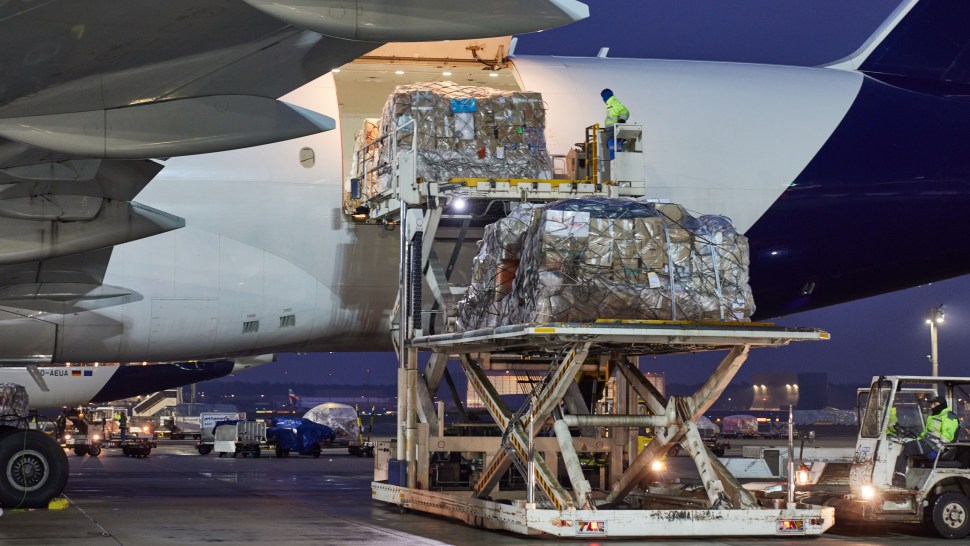
The cargo arm of Lufthansa Group said Monday it has agreed to purchase the Frankfurt operation of Fiege Air Cargo Logistics GmbH, bringing cargo handling operations at its Frankfurt hub under direct management, three weeks after completing the acquisition of another German cargo handling agent at the airport.
The transaction reflects Lufthansa Cargo’s (XETRA: LHA) recent strategy to become more vertically integrated in the air logistics sector. By reducing the number of shipment transfers to third-party vendors the company ostensibly can provide more reliable service and sell that as an advantage over other carriers that rely on airport services companies to move cargo between trucks and aircraft.
The airport logistics provider, which also has branches at the Cologne/Bonn, Germany, and Zurich airports, will continue to help Lufthansa Cargo recruiting, training and providing specialized warehouse personnel to handle air shipments, Lufthansa Cargo said. Fiege Air Cargo is part of logistics services conglomerate Fiege Logistik Stiftung & Co. KG. It took over the physical cargo handling for Lufthansa in Frankfurt in 2020.
Lufthansa Cargo is currently the No. 14 carrier in the world, by traffic volume, according to the International Air Transport Association. It operates 12 Boeing 777 freighter aircraft and is able to market capacity on six 777s operated by AeroLogic, a joint venture between Lufthansa and DHL Express, for a total of 18 widebody freighters under its control. It also manages the belly capacity of sister airlines Lufthansa Airlines, Austrian Airlines, Brussels Airlines, Discover Airlines and SunExpress to transport freight.
“We offer our customers high-quality and reliable solutions. Frankfurt is the most important hub in our network. In addition to significant investments in our new infrastructure and warehouse systems, a key question is how we can best operate this infrastructure. Taking full responsibility for handling operations is a logical step in this regard. This will allow us to introduce new technologies and automate our warehouse more quickly thanks to leaner structures, thereby enhancing quality and efficiency. In this way, we are setting the course for a successful future for the company. At the same time, we are pleased that we will continue our good cooperation with Fiege on a new basis over the long term,” said Frank Bauer, chief operations officer at Lufthansa Cargo, in a news release.
Terms of the deal, which still requires customary regulatory review, were not disclosed.
Why It Matters: The planned acquisition is part of Lufthansa Cargo’s strategic growth plan. The company’s goal is to return to the top three global air cargo providers by 2030. In addition to the consistent further development of its core business, Lufthansa Cargo is making targeted investments in measures to expand capacity, increase efficiency, and automate operations to support global businesses.
On Nov. 2, Lufthansa Cargo completed the acquisition of LUG air cargo handling GmbH from the Dettmer Group to increase warehouse capacity and operational flexibility in German, and exert more direct control of shipments during their journey versus using outside agents. LUG continues to operate as its own brand within Lufthansa Cargo and continues to support existing customers besides Lufthansa Cargo.
The additional ground handling capacity provided by LUG at Frankfurt International Airport complements Lufthansa Cargo’s existing infrastructure, including the $682 million cargo terminal expansion and modernization project scheduled for completion in 2030.
Lufthansa Cargo has since installed Uwe Glunz, a veteran company manager, and Patrik Tschirch, managing director of LUG, as co-CEOs of LUG.
The company earlier this year merged heyworld, which focuses on providing expedited cross-border shipping for e-commerce shipments and CB Customs Broker, into a new company called GlobeCross GmbH.
Q3 results
In the third quarter, Lufthansa Cargo tripled operating profit year over year to 162 million euros (equivalent to $177 million) behind a 28% increase in core transportation revenue as the airline picked up business from Middle East carriers heavily impacted by the Iran conflict. The reduction of industry capacity and the hike in jet fuel prices led to a 22% increase in yields. Demand was driven by continued strong business in the Asia/Pacific region in particular, as well as in the Americas.
Lufthansa’s cargo subsidiary achieved an adjusted operating margin of 15.6%, up from 6% in the comparable period.
Click here for more FreightWaves/American Shipper stories by Eric Kulisch.
RELATED STORIES:
AI hardware, Asia demand lift Lufthansa Cargo revenue 27%
Lufthansa Cargo to buy terminal operator in Germany
Lufthansa Cargo invests more than $600M to overhaul Frankfurt hub
