




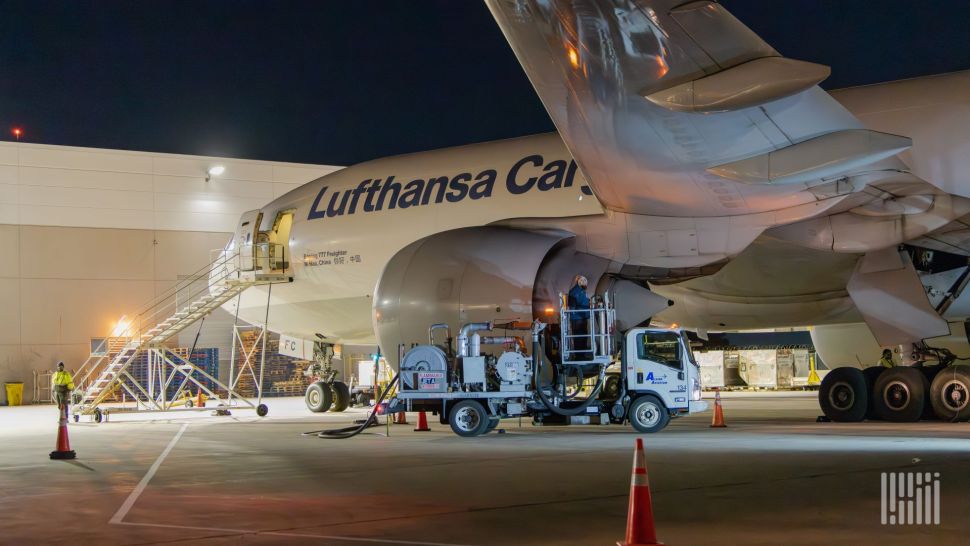
The cargo division of Deutsche Lufthansa AG (FRA: LHA) posted a 26% gain in adjusted operating profit during the second quarter as strong shipping demand in Asia and from AI-driven cloud service providers, boosted revenue despite volatile market conditions and higher fuel costs associated with the U.S.-Iran war.
In recent months, Lufthansa Cargo launched a full-service, cross-border e-commerce logistics subsidiary through the merger of two in-house companies and completed the first phase of a massive modernization project at its main hub at Frankfurt airport.
The growth and new investments led Chief Financial Officer Gregor Schleussner on Tuesday to declare that Lufthansa Cargo would return to the top echelon of cargo airlines by the end of the decade.
“Companies that want to succeed in the long term must be faster, more efficient, and more adaptable than their competitors. This is why we continue to work hard to create the foundation for Lufthansa Cargo’s next phase of development through our Bold Moves strategy. Our goal is clear: by 2030, we aim to return to the ranks of the world’s top three cargo airlines,” he said in a news release issued in conjunction with Group financial results.
Lufthansa Cargo is currently the No. 14 carrier in the world, by traffic volume, according to the International Air Transport Association. It operates 12 Boeing 777 freighter aircraft and is able to market capacity on six 777s operated by AeroLogic, a joint venture between Lufthansa and DHL Express, for a total of 18 widebody freighters under its control. It also manages the belly capacity of sister airlines Lufthansa Airlines, Austrian Airlines, Brussels Airlines, Discover Airlines and SunExpress to transport freight.
FreightWaves reported on Monday that Lufthansa Cargo has quietly abandoned plans to reinstate four Airbus A321 standard-size freighters pulled from European and North Africa regional service in April. The company didn’t provide a reason for souring on the aircraft, but analysts suspect it has to do with operating and market characteristics that make it difficult to fly them at a profit.
Lufthansa Cargo revenue grew 27% during the second quarter to 1 billion euros (equivalent to $1.2 billion). Operating income grew 26% to $1.21 billion, and on an adjusted basis was up 58% to $133.6 million. During the first half, revenue was up 16% and profit margin rose 2.2 points to 10.4%.
Second-quarter demand remained strong, up 3%, despite disruptions and economic uncertainty associated with fighting in the Middle East. Lufthansa benefitted from flight reductions at Middle Eastern competitors such as Emirates and Qatar Airways Cargo and the shift of some ocean freight to air as businesses sought more predictable transport, resulting in a 27% increase in yields, year over year. Fuel surcharges offset fuel expenses and brought in additional revenue, which positively contributed to yields.
The crisis triggered a surge in demand on passenger and freighter routes to Asia. Yields to Asia and on new intra-Asia routes increased by 30%, while yields to the Middle East rose even more. The company also attributed profitability to the increased focus on high-margin industry sectors like pharmaceuticals, semiconductors, automotive, and artificial intelligence.
“The increased need for transportation of server racks indeed has almost become an industry-shaping element. We are allocating and reallocating our network to serve our customers who try and who want to move server racks around the world,” Lufthansa Group CEO Carston Spohr said on a call with analysts. “As you can imagine, for these high-risk and very expensive equipment, logistical costs are almost immeasurable, so this is a very profitable business. You do need freighter aircraft for this business by the sheer size of these racks.”
Robust demand for semi-conductors and AI-related hardware helped air cargo industry volumes grow 7% in June, according to research from Xeneta.
Available cargo capacity expanded by 2%, driven by 6% belly space in passenger aircraft, particularly from the marketing of capacity on ITA Airways. Lufthansa Group acquired a minority stake in the Italian carrier in 2025.
Hub modernization
Part of the premium strategy includes modernizing cargo infrastructure on the ground.
Lufthansa is building a $682 million, 3.5 million square-foot cargo terminal with high bays for efficient pallet storage and automated transport system that will significantly expand cargo handling capacity and efficiency. The initial building, considered the most important phase, spans 860,000 square feet — equivalent to 11 soccer fields.
Lufthansa Cargo boasts the terminal will be the most modern air cargo hub in Europe when completed in 2030.
The new facility features sophisticated warehouse management systems and conveyors to efficiently route goods, a fully automated 131-foot tall high-bay warehouse with nearly 3,000 storage slots for large pallets and an automated pallet warehouse for temperature-sensitive and specialized shipments. The high-bay section alone will enable more than 300 storage and retrieval operations per hour, doubling capacity, Lufthansa said in a news release.
The cargo airline also consolidated the activities of its heyworld GmbH and CB Customs Broker subsidiaries under the newly established brand GlobeCross. The new company combines e-commerce logistics service, including last-mile delivery, with customs clearance expertise to provide businesses with end-to-end transport for small parcel shipments. The strategy goes beyond the traditional airport-to-airport model for an airline so Lufthansa Cargo can capture additional business opportunities in the growing parcel logistics sector.
Overall, Lufthansa Group profits were dragged down by $864 million in extra fuel costs compared to last year. Operating profit fell 56% to $441 million and net income plunged nearly 90% to $141.7 million.
Click here for more FreightWaves/American Shipper stories by Eric Kulisch.
Write to Eric Kulisch at ekulisch@freightwaves.com.
RELATED STORIES:
Is Lufthansa giving up on its Airbus A321 cargo fleet?
Lufthansa Cargo to market capacity on ITA Airways, add Rome hub
Brokerage Compliance Symposium
The day before F3. Every compliance issue you face - fraud exposure, carrier liability, FMCSA rules, cargo theft, insurance gaps - navigated by attorneys and operators defining best practices in a changing industry.
F3 Awards Dinner
The night before F3. FreightTech100 companies honored. FreightTech 25 and Shipper of Choice winners revealed live. Cocktail reception into dinner and live music - 300 industry leaders in one purpose-built room.
F3: Future of Freight Festival
Industry-defining keynotes, rapid-fire technology demos, and industry leaders networking in experiences across Chattanooga - plus the inaugural F3 Awards Dinner featuring the FreightTech and Shipper of Choice reveals.
The day before F3. Every compliance issue you face - fraud exposure, carrier liability, FMCSA rules, cargo theft, insurance gaps - navigated by attorneys and operators defining best practices in a changing industry.
The Signal at Chattanooga Choo Choo • Chattanooga, TN Register NowThe night before F3. FreightTech100 companies honored. FreightTech 25 and Shipper of Choice winners revealed live. Cocktail reception into dinner and live music - 300 industry leaders in one purpose-built room.
The Signal at Chattanooga Choo Choo • Chattanooga, TN Register NowIndustry-defining keynotes, rapid-fire technology demos, and industry leaders networking in experiences across Chattanooga - plus the inaugural F3 Awards Dinner featuring the FreightTech and Shipper of Choice reveals.
The Signal at Chattanooga Choo Choo • Chattanooga, TN Register Now