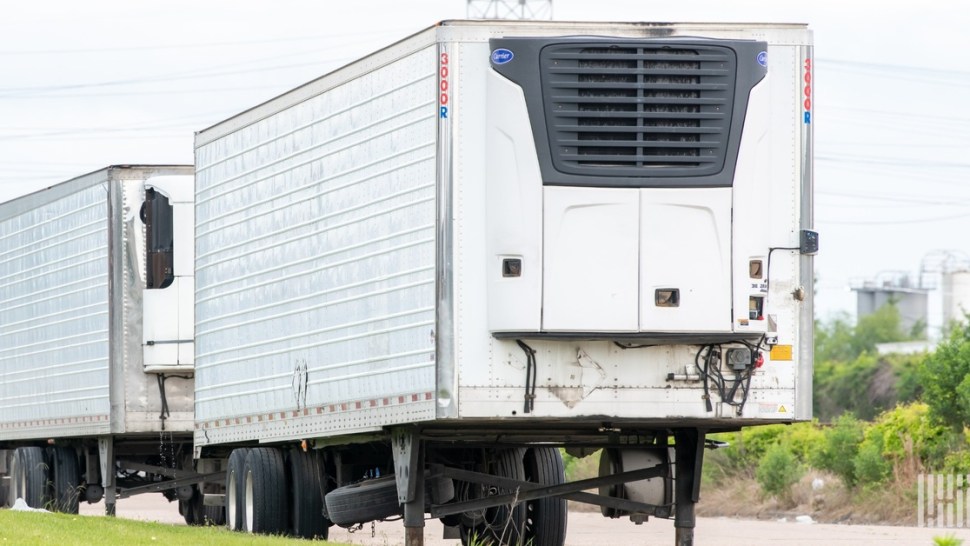

Most shippers, by this point, tend to believe they have visibility into their cold chain. What “visibility” truly covers, though, is often little more than surface-level location data. The gap between knowing where a shipment is and knowing what happened to it along the way is where cold chain programs can come across some of their costliest failures, whether the cargo is a pallet of insulin or a truckload of frozen shrimp.
The industries built around temperature-sensitive freight don’t talk to each other much. Pharmaceutical logistics teams are managing global, multimodal shipments that can pass through dozens of handlers under enforceable federal regulation. Food and beverage teams are managing largely regional freight where a bad outcome typically results in spoilage on a relatively small scale. The various types of cold-chain operations have their differences, but ultimately the failures are similar: unconnected data, alerts that arrive too late or too often to act on, and incidents that occur due to a combination of security and quality control lapses.
We asked specialists at Overhaul (which works across temperature control and cargo security applications in life sciences, food and beverage) to walk through where cold chain programs are exposed without realizing it. Often, it’s the assumptions you take for granted that can cause some of the most devastating issues.
1. Location isn’t the same as condition.
The most common cold chain “visibility” tool is a GPS ping, but location alone is insufficient, particularly when it comes to temperature-sensitive loads.
“GPS tells you where a truck is. It does not tell you whether the product inside still meets the temperature spec,” said Todd Thompson, Director of Enterprise Sales at Overhaul. Thompson works with food and beverage shippers and says that capturing, reporting, and reacting to ambient temperature, product temperatures, shock, and humidity allows for corrective actions to be applied while a shipment is still recoverable. A map pin doesn’t do that.
2. The custody record is unhelpful when it’s scattered.
Most companies aren’t missing chain-of-custody data, but they’re lacking a single place to find it. “Companies are compliant in capturing the data,” Thompson said. “The responsibility to provide this data is understood, but the problem is that the data is scattered in disparate systems and in different formats, therefore delaying responsiveness,” he said.
Pharmaceutical shipments compound the problem. A single drug delivery to a pharmacy can involve roughly 50 different handlers across the supply chain, according to Melita Marks, Cold Chain Market Advisor at Overhaul.
3. More alerts can lead to poorer visibility through fatigue.
Modern sensors can unfortunately generate a lot of noise, and pharma logistics teams are often leaner than they used to be. “They’re getting disjointed information, with too many alerts,” Marks said. That pushes decisions from proactive to reactive. Left unaddressed, that fatigue becomes its own risk.
“Pharma companies need smarter systems to pinpoint what to pay attention to,” Marks said, pointing to risk-scoring, shipment triage, and condition data with live events as the fix rather than simply adding more alerts.
4. Passing at the dock doesn’t mean nothing happened.
A shipment can drift out of range repeatedly in transit and still read clean on arrival because the product temperatures recovered before the receiving process started. Without the adequate temperature history combined with location information, it may be almost impossible to track down when and where a lapse occurred, if you’re even aware at all.
“On frozen, a partial thaw and refreeze on a case of fries does not fail at the dock, it fails in the fryer,” Thompson said. The temperature abuse can surface long after the fact as a shortened shelf life or a store/restaurant claim further down the supply chain.
5. Disruption response is a speed problem, not a lead-time problem.
Large, forecastable events like hurricanes give shippers time to plan around them. The harder cases are the sudden ones, as in a reefer failure or an unplanned closure. In those types of instances, the question isn’t whether to reroute, but how much product is still usable.
“In mature cold chain programs, there have been responses, corrective action decisions, and rerouting if needed, that have happened in minutes,” Thompson said. “More typically you are looking at a few hours from alert to action based on product category,” he said. The constraint, he noted, is rarely the event itself, but instead in how fast and complete the condition data reaches the people who can act on it.
6. Entering a regulated lane is a financial decision before it’s a compliance one.
Carriers who might be eyeing an expansion from general reefer freight into pharma often underestimate what it costs to get there. Reefer trailers need to be temperature-mapped empty and loaded against seasonal extremes, and warehouses need their own seasonal temperature and humidity mapping across every storage zone. Typically, pharma customers require a Technical Service Agreement that spells out quality standards and operational responsibilities, backed by annual audits, on top of standing federal requirements like current Good Manufacturing Practices and 21 CFR Part 11 recordkeeping.
“The real question is not the checklist, it’s the math,” Thompson said. Most of the set-up costs come before the first shipment, while the revenue is normally measured per shipment. So the decision is whether a carrier can win enough pharma volume, at the margin those shipments actually carry, to justify the cost of entry. “The trap is treating it as something you can do partially,” Thompson said.
A carrier can run excellent food distribution and still lack the recordkeeping infrastructure pharma requires, simply because food never demanded it. That gap doesn’t close gradually on a few loads a month.
7. Carrier vetting hasn’t kept pace with fraud.
Freight theft tactics evolve constantly, and high-value, temperature-controlled loads are a frequent target.
“The largest problem is double brokering and chameleon or phoenix carriers,” said Danny Ramon, Director of Security Intelligence and Response at Overhaul. Ramon pointed to practical tells that often get missed, including checking a tractor-trailer for remarking, ghost lettering, taped-over signage, or zip-tied license plates. It’s vital to verify not just who’s picking up a load, but also what physically shows up to do it.
8. A security incident and a quality incident are often the same event.
When a load is tampered with or diverted, the fallout is rarely isolated to one department.
“A security incident, human or malicious, may trigger a quality risk exposure,” Marks said. “Quality ultimately needs to determine if a security or condition issue requires the product to be destroyed.”
In the moment, logistics teams tend to focus on the operational fix while security wants law enforcement engaged. After the fact, security, quality, and logistics all have to reconvene to document what happened and prevent it from recurring. Ownership of that handoff, done poorly, is yet another point of failure. Liability shifts along the way. A pharma manufacturer, for instance, typically carries financial and regulatory responsibility up to the first wholesaler, at which point the risk and the compliance obligations pass to the next party in the chain.
9. Compromised product re-entering the supply chain happens more than shippers assume.
Stricter serialization has made this rarer in well-regulated markets, but it hasn’t made it rare. Marks estimated that 3% to 4% of pharmaceutical product is expired or destroyed due to temperature mishandling somewhere in the supply chain, and that’s before accounting for diverted product that finds its way back into legitimate-looking inventory. Ramon added that the visibility gap, not just black-market demand, is what lets it happen.
“Many shippers find out about the theft when their customer calls to ask when their shipment should arrive, far past any reasonable chance of recovery,” Ramon said.
10. Condition monitoring isn’t only a pharma-and-food problem.
Categories that don’t seem temperature-sensitive at first glance often are. Humidity affects tobacco. Temperature and shock both affect wine and spirits, given how fragile the packaging is.
“There is practical applicability of condition monitoring for these industries,” Thompson said, even though security posture there is usually driven by risk tolerance rather than regulation. The stakes are still real, regardless. These categories are heavily taxed, so a loss carries the product’s value plus the tax liability on top of it.
Chemical shipments carry their own version of the same blind spot. Certain composite materials must stay within tight temperature bands to avoid premature curing or shortened shelf life, without any of the human-safety testing that governs pharma.
Closing the gaps
None of these problems are solved by simply adding another sensor or another alert. What they share is a data problem. Information about a shipment’s location, condition, custody, and security status live in separate systems, held by separate parties, checked at separate times. When something goes wrong, someone has to reconstruct it after the fact.
The starting point doesn’t have to be complicated. Thompson’s advice for food and beverage teams is to pick one shipment that went fine and pull the full custody record on it, start to finish. Who did you have to call, email, or text? How long did you wait for each answer? Did what came back have the detail you needed, and can you verify all of it? The results will identify your gaps, on a day and a shipment with nothing at stake.
On the pharma side, Marks points to a similar shift already underway. Pharma manufacturers, along with their carriers, should be moving away from manual, labor-intensive temperature review toward configurable alarm profiles that match a drug’s own stability data so that minor, expected variation doesn’t consume the same attention as a genuine excursion.
That’s the operating premise behind Overhaul’s platform, in which logistics, quality, and security data for a shipment come together. We’ve covered Overhaul’s name as it pertains to cargo theft coverage, but their team can help your quality and logistics team with a lot more than that. Learn more at overhaul.com.
Brokerage Compliance Symposium
The day before F3. Every compliance issue you face - fraud exposure, carrier liability, FMCSA rules, cargo theft, insurance gaps - navigated by attorneys and operators defining best practices in a changing industry.
F3 Awards Dinner
The night before F3. FreightTech100 companies honored. FreightTech 25 and Shipper of Choice winners revealed live. Cocktail reception into dinner and live music - 300 industry leaders in one purpose-built room.
F3: Future of Freight Festival
Industry-defining keynotes, rapid-fire technology demos, and industry leaders networking in experiences across Chattanooga - plus the inaugural F3 Awards Dinner featuring the FreightTech and Shipper of Choice reveals.
The day before F3. Every compliance issue you face - fraud exposure, carrier liability, FMCSA rules, cargo theft, insurance gaps - navigated by attorneys and operators defining best practices in a changing industry.
The Signal at Chattanooga Choo Choo • Chattanooga, TN Register NowThe night before F3. FreightTech100 companies honored. FreightTech 25 and Shipper of Choice winners revealed live. Cocktail reception into dinner and live music - 300 industry leaders in one purpose-built room.
The Signal at Chattanooga Choo Choo • Chattanooga, TN Register NowIndustry-defining keynotes, rapid-fire technology demos, and industry leaders networking in experiences across Chattanooga - plus the inaugural F3 Awards Dinner featuring the FreightTech and Shipper of Choice reveals.
The Signal at Chattanooga Choo Choo • Chattanooga, TN Register Now