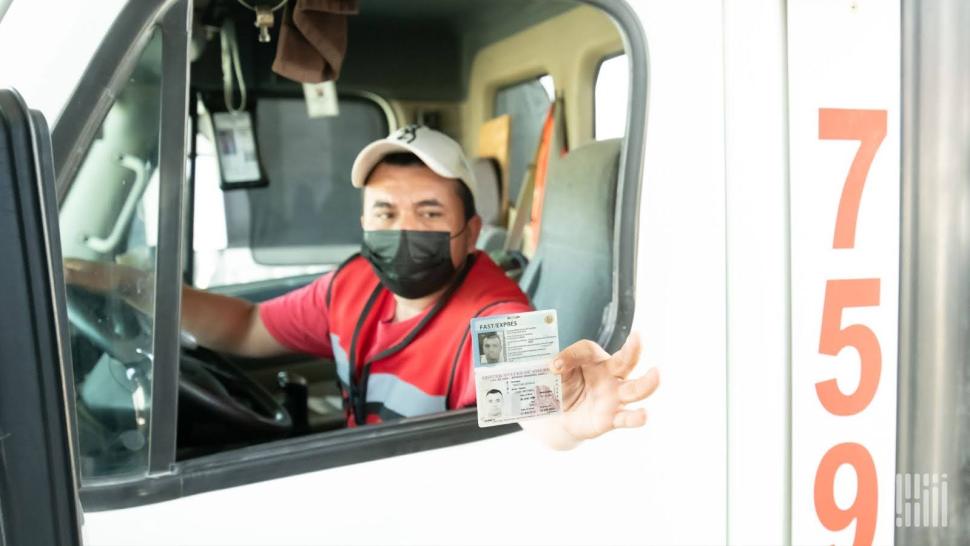
The Chinese American Truckers Association filed a federal lawsuit this week challenging the enforcement actions that have left thousands of California commercial drivers in licensing limbo since late September.
The complaint, filed January 7 in the U.S. District Court for the Central District of California, names both federal and state officials as defendants. On the federal side, FMCSA Administrator Derek D. Barrs and the agency itself are in the crosshairs. California DMV Director Steve Gordon is also named for his role in implementing what drivers are calling a bureaucratic nightmare.
The Backstory
This all traces back to September 26, 2025, when FMCSA issued what it called a “preliminary determination” ordering California to immediately pause all processing of non-domiciled commercial learner’s permits and commercial driver’s licenses. The agency cited deficiencies uncovered during its 2025 Annual Program Review.
The order required California to identify unexpired credentials issued in violation of federal standards, conduct an internal audit, void noncompliant licenses, and reissue corrected credentials that meet federal standards. The FMCSA gave the state 30 days to respond and said the resumption of normal processing would occur on a mutually agreed schedule.
That was almost four months ago. The pause remains in effect with no end date in sight.
What FMCSA Did Next
On November 13, 2025, the FMCSA doubled down with a “Conditional Determination” that expanded the scope of violations it considered. The agency took the position that any post-pause licensing activity by California constituted noncompliance with the corrective action directive.
Here’s where it gets interesting. According to the complaint, the FMCSA criticized California for processing certain license upgrades after the pause began, specifically citing an incident in which removing an intrastate restriction from a driver’s license allegedly led to a fatal crash. The agency’s position was that if California had fully complied with the pause, the driver would not have had an interstate CDL, and the crash “may have been avoided.”
That’s FMCSA using a single incident to justify the broadest possible interpretation of what the pause should cover.
The agency also warned that California’s failure to complete corrective actions, or any “undue delay,” would result in a Final Determination of substantial noncompliance. That determination would trigger withholding of federal highway funds and potential decertification of California’s entire CDL program.
California’s Response Created Two Problems
The DMV implemented the pause as directed, but the complaint alleges the state agency went further in ways that are now stranding qualified drivers.
The first problem involves renewal and extension processing. Drivers with expiring non-domiciled CDLs cannot renew, replace, or extend their licenses, even when they have current eligibility documentation. The DMV has adopted a blanket refusal policy, creating what the lawsuit calls a rolling “expiration cliff” in which more drivers lose the ability to work each passing week.
The second problem is worse. Starting in November 2025, the DMV began issuing mass cancellation notices to drivers whose CDL expiration dates do not align perfectly with their Employment Authorization Document expiration dates. The complaint details how these date mismatches are often the DMV’s own administrative errors from years of issuing licenses with validity periods that did not match work authorization documentation.
The DMV is now canceling licenses based on its own past mistakes and giving drivers no meaningful path to fix the problem.
Real Drivers, Real Harm
The lawsuit includes declarations from multiple CATA members across Southern California counties showing how this plays out in practice.
One Los Angeles County driver had his vehicle stolen in December 2025, resulting in the loss of his physical CDL, EAD, Social Security card, and bank cards. His license remains valid through August 2029 and his work authorization runs through December 2029. Because of the categorical pause, he cannot obtain a replacement license. The man faces a total loss of livelihood over a theft he was not responsible for.
A San Bernardino County driver whose CDL was scheduled to expire January 2, 2026, received a cancellation notice in November 202,5, giving him 60 days. The DMV later announced a 60-day extension, pushing cancellations to March 6, 2026, but provided no mechanism for renewal before expiration. His CDL expired on January 2 and became invalid. Without a court order, he has permanently lost his livelihood.
Another driver from Orange County presents an even more absurd situation. His CDL was set to expire January 20, 2026. He holds work authorization valid through January 2030. He received an official renewal notice in October 2025, followed by a cancellation notice in November stating that his license would be cancelled by January 5, 2026. The DMV’s December extension announcement purportedly pushed cancellations to March 6, but the agency provided no administrative mechanism to actually renew his license. His CDL will expire on January 20, despite the supposed extension.
A Riverside County driver holds a valid CDL expiring October 2030 and work authorization through September 2029. He received a cancellation notice in November 2025 alleging his CDL expiration date exceeded his authorized stay period. The problem? He presented the exact EAD the DMV required at the time of issuance. The date discrepancy was created entirely by DMV systems and processes, not by any misconduct on his part.
The complaint includes similar stories from drivers in Los Angeles, San Bernardino, and Riverside counties, each demonstrating how bureaucratic errors are being used to strip qualified drivers of their credentials.
What The Association Actually Wants
This is not a lawsuit seeking to blow up federal oversight of state CDL programs. The Chinese American Truckers Association explicitly states that it does not challenge the FMCSA’s general oversight authority and is not seeking the broad resumption of non-domiciled issuance during corrective actions.
What they want is narrow and targeted. The association seeks what it calls a “safe lane,” allowing California to accept and process individualized renewal, replacement, and extension requests from otherwise-qualified drivers who can demonstrate current eligibility and valid lawful presence documentation.
Separately, they seek relief for drivers facing date-certain cancellations due to alleged administrative mismatches. These drivers have valid credentials and valid work authorization. The only problem is a date discrepancy created by DMV systems, not driver fraud or misconduct.
The requested relief would not permit any driver to operate beyond verified lawful presence documentation validity. It would not alter training, testing, or safety qualification requirements. It would simply allow individual processing for qualified drivers during the indefinite enforcement pause.
The Legal Claims
The complaint asserts four causes of action.
The first three target FMCSA and Administrator Barrs under the Administrative Procedure Act. The association argues the agency exceeded its statutory authority by expanding the concept of a “pause” beyond what federal law requires, using threatened sanctions to coerce California into the broadest possible interpretation that prevents even narrowly tailored individual processing.
The fourth claim targets the DMV Director, Gordon, under the Fourteenth Amendment’s Due Process Clause. The association argues that the categorical refusal to process renewal or extension requests and the mismatch-driven cancellation notices deprive drivers of protected interests without constitutionally adequate notice or an opportunity to be heard.
This lawsuit represents the first organized legal pushback against enforcement actions that have affected an unknown number of California commercial drivers since September. The association’s membership continues to grow as additional affected drivers learn about the case.
FMCSA has positioned its enforcement as necessary to address deficiencies in California’s non-domiciled licensing program. The agency’s conditional determination made clear that substantial noncompliance findings could result in withholding federal highway funds.
But the drivers caught in the middle are not the ones who designed California’s licensing systems or made administrative decisions about credential validity periods. They are working drivers who followed the rules as they existed and now find themselves unable to work through no fault of their own.
The case has been assigned to the Central District of California. No hearing dates have been set as of publication.
Brokerage Compliance Symposium
The day before F3. Every compliance issue you face - fraud exposure, carrier liability, FMCSA rules, cargo theft, insurance gaps - navigated by attorneys and operators defining best practices in a changing industry.
F3 Awards Dinner
The night before F3. FreightTech100 companies honored. FreightTech 25 and Shipper of Choice winners revealed live. Cocktail reception into dinner and live music - 300 industry leaders in one purpose-built room.
F3: Future of Freight Festival
Industry-defining keynotes, rapid-fire technology demos, and industry leaders networking in experiences across Chattanooga - plus the inaugural F3 Awards Dinner featuring the FreightTech and Shipper of Choice reveals.
The day before F3. Every compliance issue you face - fraud exposure, carrier liability, FMCSA rules, cargo theft, insurance gaps - navigated by attorneys and operators defining best practices in a changing industry.
The Signal at Chattanooga Choo Choo • Chattanooga, TN Register NowThe night before F3. FreightTech100 companies honored. FreightTech 25 and Shipper of Choice winners revealed live. Cocktail reception into dinner and live music - 300 industry leaders in one purpose-built room.
The Signal at Chattanooga Choo Choo • Chattanooga, TN Register NowIndustry-defining keynotes, rapid-fire technology demos, and industry leaders networking in experiences across Chattanooga - plus the inaugural F3 Awards Dinner featuring the FreightTech and Shipper of Choice reveals.
The Signal at Chattanooga Choo Choo • Chattanooga, TN Register Now