




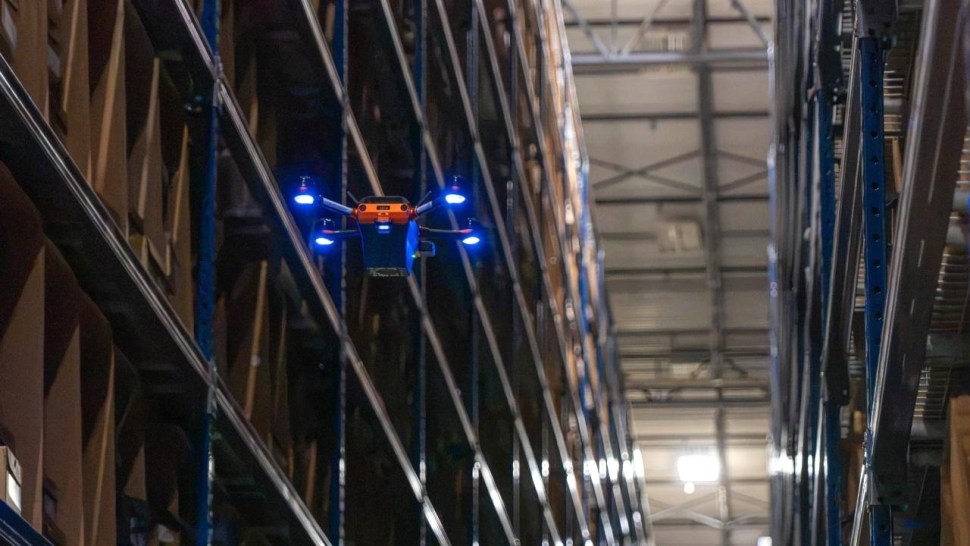
Sportswear company ASICS is recovering misplaced products nearly 60% faster at its Byhalia, Mississippi, distribution center since it began conducting nightly flights of high-risk storage areas with autonomous inventory drones.
The drones, manufactured by Corvus Robotics, have increased counting frequency six-fold compared to the normal practice of counting inventory twice a year. The data collected each night is aggregated and now analyzed on a monthly basis, allowing orders to ship on time and at full price. The new system has saved about 200 hours of monthly counting labor, which ASICS has redirected into inventory research and exception management, the companies said Tuesday.
The ASICS facility holds close to 3 million units — 2.3 million pairs of footwear and 700,000 pieces of apparel and accessories — across roughly 44,000 stock keeping units, all managed in a Manhattan Associates warehouse management system. It fills e-commerce orders and ships to wholesale accounts, along with ASICS full price and outlet retail stores.
Corvus drones provide surveillance in the areas that tend to produce the most discrepancies — the singles area, where returned and single pair products get stored and picked, and case reserve. Both were counted twice a year under ASICS cycle count policy.
In one three-month stretch the drones surfaced 26 misplaced cases holding more than 200 pairs of shoes, products that would otherwise have stayed unavailable to customers until the next scheduled physical count.
“If a unit went missing, we might not find it for six months,” said Kyle Koestler, senior director of distribution and transportation at ASICS America Corp., in a news release. “That could be the last pair in the building for an order we’ve already taken, and then the customer gets a cancellation. With Corvus One, we’re cycle counting on a monthly basis so we can surface any errors sooner and ensure customer orders are delivered on time.”
The inventory control team is putting the 200 hours in time savings towards inventory reconciliation in the packing operation, root cause research and special projects for the wholesale business.
In both areas the drone does two jobs on the same pass, reading every Universal Product Code and counting the boxes in each location. In the singles area, returns mean the same SKU can show up several times in one location, so a UPC read on its own can get attached to the wrong box. Counting the boxes gives ASICS a physical total to check the scans against. If the drone counts 10 boxes, it should come back with 10 UPC reads, according to Corvus.
ASICS schedules seven flights a night, starting around 7 p.m. The aisles the drones fly in are less than six feet wide. The Corvus One drone flies using onboard computer vision and spatial reasoning, with no additional infrastructure anywhere in the building. Each morning an inventory associate reviews each flight and resolves most discrepancies from a desk, working off the video and images the drones capture of every location.
The accuracy provides a revenue benefit too. ASICS publishes availability feeds to online marketplaces. Before inventory management by drone the team held back 12 to 15 units out of every 100 to make sure it could deliver on what it promised. Product at the bottom of the lot never shows up on the marketplace, leaving ASICS having to liquidate the goods at a steep discount. ASICS now publishes the full feed and sells that product at full price, according to the announcement.
ASICS says using drones to count inventory also saves energy because employees are operating lift equipment through the aisles less frequently.
Corvus is based in Mountain View, California. Other companies offering warehouse inventory drones include Gather AI and Verity.
Click here for more FreightWaves/American Shipper stories by Eric Kulisch.
Write to Eric Kulisch at ekulisch@freightwaves.com.
RELATED STORIES:
Wing to invest $125M in drone manufacturing plant
Walmart to take drone delivery nationwide as Zipline raises $1.5B
