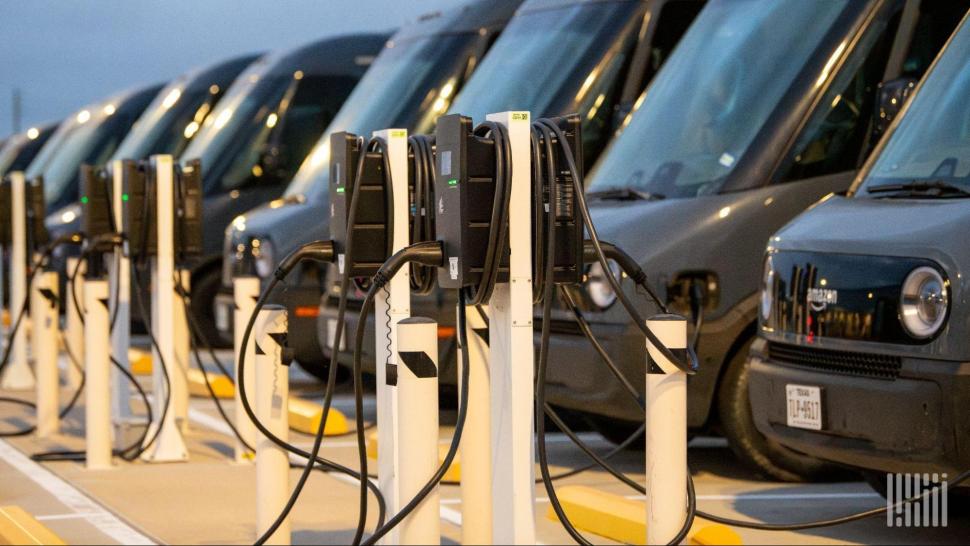
The freight industry spent decades perfecting the art and operational science of diesel fueling. Routes were mapped, fuel stops were timed, and fuel desks tracked regional pump prices to shave fractions of a cent per gallon. It was simple because the physics were simple: fill the tank, go.
Electric fleets don’t get that simplicity. Charging windows, demand charges, time-of-use pricing, battery degradation, grid constraints, and route variability: the variables multiply fast. For a fleet running 30 or more electric trucks, the old approach breaks down completely.
BetterFleet CEO Dan Hilson told FreightWaves that’s the gap his company is built to close.
“People tried a lot of different things,” Hilson said. “They’d say, “We’ll chuck those chargers there and this software there.” And certainly now it’s consolidating into: we have to step back and treat this as an overarching project that has an enterprise software system across it.”
Energy Cost Savings Could Be Higher
The obvious win in electric fleet management is energy cost. The path to savings, though, is less obvious than simply charging overnight.
In California, time-of-use pricing creates a penalty window from 4 p.m. to 9 p.m., the exact hours many truck drivers return to the depot. A driver who plugs in at shift’s end out of habit may lock in the highest electricity prices of the day.
“The driver comes back and he just knows to plug in when he gets back to the depot,” said Hilson. “Well, hey, you’re probably plugging in right during peak pricing for that electricity. So the new way of doing things is trying to think about your energy use. Maybe he plugs that in, but maybe the charger is set to actually begin charging after the rates go down.”
Demand charges compound the problem. Utilities set a power threshold, and if a fleet’s instantaneous draw spikes past it even briefly, the consequences are severe.
“In some energy markets, if you go over that line for one minute of a year, your entire energy bill resets for that year,” Hilson said.
BetterFleet’s platform manages fleets against both constraints simultaneously, throttling charging to stay below demand thresholds while scheduling the bulk of energy draw during off-peak windows. The result, Hilson said, is “enormous savings” even for customers running multiple charger brands across a single site.
The Case Against the Megawatt Charger
Part of what BetterFleet is selling is a different mental model, one that pushes back against the industry fixation on megawatt-level charging speeds.
“I don’t know that I’m completely sold on MW charging for back to base charging scenarios,” Hilson said. “If you’re saying we’re just going to run it out at a MW, but we need a second one just in case, that’s two megawatts if they ever run at the same time. And the demand charges are a big part of the cost.”
The alternative: a dense network of slower chargers managed by software. Fifteen 7-kilowatt chargers instead of one megawatt unit gives a fleet redundancy. If a few go offline, the operation keeps moving. Staggered charging means no single moment of peak demand.
The analogy Hilson draws is closer to how consumers already think about their phones.
“Anyone who owns an EV knows it’s just a fundamentally different paradigm,” Hilson said. “I can slow charge overnight at home. I don’t even need a 7-kilowatt charger. For my needs, it’s enough to top up every night.”
Extending that logic to logistics, knowing a truck’s route, its battery state, the weather forecast, and tomorrow’s grid prices, is what BetterFleet’s machine learning is designed to handle.
Electric Fleet Charging and Battery Longevity
Energy pricing is only part of what the platform tracks. BetterFleet also monitors battery degradation at the vehicle level, flagging units aging faster than expected and identifying when maintenance is, and isn’t, warranted.
“With EVs, you want to have less maintenance costs,” Hilson said. “That means you need to be saying when not to maintain and not just bringing it in. How do we save money by not maintaining things?”
Hilson frames the battery not just as a power source but as a core fleet asset, one that, with proper management, can deliver two or more extra years of useful life. The platform monitors charger health as well, dispatching maintenance teams only when predictive models indicate a likely failure rather than on a fixed schedule.
“When you’re looking at a very large program, these small numbers become very big,” Hilson said. “Being able to optimize all of those costs is really where the industry is at.”
What’s Next: Priority Power, Microgrids, and Resilience
BetterFleet recently launched a priority charging feature that lets fleet operators designate specific vehicles for preferential power allocation when they plug in, protecting high-priority routes on days when grid capacity or charger availability is constrained.
“Those five vehicles specifically, when they plug in, give them more juice,” Hilson said. “An operator can go in and say, “Those two vehicles today, whatever is happening, make sure they get the power.””
Other recent feature releases include deeper integration with local battery storage and microgrid systems, expanded battery safety and fire system integration, and shared charging platforms that let fleet operators monetize underutilized infrastructure.
Hilson also flagged resilience planning as a priority, building automated response protocols for scenarios where chargers fail or sites go offline. “The industry is not very mature in terms of standard operating procedures for disaster recovery in fleet charging.”
In addition there is more thought now to using EV as part of resilience planning for petrol and diesel supply shortages. Australia, he noted, is already providing a real-world stress test.
“The fuel crisis is really hitting hard,” Hilson said. “Electric vehicles in Australia are suddenly really booming because of that dynamic. If there’s a problem, how do you keep the fleet running?”
The broader goal, Hilson said, is getting fleets comfortable enough with EV management to push vehicle utilization higher, completing more routes per day with fewer trucks by trusting the software to tell drivers what’s possible in all situations both standard days and when there is a problem..
“At the moment, it’s still a pretty cautious approach, making sure the vehicle will get back,” he said. “But if you can really manage this to do more, and therefore get more out of every vehicle, you don’t need another vehicle potentially. That’s a big part of what we’re doing.”
Brokerage Compliance Symposium
The day before F3. Every compliance issue you face - fraud exposure, carrier liability, FMCSA rules, cargo theft, insurance gaps - navigated by attorneys and operators defining best practices in a changing industry.
F3 Awards Dinner
The night before F3. FreightTech100 companies honored. FreightTech 25 and Shipper of Choice winners revealed live. Cocktail reception into dinner and live music - 300 industry leaders in one purpose-built room.
F3: Future of Freight Festival
Industry-defining keynotes, rapid-fire technology demos, and industry leaders networking in experiences across Chattanooga - plus the inaugural F3 Awards Dinner featuring the FreightTech and Shipper of Choice reveals.
The day before F3. Every compliance issue you face - fraud exposure, carrier liability, FMCSA rules, cargo theft, insurance gaps - navigated by attorneys and operators defining best practices in a changing industry.
The Signal at Chattanooga Choo Choo • Chattanooga, TN Register NowThe night before F3. FreightTech100 companies honored. FreightTech 25 and Shipper of Choice winners revealed live. Cocktail reception into dinner and live music - 300 industry leaders in one purpose-built room.
The Signal at Chattanooga Choo Choo • Chattanooga, TN Register NowIndustry-defining keynotes, rapid-fire technology demos, and industry leaders networking in experiences across Chattanooga - plus the inaugural F3 Awards Dinner featuring the FreightTech and Shipper of Choice reveals.
The Signal at Chattanooga Choo Choo • Chattanooga, TN Register Now