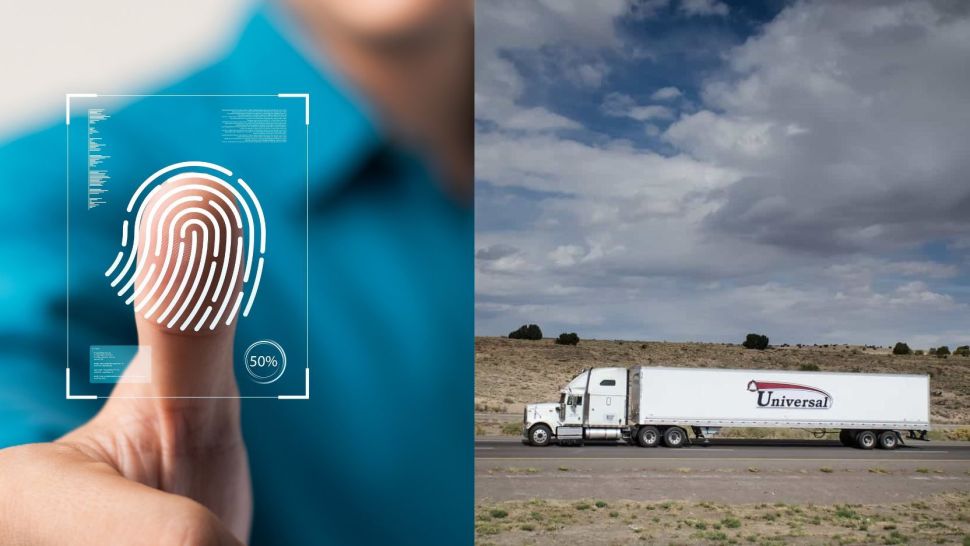
A lawsuit filed in 2021 by an Illinois truck driver for a unit of Universal Logistics over the strict Illinois biometric law has been granted class status.
The biometric law in the Land of Lincoln has long been considered the most stringent in the country and has been called “a threat to business.”
It has been the focus of other trucking-related litigation, including a case against in-cab video company Lytx that resulted in payouts to thousands of drivers of between about $650 and $850 per person.
Brandon Willis was a driver for Universal Intermodal Services, which is a subsidiary of publicly-traded Universal Logistics (NASDAQ: ULH). He filed his lawsuit in 2021 in U.S. Federal District Court for the Northern District of Illinois on behalf of himself and other drivers over the company’s use of a fingerprint scanner at the company’s Harvey, Illinois facility.
Universal Intermodal is the lead defendant. But the list of defendants was widened from the initial lawsuit in an amended August 2023 complaint to include HR-1 LLC (an arm of the private business of Matthew Moroun, who owns about 70% of Universal), Universal Management Services, Inc. and Data System Services, an outside company that provided biometric services to Universal.
At the core of the dispute and lawsuit was whether Universal was violating the provisions of Illinois’ Biometric Privacy Act (BIPA), which was passed in 2008 and amended in 2024.
Time in question goes back more than 10 years
The more immediate question ruled on by Judge Elaine E. Bucklo was whether the Willis lawsuit could become a class action, taking in not just Universal employees but other workers doing business with Universal who “clocked in” to the company’s system between March 30, 2016 through the present.
Judge Bucklo’s decision on the class status only tangentially touched on the issues raised in Willis’ lawsuit.
However, she does recap some of the basics of the lawsuit and the alleged violation of BIPA.
BIPA, according to Judge Bucklo, requires that whatever entity is gathering biometric information must inform that person whose information is collected in writing, and receive a written release regarding collection and retention of the biometric data.
The Willis lawsuit alleges that the defendants in the case “took actions that directly violated the BIPA,” according to Judge Bucklo. Some of the other defendants are vicariously liable “for the BIPA violations of others, and some may be both.”
In the amended lawsuit, Willis said the defendants “directed, authorized, and coordinated the capture and collection of the fingerprints of workers and other persons at the Illinois Facilities by requiring the workers and other persons to use Biometric Scanners to clock in and clock out each day.” They did so, the lawsuit says, “without the required consent of the persons being scanned.”
Just employees, or others
The key question Judge Bucklo decided was the scope of the class action and whether it could include just Universal employees or any persons who had their fingerprints scanned where the company operated.
By granting the wider definition of the class, Judge Bucklo brought in a group of people who will be more than 50% of the now larger number of plaintiffs. As she noted in her decision, “most” of the workers who had their fingerprints scanned worked either for a company called LINC–a Universal Logistics subsidiary that was not named as a defendant–or a third-party staffing agency.
The extension of the class to non-Universal employees, Judge Bucklo wrote, is because “plaintiff is suing Intermodal not because Intermodal was his employer but because Intermodal is the entity that allegedly collected stores, and/or transmitted his biometrics without complying with BIPA’s procedural safeguards.”
That would be the basis for expanding the class to include non-Intermodal employees, which Judge Bucklo ultimately did.
Another Illinois case involving trucking and BIPA, brought in late 2024 by driver Floyd Eskridge who sought a class action against HMD Trucking, was settled out of court late last year. That case also was in the Northern District.
More articles by John Kingston
Teamsters claim victory over Amazon at NLRB, next step likely more challenging
Latest move by FMCSA suggests Motus rollout woes are continuing
After a five-year wait, C.H. Robinson makes a broker acquisition
Brokerage Compliance Symposium
The day before F3. Every compliance issue you face - fraud exposure, carrier liability, FMCSA rules, cargo theft, insurance gaps - navigated by attorneys and operators defining best practices in a changing industry.
F3 Awards Dinner
The night before F3. FreightTech100 companies honored. FreightTech 25 and Shipper of Choice winners revealed live. Cocktail reception into dinner and live music - 300 industry leaders in one purpose-built room.
F3: Future of Freight Festival
Industry-defining keynotes, rapid-fire technology demos, and industry leaders networking in experiences across Chattanooga - plus the inaugural F3 Awards Dinner featuring the FreightTech and Shipper of Choice reveals.
The day before F3. Every compliance issue you face - fraud exposure, carrier liability, FMCSA rules, cargo theft, insurance gaps - navigated by attorneys and operators defining best practices in a changing industry.
The Signal at Chattanooga Choo Choo • Chattanooga, TN Register NowThe night before F3. FreightTech100 companies honored. FreightTech 25 and Shipper of Choice winners revealed live. Cocktail reception into dinner and live music - 300 industry leaders in one purpose-built room.
The Signal at Chattanooga Choo Choo • Chattanooga, TN Register NowIndustry-defining keynotes, rapid-fire technology demos, and industry leaders networking in experiences across Chattanooga - plus the inaugural F3 Awards Dinner featuring the FreightTech and Shipper of Choice reveals.
The Signal at Chattanooga Choo Choo • Chattanooga, TN Register Now