





The views expressed here are solely those of the author and do not necessarily represent the views of FreightWaves or its affiliates.
The number of bytes of data generated per day is in the quintillions. Recording more video via Zoom or Skype, connecting more machines, household appliances – and perhaps autonomous vehicles as well – via the Internet of Things (IoT) is sure to increase the daily rate exponentially.
Gathering data is one thing, moving it within an ever-growing global community of users is quite another. The emerging vision, or aspiration, in supply chain management is data-enabled decision-making along the supply chain assisted by artificial intelligence (AI) and powered by this veritable avalanche of data.
This is all well and good. But just like shared access to the great outdoors required great expanses of highways, data movement requires virtual highways. Of course, just as highways congest so can virtual highways. Will fifth-generation digital cellular (5G) networks provide the access and speed of transfer necessary to facilitate IoT and real-time tracking of just about everything? This multi-year implementation process is now underway.
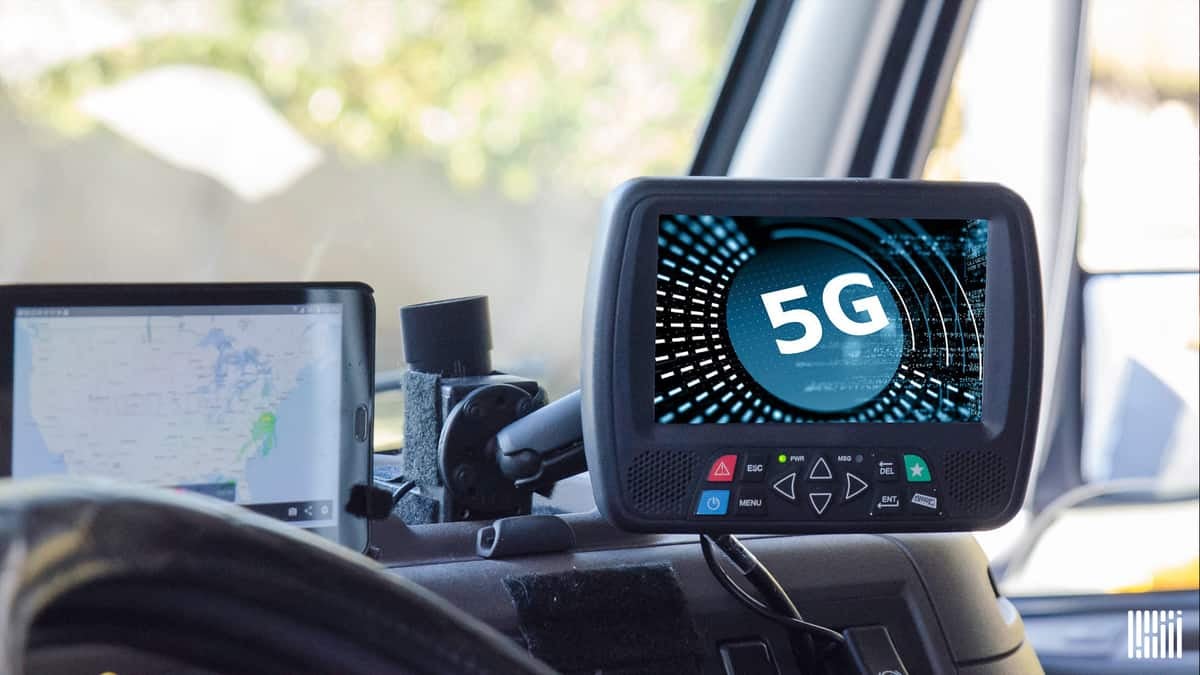
(Photo: Jim Allen/FreightWaves)
Legacy systems that use 4G are not compatible with 5G. This means that companies will have to pay-to-play by investing in brand-new 5G infrastructure. Both 4G and 5G rely on networks of cell towers. The problem is that 5G needs more of them since the signals, though much faster, have a shorter range to and from the towers. Hence, the need for more towers in a viable 5G network.
It is perhaps unfortunate that information technology changes so quickly. After all, 4G’s prevalence is less than a decade old and already 5G is being hyped to such a degree that calls for the former to be replaced are getting louder. Why the rush? IoT is being tailored for 5G and it is likely that the 5G virtual highway will provide the necessary bandwidth. The Federal Communications Commission (FCC) has been active in creating incentives for the private sector to invest in 5G. Two examples include less regulatory impediments for those companies investing in 5G and less stringent rate regulations for those offering it to their customers.
(Photo: Jim Allen/FreightWaves)
Experts calculate an average speed of 50 megabits per second (mbps) for 4G. This has made it easy for smartphone users to search the internet without interminable wait times. This average is akin to measuring speed along a roadway during normal traffic. Maximum 4G speed is about 100 mbps; but that is like driving on a freeway alone at night. 5G promoters are promising top speeds of 10 gigabits per second (gbps) which is 100 times faster than 4G. This, of course, is not an average speed and it is hard to estimate an accurate one at this point because 5G is not widely available and it certainly is not servicing a ubiquitous IoT community as yet.
Except for rudimentary things, technology cannot replace human decision-making. This is especially true at the strategic level. The onus to take responsibility for errors and misjudgments will still hang over managers. Any mistake sent at 4G or 5G speed is still a mistake. Building vendor relationships and customer service will be just as time-consuming in a 5G world. After all, 5G is just a technology that moves data. Turning that data into information – and information into knowledge – cannot be handled by computer technology alone.
Click here to see other commentaries by Darren Prokop on American Shipper and FreightWaves.
Brokerage Compliance Symposium
The day before F3. Every compliance issue you face - fraud exposure, carrier liability, FMCSA rules, cargo theft, insurance gaps - navigated by attorneys and operators defining best practices in a changing industry.
F3 Awards Dinner
The night before F3. FreightTech100 companies honored. FreightTech 25 and Shipper of Choice winners revealed live. Cocktail reception into dinner and live music - 300 industry leaders in one purpose-built room.
F3: Future of Freight Festival
Industry-defining keynotes, rapid-fire technology demos, and industry leaders networking in experiences across Chattanooga - plus the inaugural F3 Awards Dinner featuring the FreightTech and Shipper of Choice reveals.
The day before F3. Every compliance issue you face - fraud exposure, carrier liability, FMCSA rules, cargo theft, insurance gaps - navigated by attorneys and operators defining best practices in a changing industry.
The Signal at Chattanooga Choo Choo • Chattanooga, TN Register NowThe night before F3. FreightTech100 companies honored. FreightTech 25 and Shipper of Choice winners revealed live. Cocktail reception into dinner and live music - 300 industry leaders in one purpose-built room.
The Signal at Chattanooga Choo Choo • Chattanooga, TN Register NowIndustry-defining keynotes, rapid-fire technology demos, and industry leaders networking in experiences across Chattanooga - plus the inaugural F3 Awards Dinner featuring the FreightTech and Shipper of Choice reveals.
The Signal at Chattanooga Choo Choo • Chattanooga, TN Register Now