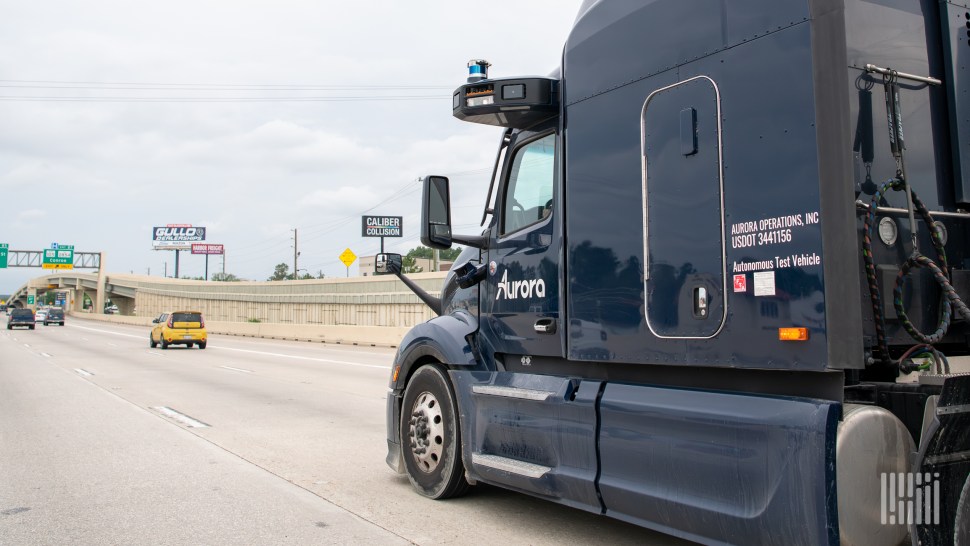
A bill moving through the House of Representatives right now would establish the first federal framework for putting fully autonomous heavy-duty trucks on public roads. The SELF DRIVE Act of 2026 — formally H.R. 7390, introduced February 5 by Rep. Bob Latta of Ohio — is being framed by its supporters as a necessary step to keep the United States competitive in the global autonomous vehicle race and to clear the regulatory uncertainty that has kept autonomous trucking in a perpetual testing phase. The bill would allow autonomous truck manufacturers to run limited commercial freight operations while under testing permits, preempt a patchwork of conflicting state regulations with a single federal framework, and direct the Department of Transportation to establish new safety standards for vehicles equipped with automated driving systems.
On paper, that sounds like progress. In practice, the nation’s largest trade association representing small-business truckers and owner-operators read that bill and said no — clearly, specifically, and in writing to the House Energy and Commerce Committee on March 9.
OOIDA’s letter, signed by President and CEO Todd Spencer, raises objections that go well beyond the familiar debate about automation and job loss. The concerns OOIDA puts on the table are about safety standards, cybersecurity, regulatory transparency, and a pattern in federal rulemaking that this industry has already lived through once — and paid for.
What the Bill Actually Does
Before getting to the objections, it is worth understanding what H.R. 7390 actually proposes, because the framing matters.
The SELF DRIVE Act — an acronym for Safely Ensuring Lives Future Deployment and Research in Vehicle Evolution — is the third time this legislation has been introduced. Earlier versions came in 2017 and 2021. Both failed to become law, partly because they deliberately excluded heavy trucks to avoid labor friction. This version includes them.
The bill expands NHTSA’s authority over vehicles with automated driving systems and directs the development of new federal motor vehicle safety standards for those vehicles. It would create a National Automated Vehicle Safety Data Repository to collect crash data from autonomous vehicle manufacturers. It would allow autonomous trucks to carry freight commercially during the testing and evaluation phase — meaning these vehicles would no longer be restricted to closed tracks or non-revenue operations while their safety records are being built. And it would preempt state laws that restrict or prohibit autonomous vehicles, creating a single federal standard that overrides the patchwork of rules that currently exists across the country.
The bill is bipartisan. It is backed by technology and automotive industry interests with significant resources behind the push for federal preemption. It is currently in committee and could be folded into the broader surface transportation reauthorization Congress is working on this year — which would give it a significant vehicle for passage without a standalone vote.
For small carriers, understanding what this bill does and does not require is the starting point for evaluating whether OOIDA’s concerns are warranted.
The Self-Certification Problem
The central objection in OOIDA’s letter is not that autonomous trucks should never exist. It is that H.R. 7390 would allow them to operate on public roads based on what the companies developing them say about their own safety — without any requirement for independent verification before deployment.
The bill requires manufacturers to develop a “safety case” — a document describing how the vehicle operates safely. But there is no requirement that the federal government review and approve that safety case before the truck rolls onto a public highway. The safety case does not have to be submitted to the Department of Transportation before deployment. It only needs to be submitted upon request. As OOIDA frames it, this is self-certification — the manufacturer asserts the vehicle is safe, and the public has no mechanism to independently verify that assertion until after something goes wrong.
OOIDA draws a direct comparison to the Electronic Logging Device mandate to make this point, and it is a comparison the trucking industry should take seriously because it is not abstract. When FMCSA established the ELD requirement, it set only minimally compliant security standards and required no third-party validation or testing before manufacturers could self-certify their devices. The result is a documented pattern of ELDs that are vulnerable to cyberattacks — devices that researchers at Colorado State University found could allow hackers to take control of, steal data from, or spread malware across entire fleets. In 2019, the FBI issued a security bulletin specifically identifying ELD vulnerabilities as a cybercrime risk because ELDs create a bridge between previously unconnected systems critical to trucking operations.
The self-certification model produced that outcome for a relatively contained technology: a logging device. H.R. 7390 proposes the same model for an 80,000-pound truck operating without a human behind the wheel on public interstates. The scale of what goes wrong if the safety case is wrong is categorically different.
The Cybersecurity Gap
OOIDA’s letter identifies a specific and technically significant problem with the bill’s cybersecurity provisions that deserves more attention than it is getting in the broader coverage of this legislation.
H.R. 7390 requires manufacturers to maintain a written cybersecurity policy — a document describing how they would detect and respond to cyberattacks, unauthorized intrusions, and false vehicle control commands. But the bill does not define specific technical standards that policy must meet, does not require manufacturers to prove compliance with their own stated policies, and does not require any verification that cybersecurity protections are actually functioning as described.
There is no requirement in the bill for public disclosure if a cyber intrusion occurs. There is no mandate for companies to take vehicles offline following a cyber incident. The bill gives manufacturers significant discretion over how they respond to cybersecurity threats while offering the public essentially no transparency or assurance that those threats are being handled appropriately.
The bill does attempt to address this gap by referencing a Department of Commerce rule on connected vehicle cybersecurity. But here is the problem: commercial motor vehicles were specifically excluded from that rule’s scope. The Department of Commerce omitted them precisely because of the complex nature of the sector and national security concerns — specifically identifying that vehicle connectivity systems for CMVs pose a significant national security risk when designed, developed, manufactured, or supplied by Chinese or Russian entities, and that these risks would likely require a separate rulemaking to address. The bill points to a rule that does not cover the vehicles the bill is designed to govern.
For a small carrier trying to evaluate what this means operationally, the question is not abstract. An autonomous truck operating on public roads is a networked vehicle. Its driving decisions are made by software systems that receive and process data continuously. If those systems can be compromised — through a cybersecurity vulnerability in the automated driving system, through a compromised connection in the communications chain, or through spoofed control commands — the consequences on a public highway are not a data breach. They are a vehicle control event involving an 80,000-pound truck.
The Regulatory Framework That Does Not Exist Yet
Beyond the safety case and cybersecurity issues, OOIDA raises a more fundamental problem: the basic regulatory questions about how autonomous CMVs fit into the existing federal safety framework have not been answered yet.
In 2019, FMCSA issued an Advanced Notice of Proposed Rulemaking specifically to gather input on how autonomous CMVs could be deployed, what safety measures should be in place, and what CDL qualifications should be required for operators or remote monitors of these vehicles. That rulemaking process raised specific questions it was designed to answer. As of today, many of those questions remain open.
H.R. 7390 does not answer them. It does not address what qualifications a remote operator — a person monitoring an autonomous truck and potentially taking control if the system disengages — must hold. It does not directly address how an automated driving system meets the existing Federal Motor Carrier Safety Regulations that govern human drivers. It does not specify whether the full framework of inspection requirements, hours-of-service limitations, drug and alcohol testing requirements, and physical qualification standards applies to remotely operated autonomous trucks in the same way it applies to human drivers behind the wheel.
OOIDA’s position is direct on this point: all autonomous and remotely operated CMVs must remain fully subject to FMCSRs. The reasoning is sound. If technology disengages unexpectedly — and the entire premise of having a remote operator is that disengagement is possible — the person who assumes control in that moment is performing the function of a CDL-qualified driver and should be held to the same standards. The CDL framework represents decades of accumulated safety knowledge about what it takes to safely operate a commercial motor vehicle. Deploying 80,000-pound trucks under a different, lighter framework before the questions have been answered and the data has been collected is not a road safety policy. It is a road safety experiment conducted on public highways.
What This Means for Small Carriers
The job displacement argument is the most visible concern in the public conversation about autonomous trucking, and it is a legitimate one. J.B. Hunt’s analysis projects that between non-domiciled CDL restrictions and other workforce changes already underway, the commercial driver workforce could shrink substantially over the next several years even before autonomous trucking scales meaningfully. Adding a legislative pathway for driverless commercial freight — with the revenue-generating commercial operations provision in H.R. 7390 accelerating the timeline from pilot to deployment — compresses whatever runway the industry has for workforce adjustment.
But for small carriers specifically, the concerns OOIDA raises go beyond the workforce question to something more immediate. The carriers who will share the road with autonomous trucks in the near term — if this bill passes in its current form — will be sharing it with vehicles whose safety has been verified by the companies that built them, not by an independent government standard. When something goes wrong — and FMCSA’s own analysis projects that at least 200 automated vehicle crashes per year should be expected even in an optimistic deployment scenario — the liability, insurance, and safety consequences flow through the entire carrier community on that road.
Small carriers do not have the margin to absorb the kind of insurance market disruption that follows a wave of high-profile autonomous vehicle incidents. They do not have the legal resources to navigate the liability questions that arise when an autonomous truck and a human-operated truck are involved in the same incident and the regulatory framework for assigning responsibility has not been settled. They do not have the political infrastructure that the autonomous vehicle companies bringing H.R. 7390 forward have used to shape this legislation.
What small carriers have is OOIDA in Washington making the argument that safety verification should be independent, that cybersecurity standards should be specific and enforceable, that the existing regulatory questions should be answered before deployment rather than after, and that the public’s ability to know whether these vehicles are safe should not depend on a company’s willingness to submit documentation upon request.
That is not an anti-technology argument. It is an argument for the same standard the trucking industry is already held to — prove it before you operate it, and let someone other than you verify the proof.
The Broader Question
This bill is still in committee. It has not passed. It may be folded into surface transportation reauthorization, which would give it less visibility than a standalone vote. Whether it advances in its current form or gets amended under committee pressure from OOIDA and other industry stakeholders remains to be seen.
But the direction of travel is clear. This is the third attempt at federal autonomous vehicle legislation. The previous two failed partly because they excluded heavy trucks. This one includes them. The political and financial forces behind it are substantial. The question for small carriers is not whether autonomous trucking is coming — it is whether the regulatory framework it operates under when it arrives will hold it to the same safety standards the rest of the industry is required to meet.
OOIDA’s answer to that question, as of March 9, 2026, is that H.R. 7390 in its current form does not get there. And the trucking industry — small carriers especially — has every reason to pay attention to that argument before this legislation gets further down the road.
The SELF DRIVE Act represents the most significant autonomous vehicle legislation for heavy trucking this industry has seen. Whether it becomes law in its current form or gets substantially revised through the committee process depends in large part on whether the industry shows up to make the argument that OOIDA made on March 9. Small carriers have a direct stake in getting this right — not because autonomous trucks are bad, but because 80,000 pounds moving on a public highway without a verified safety standard is a risk that lands on everyone.
Brokerage Compliance Symposium
The day before F3. Every compliance issue you face - fraud exposure, carrier liability, FMCSA rules, cargo theft, insurance gaps - navigated by attorneys and operators defining best practices in a changing industry.
F3 Awards Dinner
The night before F3. FreightTech100 companies honored. FreightTech 25 and Shipper of Choice winners revealed live. Cocktail reception into dinner and live music - 300 industry leaders in one purpose-built room.
F3: Future of Freight Festival
Industry-defining keynotes, rapid-fire technology demos, and industry leaders networking in experiences across Chattanooga - plus the inaugural F3 Awards Dinner featuring the FreightTech and Shipper of Choice reveals.
The day before F3. Every compliance issue you face - fraud exposure, carrier liability, FMCSA rules, cargo theft, insurance gaps - navigated by attorneys and operators defining best practices in a changing industry.
The Signal at Chattanooga Choo Choo • Chattanooga, TN Register NowThe night before F3. FreightTech100 companies honored. FreightTech 25 and Shipper of Choice winners revealed live. Cocktail reception into dinner and live music - 300 industry leaders in one purpose-built room.
The Signal at Chattanooga Choo Choo • Chattanooga, TN Register NowIndustry-defining keynotes, rapid-fire technology demos, and industry leaders networking in experiences across Chattanooga - plus the inaugural F3 Awards Dinner featuring the FreightTech and Shipper of Choice reveals.
The Signal at Chattanooga Choo Choo • Chattanooga, TN Register Now