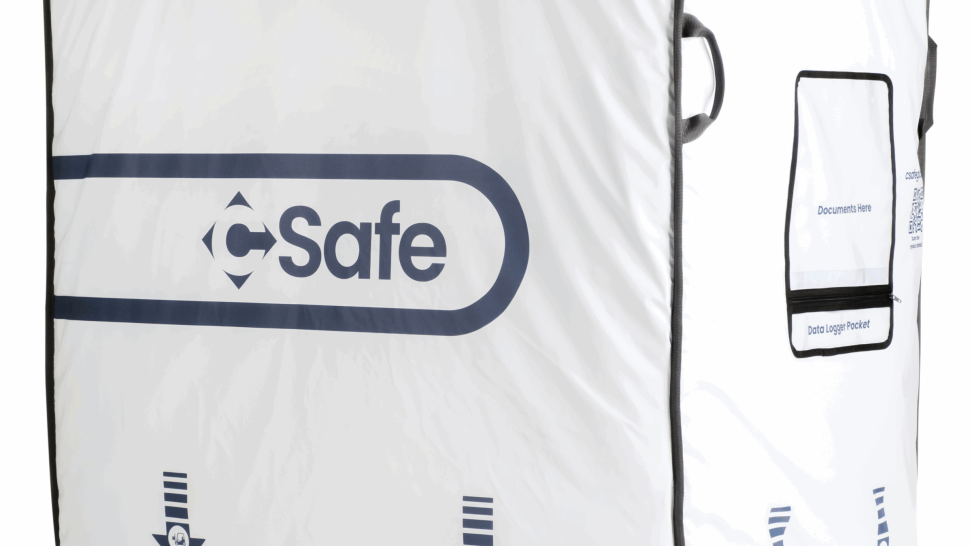
Environmental accountability is no longer optional; pharmaceutical manufacturers are under mounting pressure to demonstrate that their logistics can be both safe and sustainable. CSafe believes its newly launched Silverskin RE reusable thermal cover bridges that divide, providing robust product protection while slashing waste and carbon footprint.
Its reusable thermal cover is built to endure repeated missions while maintaining high performance. Crafted from durable, weather-resistant materials, the cover preserves thermal integrity across multiple shipping cycles. Its exterior is cleanable and sanitized, the zip-closure door allows one-person operation, and integrated tracking ensures visibility through complex logistics networks. The cover’s patent-pending tamper-evident features and adjustable strapping allow it to conform to both U.S. and EU pallet standards, enhancing adaptability across global supply chains.
Join the leaders shaping freight’s future at
F3: Future of Freight Festival, Oct 21-22.
Network with the industry’s best and discover what’s next.
Silverskin RE supports temperature mitigation in two critical zones—+2 °C to +8 °C and +15 °C to +25 °C—covering a wide spectrum of pharmaceuticals, from biologics to more stable formulations. Customers can purchase units outright or adopt CSafe’s rental model, under which the company provides end-to-end lifecycle management, including inspection, cleaning, regulatory compliance, and return logistics.
“We see sustainability not as a nice-to-have, but as an essential design criterion for next-generation cold chain logistics,” said Patrick Schafer, CEO of CSafe. “With the Silverskin RE, we’re giving pharmaceutical companies an alternative to single-use thermal covers—a tool that maintains the reliability CSafe is known for while reducing waste, emissions, and lifecycle costs over time.”
The cold chain is surprisingly resource-intensive. Cooling systems in logistics consume roughly 5% of the world’s total energy and account for around 2.5% of global greenhouse gas emissions, exceeding even aviation in impact. The pharmaceutical cold chain, in particular, is especially carbon-intensive: some studies suggest it produces 55% more greenhouse gas emissions than the automotive sector. The global healthcare industry contributes approximately 4.4 percent of total greenhouse emissions, with transportation, manufacturing, and packaging of medical goods as major drivers.
Beyond energy and emissions, the issue of waste looms large. The biopharma sector reportedly produces 300 million tons of plastic waste annually, much of it from single-use packaging. More than 90% of all packaging waste ends up in landfills or the environment.
Operational risk amplifies the urgency of innovation. The World Health Organization estimates that up to 50% of vaccines were lost globally due to cold-chain failures before the COVID-19 era. Industry analyses also estimate that more than $35 billion in value is lost annually due to temperature excursions in pharmaceutical logistics.
CSafe’s launch of Silverskin RE coincides with a surge in market demand for sustainable cold chain packaging. The global pharmaceutical cold chain packaging market was estimated at $17.9 billion in 2024 and is projected to grow to $63.3 billion by 2033, reflecting the adoption of advanced, eco-conscious materials, according to Grand View Research. In the U.S. alone, the market was valued at USD 1.23 billion in 2024 and is expected to expand at a compound annual growth rate (CAGR) of 14.6 percent through 2030.
Brokerage Compliance Symposium
The day before F3. Every compliance issue you face - fraud exposure, carrier liability, FMCSA rules, cargo theft, insurance gaps - navigated by attorneys and operators defining best practices in a changing industry.
F3 Awards Dinner
The night before F3. FreightTech100 companies honored. FreightTech 25 and Shipper of Choice winners revealed live. Cocktail reception into dinner and live music - 300 industry leaders in one purpose-built room.
F3: Future of Freight Festival
Industry-defining keynotes, rapid-fire technology demos, and industry leaders networking in experiences across Chattanooga - plus the inaugural F3 Awards Dinner featuring the FreightTech and Shipper of Choice reveals.
The day before F3. Every compliance issue you face - fraud exposure, carrier liability, FMCSA rules, cargo theft, insurance gaps - navigated by attorneys and operators defining best practices in a changing industry.
The Signal at Chattanooga Choo Choo • Chattanooga, TN Register NowThe night before F3. FreightTech100 companies honored. FreightTech 25 and Shipper of Choice winners revealed live. Cocktail reception into dinner and live music - 300 industry leaders in one purpose-built room.
The Signal at Chattanooga Choo Choo • Chattanooga, TN Register NowIndustry-defining keynotes, rapid-fire technology demos, and industry leaders networking in experiences across Chattanooga - plus the inaugural F3 Awards Dinner featuring the FreightTech and Shipper of Choice reveals.
The Signal at Chattanooga Choo Choo • Chattanooga, TN Register Now