




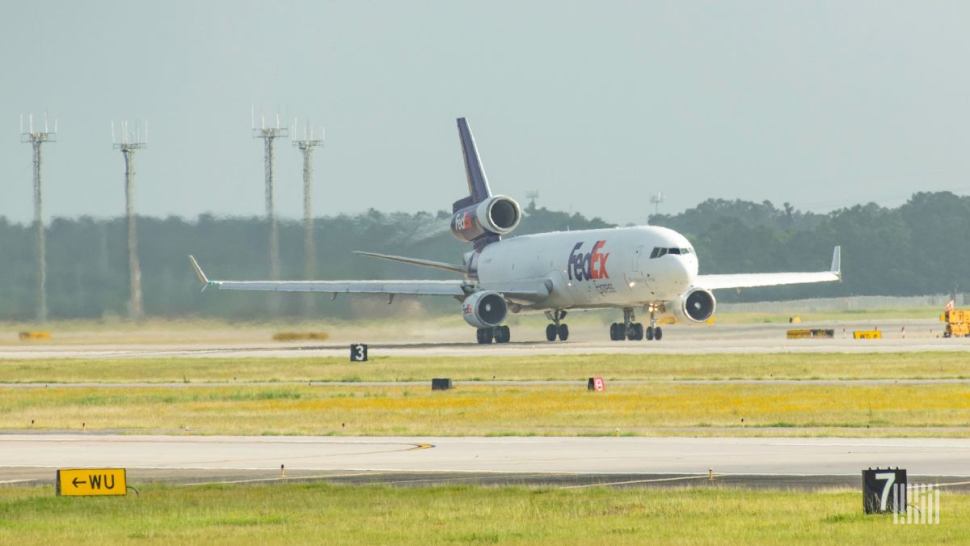
A FedEx Corp. McDonnell Douglas MD-11 cargo jet overran the runway at Miami International Airport amid heavy rain and thunderstorms, causing the Federal Aviation Administration to issue a temporary ground stop of all flight activity during a busy holiday travel day.
Less than three months ago, an Amazon Air Boeing 767 freighter had a runway excursion at Miami airport, hit a vehicle, crashed through the fence and crossed a road before coming to a stop, resulting in the death of five people and serious injuries to other people.
“A FedEx aircraft overran Runway 26R at Miami International Airport at approximately 8:40 p.m. All runways are closed except for the south runway (9R). Miami-Dade Fire Rescue units have responded, and there are no reported injuries,” the airport said in a statement. There were two pilots on board the aircraft.
The ground stop has since been lifted.
The large FedEx (NYSE: FDX) freighter arriving from the company’s global hub in Memphis, Tennessee, missed the target runway’s landing zone, turned slightly left after leaving the runway to avoid a localizer antenna and came to a stop near the airport perimeter fence, according to The Aviation Herald.
“FedEx Flight 910 from Memphis to Miami experienced an issue upon landing Wednesday evening at Miami International Airport. We are grateful that our crew is safe and there are no reported injuries. We are coordinating closely with investigating authorities, and any additional questions should be referred to the FAA,” FedEx said in a statement.
Executives late last month said that most of the company’s 27 MD-11 tri-engine jets have returned to service after fixing a design flaw that investigators have primarily attributed to the fatal crash last November of an MD-11 operated by UPS.
The MD-11 will likely be idle for an indefinite period to allow for an investigation of the incident and inspect the plane for potential damage. The loss of availability creates a logistics headache for FedEx during the peak shipping season, but the company will likely be able to replace the capacity with reserve aircraft, using an outside carrier or relying more on its truck network.
Why It Matters: Cargo airlines have been involved in a series of accidents at Miami airport in the second half of the year. Earlier this month, A UPS Boeing 767-300 freighter aircraft sustained damage in a low-speed ground collision when the pilots got too close to an intersection and a passenger jet moving towards its gate struck the plane with its wing tip.
The National Transportation Safety Board is still investigating the Amazon Air accident. Amazon’s Boeing 767-300 aircraft was operated by third-party carrier 21 Air.
According to the NTSB’s preliminary report, the crew came in too fast and was unable to extend the flaps to the proper landing position. The plane was above the proper glide slope and when the crew pushed the nose down to get back on the proper glide slope it caused the plane to gain speed. Instead of executing a go-around, the plane touched down long on the runway with one wheel and it took several seconds for the other wheels to touch down. By then, it was too late to stop and the plane rolled past the runway.
Click here for more FreightWaves/American Shipper stories by Eric Kulisch.
RELATED STORIES:
UPS accident in Miami sidelines 767 freighter during busy shipping season
CooperVision contact lens shipment stranded on disabled Amazon cargo jet
Amazon calls timeout on 21 Air cargo contract
2 Miami runways still closed after deadly Amazon cargo jet accident
