What Was Announced
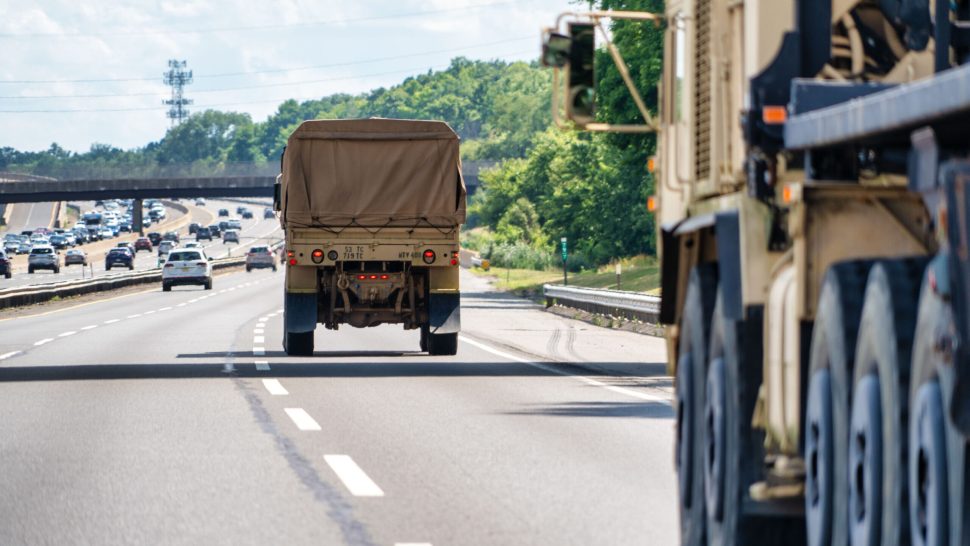
U.S. Transportation Secretary Sean P. Duffy announced Freedom Haulers, describing it as a patriotic hiring campaign to move veterans into trucking careers. The Department of Transportation leads it, with contributions from the Department of Veterans Affairs, the Department of Labor and the Department of War. The launch package included a digital ad, radio spots and a microsite at freedomhaulers.dot.gov cataloging federal resources and private sector partners.
A kickoff event scheduled for Monday, July 27 was postponed. It happened today at the White House, with President Trump joining Duffy to announce the policy measures.
Three changes came out of that event. The Military Skills Test Waiver window extends from one year post-separation to two. Seven states join the Even Exchange Program, bringing participation to 34: Alabama, Arkansas, Florida, Indiana, Louisiana, Maryland and Wyoming. And active-duty service members may now apply and test for a commercial learner’s permit or CDL in the state where they are stationed rather than traveling back to their state of domicile.
Separately, Werner Enterprises pledged to hire 1,400 military veterans and military spouses in 2027. The Owner-Operator Independent Drivers Association endorsed the campaign, with President Todd Spencer noting that nearly 40 percent of OOIDA’s membership has served in the armed forces. “With nearly 40 percent of our membership having served in the U.S. Armed Forces, OOIDA’s members bring a unique dedication to both national security and road safety. Military veterans have the skills to succeed in trucking and that’s what makes them the safest operators of the 80,000-pound commercial vehicles that traverse America’s roadways. OOIDA strongly applauds the Trump Administration for launching the Freedom Haulers initiative to ensure the most well-trained, professional men and women are operating large trucks on our nation’s roadways and keeping our supply chain secure.”
The Baseline Context
To evaluate what changed, you have to know what was already there. FMCSA has operated a suite of military driver programs for years, and they are more permissive than most carriers realize.
The Military Skills Test Waiver, codified at 49 CFR 383.77, lets states waive the CDL skills test for service members and veterans with two years of safe experience operating heavy military vehicles. It is available in every state. FMCSA reports that roughly 40,000 service members and veterans have used it.
The Even Exchange Program handles the other half. In participating states, qualified military drivers are exempt from the CDL knowledge test. Combine the two and a veteran can exchange a military license for a civilian CDL without taking either test.
Here is the piece that gets least attention and matters most. Under 49 CFR 380.603(a)(3), veterans who meet the requirements of 383.77 are excepted from Entry-Level Driver Training entirely. When FMCSA adopted that exception, it stated that military training and testing meet or exceed the agency’s own standards in appendices A through E of Part 380, and the Commercial Vehicle Training Association agreed that Army, Navy, Air Force and Marine training manuals covered the required skills in considerable detail. So in essence, a qualifying veteran was already exempt from the federal training mandate that costs civilian applicants several thousand dollars.
The VA tuition benefit was also already in place. FMCSA’s own campaign materials state that the VA’s tuition cap typically covers 100 percent of CDL training costs at colleges and technical schools for veterans who served at least 36 months. Add the Under 21 Military Driver Program, CMV Operator Safety Training grants to schools that train veterans, and DOT’s Veterans Transportation Career Center, and the federal scaffolding was substantially complete before July.
Freedom Haulers: what changed and what did not
| In place before July 2026 | What the July 30 announcement changed |
|---|---|
| Military Skills Test WaiverAvailable in all 50 states under 49 CFR 383.77. Waives the CDL skills test for veterans with two years of documented safe heavy military vehicle experience. Claim window ran one year after separation. | Claim window extended to two years after separation. Eligibility criteria unchanged. |
| Even Exchange ProgramExempts qualified military drivers from the CDL knowledge test, but only in states that elect to participate. | Seven states added: Alabama, Arkansas, Florida, Indiana, Louisiana, Maryland and Wyoming. Participation now 34 states. |
| Entry-Level Driver Training exemptionVeterans meeting the 383.77 conditions were already excepted from the federal ELDT mandate under 49 CFR 380.603(a)(3). | Nothing. Already in place. |
| Testing location for active dutyService members generally applied and tested for a permit or CDL in their state of domicile. | May now apply and test in the state where currently stationed. |
| VA tuition benefitVA tuition cap typically covered 100 percent of CDL training costs for veterans with at least 36 months of service. | Nothing. Featured in campaign messaging. |
| Under 21 Military Driver ProgramFMCSA program assessing safety impacts of qualified military drivers aged 18 to 21 operating commercial vehicles. | Nothing. Not addressed. |
| Federal awareness effortFMCSA program webpages and a printed programs brochure. | Microsite, digital ad, radio spots and an interagency campaign spanning Transportation, Veterans Affairs, Labor and War. |
| Employer hiring commitmentsIndividual carrier veteran hiring programs, with no coordinated federal pledge. | Werner Enterprises pledged to hire 1,400 military veterans and military spouses in 2027. |
Sources: FMCSA Military Driver Programs; 49 CFR 383.77 and 380.603(a)(3); FMCSA news release, July 24, 2026; policy measures announced July 30, 2026.
Comparing the New Against the Existing
Set the announcements against that baseline and the picture is mixed.
The waiver window extension is real but somewhat bounded. Moving from one year to two doubles the period in which a separated veteran can claim the skills test waiver, which matters for someone who took a year to decide, went to school first, or dealt with a medical issue. It does not change who qualifies or what they must demonstrate.
The Even Exchange expansion is the most straightforwardly additive item. Seven states is a meaningful jump, and for a veteran in Florida or Alabama the knowledge test requirement disappears where it did not before. It is worth noting what this is procedurally: states elect to participate, and DOT persuaded seven more to opt in. That is coordination work, not new federal authority.
The active-duty domicile change is the item most likely to be underrated. Requiring a service member stationed at Fort Bragg but domiciled in Nevada to travel home to test was a real hassle point that produced real apprehension, and removing it addresses a problem the other two items do not touch.
What is not in the package is equally worth stating. There is no new appropriation identified in DOT’s materials. No new training standard. No change to the two-year experience requirement, the safe driving record requirement, or the medical certification requirement. The president’s framing that veterans who drove heavy military trucks will “automatically be eligible” for a CDL describes, in substance, a program that has existed since before this administration, now with a longer claim window and more participating states.
The largest genuinely new element is the marketing. A microsite, a viral digital ad and an interagency communications push are not nothing. If the binding constraint was that eligible veterans did not know these programs existed, awareness spending is a rational intervention. FMCSA had a brochure. It did not have a campaign.
The Current Math
The context is that this campaign follows FMCSA’s non-domiciled CDL rule, which is expected to remove roughly 194,000+ drivers from the market.
Run the numbers against the pipeline. The Military Skills Test Waiver has produced roughly 40,000 users across its operating life, which works out to a few thousand per year. Werner’s pledge of 1,400 hires is a full year of commitment from one of the largest carriers in the country. Nothing in the announced package obviously changes that order of magnitude by a factor of ten.
That comparison should be handled carefully rather than deployed as a gotcha. The two populations are not interchangeable, the exits under the non-domiciled rule phase in over one to three years rather than landing at once, and a recruitment campaign’s whole purpose is to lift a historical rate rather than match it. But a program that has moved a few thousand people a year is being positioned against a gap two orders of magnitude larger, and the gap is not addressed by extending a waiver window.
The Consistency Question, Fairly Stated
There is an obvious objection, and it deserves the strongest version of both answers.
The objection: FMCSA justified excluding 194,000 work-authorized immigrant drivers on the ground that it cannot verify their foreign driving records, and has told the D.C. Circuit that past driving history is a powerful predictor of future safety. Freedom Haulers simultaneously expands a pathway that waives the knowledge test, the skills test and the federal training requirement for a different population. Critics will say the agency tightened verification for one group while loosening it for another.
The government’s answer is coherent and should be stated plainly. Military driving records are visible to American authorities in a way foreign records are not. A veteran claiming the waiver produces documentation, most commonly the DA Form 348 equipment operator qualification record, showing two years of documented safe operation of heavy vehicles under a training regime FMCSA has formally found to meet or exceed its own standards. That is not an absence of verification. It is verification through a different channel.
Where the criticism retains force is on the testing itself. A veteran using both waivers demonstrates competence through records rather than through a skills examination. FMCSA’s position is that the underlying training substitutes adequately. Some people in this industry disagree about that, and this campaign will expand the population where the disagreement gets tested.
Worth noting separately: the campaign’s promotional material is unusually combative for a federal recruitment effort. The site’s video asks whether the viewer is a veteran and not an illegal alien, and Duffy’s July 30 statement said illegal immigrants who cannot speak the language have no business behind the wheel. Whatever a reader thinks of that framing, it is a deliberate choice to fuse a hiring campaign to an enforcement agenda.
What This Means If You Are Hiring
For a small fleet, the practical implications are narrow and worth getting right.
A veteran applicant may hold a CDL obtained without a skills test, without a knowledge test and without ELDT, and every part of that is lawful and always has been. Your insurance carrier may still have its own experience requirements, and those are contractual, not regulatory. Ask before you make an offer, not after.
Verify what the record actually shows. Two years of documented heavy vehicle operation is a real qualification, and an 88M who ran Heavy Equipment Transport System or Palletized Load System equipment has handled weight and dimension that translate directly. A service member whose vehicle time was mostly light tactical vehicles is a different candidate. The MOS code alone does not tell you which one is standing in front of you.
The domicile change may matter for recruiting near installations. A service member can now test where stationed, which means a carrier recruiting near a base is dealing with candidates who can complete licensing locally.
And the honest caution: recruitment has rarely been the hard part of this equation. Retention is. A veteran hired into a poorly run operation leaves like anyone else, and the federal government is not going to fix that for you.
Why It Matters
Freedom Haulers is best understood as an awareness campaign wrapped around three incremental policy adjustments, not the creation of a new pathway, because the pathway has existed since 2016 and has moved roughly 40,000 people through it. That distinction matters for any carrier building a hiring plan around the announcement, because what actually changed is who will hear about the programs, not what those programs require.
Brokerage Compliance Symposium
The day before F3. Every compliance issue you face - fraud exposure, carrier liability, FMCSA rules, cargo theft, insurance gaps - navigated by attorneys and operators defining best practices in a changing industry.
F3 Awards Dinner
The night before F3. FreightTech100 companies honored. FreightTech 25 and Shipper of Choice winners revealed live. Cocktail reception into dinner and live music - 300 industry leaders in one purpose-built room.
F3: Future of Freight Festival
Industry-defining keynotes, rapid-fire technology demos, and industry leaders networking in experiences across Chattanooga - plus the inaugural F3 Awards Dinner featuring the FreightTech and Shipper of Choice reveals.
The day before F3. Every compliance issue you face - fraud exposure, carrier liability, FMCSA rules, cargo theft, insurance gaps - navigated by attorneys and operators defining best practices in a changing industry.
The Signal at Chattanooga Choo Choo • Chattanooga, TN Register NowThe night before F3. FreightTech100 companies honored. FreightTech 25 and Shipper of Choice winners revealed live. Cocktail reception into dinner and live music - 300 industry leaders in one purpose-built room.
The Signal at Chattanooga Choo Choo • Chattanooga, TN Register NowIndustry-defining keynotes, rapid-fire technology demos, and industry leaders networking in experiences across Chattanooga - plus the inaugural F3 Awards Dinner featuring the FreightTech and Shipper of Choice reveals.
The Signal at Chattanooga Choo Choo • Chattanooga, TN Register Now