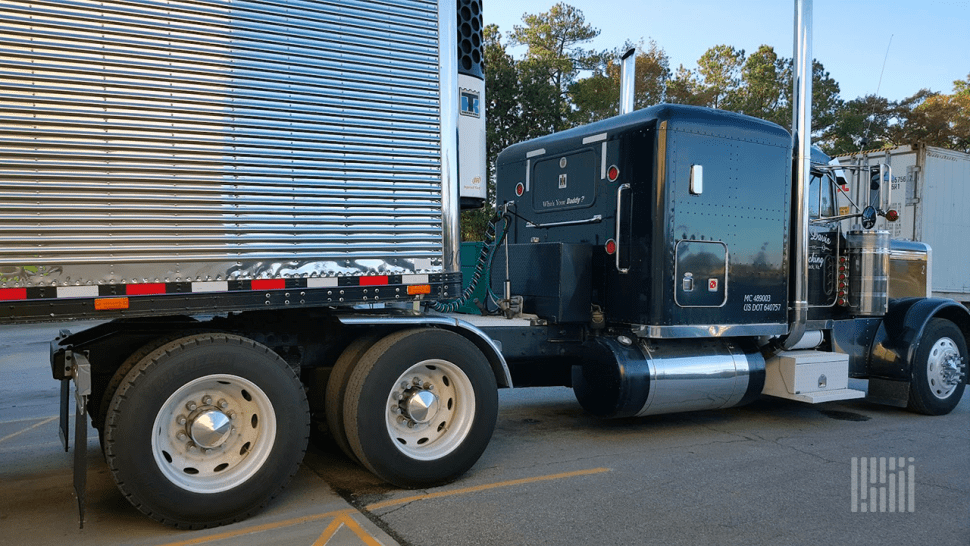
Recently, somewhere in New Jersey, a CDL school posted a testimonial that should have raised some questions. A driver from Hawaii picked up his commercial learner’s permit on the islands, bought a plane ticket east, trained at the school from Sunday through Thursday, passed his skills test on Friday, and flew home Saturday morning. By that afternoon, he had a commercial driver’s license and was legally authorized to operate an 80,000-pound tractor-trailer on any public highway in the United States.
Eight days. Permit to license. Honolulu to Trenton and back. The school posted this story with pride. And the worst part is, everything about it was completely legal.
That’s not a quirk. That’s not an edge case. That’s the system working exactly as it was designed, or more precisely, as it was left unfinished.
The hollow rule
The Entry-Level Driver Training rule, known in the industry as ELDT, took effect on February 7, 2022. It was a decade in the making. Congress first mandated it in 2012 through the Moving Ahead for Progress in the 21st Century Act (MAP-21). The compliance date was pushed back from 2020 to 2022 to give states and training providers time to update their systems. It was supposed to finally standardize what it meant to train a commercial driver in America.
It did not.
What ELDT actually requires is that a first-time CDL applicant complete theory and behind-the-wheel training through a provider registered on FMCSA’s Training Provider Registry, and demonstrate proficiency in both before sitting for a skills test. What it explicitly does not require is any minimum number of hours. Not for theory instruction. Not for behind-the-wheel time. Not for the total training duration.
“There is NO minimum number of hours required for either behind-the-wheel training or knowledge training under the new rule,” FMCSA’s own documentation states. The agency’s final rule requires only that applicants demonstrate proficiency.’ What proficiency looks like, how long it takes to achieve it, and who decides when it has been reached are all left to the training provider.
That means a school can legally certify a student as proficient after eight hours of behind-the-wheel instruction. Or five. Or three. As long as an instructor checks a box saying proficiency has been demonstrated, the Training Provider Registry records it, and the state can administer the test. The federal government has no mechanism to verify the accuracy of that certification after the fact.
The Commercial Vehicle Training Association, which represents more than 70 CDL schools operating across 43 states, acknowledged the gap when ELDT launched. The association noted that FMCSA had declined to incorporate the Entry-Level Driver Training Advisory Committee’s recommendation for a minimum of 30 hours of behind-the-wheel training for Class A programs. CVTA said it still believed the rule would enhance safety. Many industry veterans are less certain.
The registry that opened all doors
Embedded inside ELDT’s implementation is a structural flaw that has turned a safety initiative into what one industry leader describes as a full-blown crisis. To comply with the rule, training providers must register with FMCSA’s Training Provider Registry. Registration requires self-certification that the provider meets applicable federal and state requirements. FMCSA does not require proof of state licensure before a school appears in the registry. There are no mandatory on-site inspections.
Approximately 2,100 CDL schools hold licenses under state laws. The federal Training Provider Registry today lists roughly 35,000 providers.
Steve Gold, founder and chief executive of 160 Driving Academy, one of the largest commercial driver training networks in the country, with 140 locations across 43 states, bluntly laid out the implications in a December 2025 interview with FreightWaves. “The FMCSA doesn’t follow up; they don’t have any enforcement capabilities,” Gold said. “So anybody and their brother can put themselves in there as a licensed entity, and the federal government has no clue, and the states have no clue.”
Gold described many registry-listed operations as CDL mills offering little or no genuine instruction. “These schools are bypassing the state rules, and they’re self-certifying that they’re following minimum federal rules, but they’re really not providing any kind of quality training,” he said. His proposed fix is straightforward: reinstate the original requirement that a school prove state licensure before appearing on the federal registry. FMCSA has not acted on it.
Secretary of Transportation Sean Duffy addressed the problem in late 2025, announcing that the department was prepared to use financial penalties, federal investigations, and, if necessary, revoke states’ authority to issue CDLs in cases of systematic fraud. Duffy specifically asked who was testing drivers and who was verifying that candidates could speak English and demonstrate basic competency to operate large commercial vehicles. Those questions remain largely unanswered.
CDL tourism and arbitrage
Understanding why a driver flies from Hawaii to New Jersey to get a CDL requires understanding how federal and state licensing authorities intersect and how the gap between them created a market for what the industry informally calls CDL tourism or license arbitrage.
Under federal law, specifically 49 CFR §383.71, a CDL must be issued by the applicant’s state of domicile. But FMCSA’s regulations do not prohibit a driver-trainee from obtaining training outside their home state. A critical provision in the ELDT FAQ from the Training Provider Registry confirms this directly: “The final rule does not prohibit driver-trainees from obtaining training outside their state of domicile. Therefore, any ELDT requirements that may exist in the licensing state would not be applicable to the driver-trainee who obtained skills training outside that state.”
In plain language: you train in New Jersey under New Jersey’s rules, test in New Jersey, and then your home state, in this case, Hawaii, cannot require you to redo the training or retake the skills test. The state of domicile can impose additional requirements for obtaining the CDL, but it cannot require you to retest. The test result travels with you.
That creates an obvious arbitrage opportunity. States differ dramatically in how fast CDL testing can be scheduled, how many third-party examiners are available, how quickly those examiners can conduct onsite tests at training facilities, and what minimum training standards, if any, they impose on top of the federal floor.
Hawaii presents a genuine logistical bottleneck. The state has a limited number of CDL testing slots, fewer training facilities, and a smaller DMV infrastructure relative to the commercial driver population it serves. Wait times for a skills test in Hawaii can stretch for weeks. Schools on the mainland, particularly in states with dense networks of certified third-party examiners and high-throughput testing operations, can schedule tests in days. The economics favor the ticket to Newark.
New Jersey is not uniquely problematic; it is simply efficient. Efficiency in this context means compressing a process that most industry veterans believe cannot be compressed into eight days.
What training used to look like
The CDL is a relatively new credential. The Commercial Motor Vehicle Safety Act of 1986 created it, standardizing what had previously been a fragmented patchwork of state-by-state licensing, allowing a driver with a problematic record in one state to simply move to another and start over. When the CDL took effect in April 1992, it introduced a national database, a one-license requirement, and consolidated the right to operate commercial vehicles into a single standardized credential.
What it did not do was standardize training.
In the years before and immediately after the CDL’s creation, the dominant model for producing commercial drivers was the company-sponsored program. Major carriers, Schneider, JB Hunt, Swift, Werner, England, Prime, and dozens of regional fleets either operated their own training academies or contracted with established schools. Programs ran for 3 to 8 weeks minimum. Some were longer. Drivers are trained on the exact equipment they would operate after graduation. Company trainers rode along for tens of thousands of miles in the first months of employment.
The institutional knowledge behind that model was significant. A driver who came up through a Schneider academy in the 1990s spent more time training than many current drivers spend in school and in their first year combined. Fleet managers knew what they were getting because they controlled what went in.
Market forces, deregulation, and the intensifying driver shortage eroded that model through the 2000s. Major carriers gradually exited the business of running their own schools, shifting instead to tuition assistance agreements that sent recruits to third-party providers. The programs still ran weeks, not days. The direct oversight that came with carrier-owned academies was gone.
By the 2020s, the market had bifurcated sharply. Carrier-sponsored programs at established schools still run four to eight weeks and often exceed 160 hours of combined instruction. On the other end, boot camp operations teach students specifically how to pass the skills test in the minimum time. A motivated instructor can create the conditions for proficiency. The gap between those two products is enormous. The credentials they produce are identical.
The history of fraud
The problems in CDL testing are not new. In 2002, the Department of Transportation’s inspector general issued a report on CDL fraud that documented widespread irregularities in third-party testing going back to at least 1998. The report found that suspected fraud in the testing and licensing of commercial drivers had been identified in 16 states within a four-year span.
The inspector general’s office used a covert audit to illustrate the scope of the problem. An Arkansas state trooper took the driving test at three of the state’s 31 third-party testing sites. At one location, he passed the driving test. His driving test had consisted primarily of a conversation about his Army service.
A 2008 CDL Task Force report to Congress, required under the Safe, Accountable, Flexible, Efficient Transportation Equity Act, documented that the FMCSA had identified more than 15,000 individuals suspected of obtaining their CDLs fraudulently during a three-year investigation period. That figure represents a fraction of what investigators believed was actually occurring, given the limited surveillance capacity of federal and state agencies at the time.
In response, the FMCSA tightened regulations on third-party testing in 2011, including a prohibition on a training school’s examiner administering the skills test to applicants whom that examiner had personally trained. The rule was intended to reduce both the opportunity for fraud and unintended bias in the testing process. In 2013, the agency partially relaxed it, allowing schools to conduct testing as long as the individual instructor who provided the training was not the same person administering the test.
A recent investigation by The Oregonian and OregonLive documented what a fully corrupted version of that system looks like in practice. Investigators alleged that Skyline CDL School mailed envelopes containing approximately $520 to $530 in cash to a Washington state examiner in exchange for passing scores. Some drivers, investigators found, had never taken the test at all. When Washington state conducted retesting, 80% of drivers failed. The state revoked Skyline’s accreditation and cancelled more than 100 commercial licenses. Among the additional violations documented: unqualified instructors, falsified records, and deliberate bypassing of English-language proficiency requirements.
Federal regulations require commercial drivers to read and understand highway signs and traffic signals in English, to understand and respond to official inquiries, and to make entries in reports and records. Schools that bypass English proficiency requirements are not just cutting corners on paperwork. They are putting drivers on the highway who cannot read the signs above the road they are traveling.
Where the fraud and carrier ecosystems collide
It would be a mistake to view CDL mill schools as isolated bad actors. The same conditions that produce fraudulent training providers, self-certification, minimal federal oversight, rapid entry into a registry, geographic arbitrage, are the same conditions that produce chameleon carriers, phantom brokers, and authority mills.
In the CDL space, a school that self-certifies on the Training Provider Registry and operates without inspections is running the same playbook as a carrier that self-registers with FMCSA and operates without meaningful safety review.
Chameleon carriers need drivers. Drivers who cannot pass legitimate training programs need schools that will certify them regardless. Both sides of that transaction have infrastructure that accommodates them, and neither the Training Provider Registry nor the FMCSA operating authority system was built with sufficient verification mechanisms to detect the overlap.
The Leadwell Loop CDL fraud network documented in California, the dispatch training center networks in Schaumburg, Illinois, and the broader constellation of suspect training operations documented in FMCSA enforcement actions all fit a pattern: entities that exist on paper, meet the minimum threshold for federal registration, and facilitate the entry of unqualified or fraudulently credentialed individuals into the commercial driver workforce.
What’s the data say?
The Federal Motor Carrier Safety Administration’s crash statistics do not disaggregate fatalities by training duration or school type. That gap in the data is itself part of the problem; it makes it structurally impossible to prove or disprove a causal connection between compressed training timelines and crash outcomes using federal data alone.
The data show that the decline in average training duration has occurred alongside an increase in large-truck crash involvement in fatal accidents. According to FMCSA data, large trucks were involved in approximately 4,965 fatal crashes in 2022, representing a 49 percent increase from the recent low recorded in 2009. Distilling a single causal variable from a complex crash environment is difficult. But the trend’s direction is not ambiguous.
Industry veterans with decades of safety experience consistently identify training duration and quality as a foundational safety variable. A driver who has operated a loaded tractor-trailer in rain, at night, on grades, in traffic, and in reverse through a loading dock is a different driver than one who has demonstrated proficiency on a dry range on a sunny Tuesday. The skills test is designed to measure minimum competency, not real-world readiness. The gap between those two things has never been wider.
The fix that never came
FMCSA has the legal authority to set minimum training hours. The agency chose not to exercise it when it finalized the ELDT rule in 2016, and it did not revisit that decision when the rule took effect in 2022. The Entry-Level Driver Training Advisory Committee recommended a minimum of 30 hours of behind-the-wheel instruction for Class A programs. FMCSA declined. The Commercial Vehicle Training Association called that decision a missed opportunity while maintaining it would support the rule anyway.
The fix for the Training Provider Registry’s self-certification problem also falls within FMCSA’s existing authority. Requiring proof of state licensure as a condition of registry listing would immediately reduce the denominator from roughly 35,000 entries to roughly 2,100, the number of schools that have actually been vetted by a state licensing authority. Gold argues it could be done administratively, without new legislation.
Neither fix has been implemented.
Meanwhile, the Hawaii-to-New Jersey pipeline continues. It is legal. It is documented on school websites as a feature. And somewhere in the country this week, another driver is boarding a plane to a state with faster testing infrastructure and fewer training requirements, collecting a credential that will allow him to operate the largest vehicles on American roads, and heading back home before the ink is dry.
That’s not a story about one school or one driver. That’s a story about a system that decided eight days was close enough.
Brokerage Compliance Symposium
The day before F3. Every compliance issue you face - fraud exposure, carrier liability, FMCSA rules, cargo theft, insurance gaps - navigated by attorneys and operators defining best practices in a changing industry.
F3 Awards Dinner
The night before F3. FreightTech100 companies honored. FreightTech 25 and Shipper of Choice winners revealed live. Cocktail reception into dinner and live music - 300 industry leaders in one purpose-built room.
F3: Future of Freight Festival
Industry-defining keynotes, rapid-fire technology demos, and industry leaders networking in experiences across Chattanooga - plus the inaugural F3 Awards Dinner featuring the FreightTech and Shipper of Choice reveals.
The day before F3. Every compliance issue you face - fraud exposure, carrier liability, FMCSA rules, cargo theft, insurance gaps - navigated by attorneys and operators defining best practices in a changing industry.
The Signal at Chattanooga Choo Choo • Chattanooga, TN Register NowThe night before F3. FreightTech100 companies honored. FreightTech 25 and Shipper of Choice winners revealed live. Cocktail reception into dinner and live music - 300 industry leaders in one purpose-built room.
The Signal at Chattanooga Choo Choo • Chattanooga, TN Register NowIndustry-defining keynotes, rapid-fire technology demos, and industry leaders networking in experiences across Chattanooga - plus the inaugural F3 Awards Dinner featuring the FreightTech and Shipper of Choice reveals.
The Signal at Chattanooga Choo Choo • Chattanooga, TN Register Now