




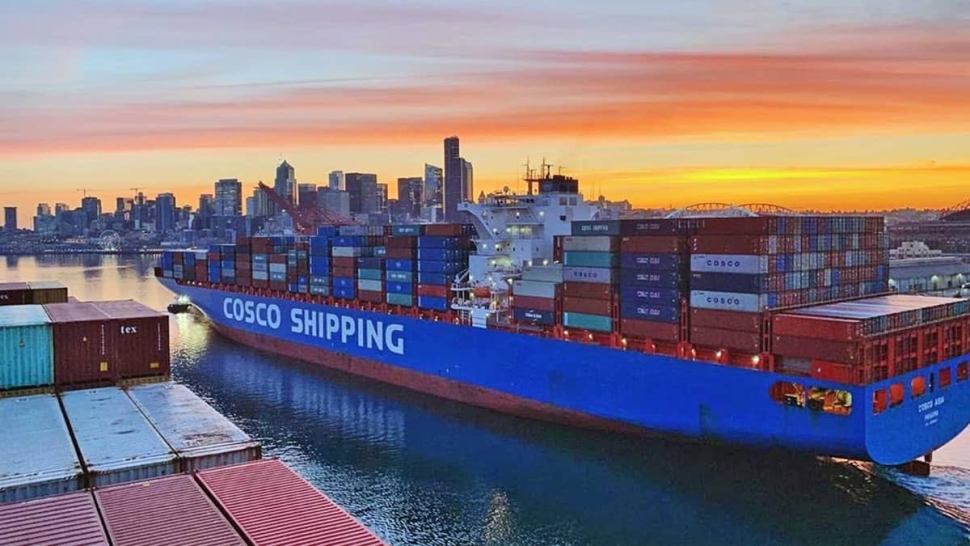
Trade flowing into and out of U.S. ports is increasingly vulnerable to market turmoil as China strengthens its investment foothold around the world, according to geopolitical experts.
Testifying at a recent congressional hearing in Washington on China’s Maritime Silk Road initiative, Carolyn Bartholomew, chair of the U.S.-China Economic and Security Review Commission, said China can use its financial control at foreign ports to create markets through which it can strengthen its trade relationships.
“By owning and/or operating a network of logistical nodes across Asia, Europe and Africa, China can control a significant portion of its inbound supply chain for essential commodities and outbound trade routes for its exports,” Bartholomew said during the Oct. 17 hearing. “In the event of conflict, China could use its control over these and other ports to hinder trade access to other countries.”
Bartholomew cited data revealing that at least two-thirds of the world’s top 50 container ports are owned by the Chinese or supported by Chinese investments, up from roughly 20% a decade ago. Those investments include terminals at major U.S. container ports in Los Angeles and Seattle.
Officials at the Chinese state-owned COSCO, among the world’s largest container shipping lines, acknowledged in 2018 that the company had connected its shipping routes along its Maritime Silk Road with emerging regional markets in West Africa, Northern Europe, the Caribbean and the U.S. “to form a more comprehensive and balanced globalized network layout.”
U.S. ports’ reliance on Chinese manufacturers for container gantry cranes is part of the investment concern, according to Rep. Alan Lowenthal, D-Calif., whose district includes the Port of Long Beach. Lowenthal pointed out during the hearing that because of that reliance, U.S. ports have pleaded with the Trump administration to exempt gantry cranes from Chinese tariffs.
“I think having us dependent on any one source is a problem, especially when that source is a country that doesn’t necessarily see us as a friend,” Bartholomew warned. “We have certainly seen them use economic leverage in the tariff wars that are taking place.” She added that China could use that leverage to achieve diplomatic and political gains and potentially “shut down our ports.”
The economic threat can also affect military readiness, testified Lt. General Giovanni Tuck, director for logistics with the U.S. Joint Chiefs of Staff.
“There was a time when all we needed to do was look at physical port security, something the U.S. Coast Guard is very equipped to do,” Tuck said. “But now we’re talking about the resiliency of a port and the cyber threat that can go with that, including with these mega cranes.” Tuck said that as the person responsible for moving American military forces to U.S. ports prior to an overseas mission, “the last thing you want is to have something happen at that port whereby they can’t actually leave.”
Chad Sbragia, Deputy Assistant Secretary of Defense for China, added that at a strategic level, “it’s important to make sure you’re measuring the cost and implications of these kind of issues, and in the past we haven’t. That’s something we have to do earlier.”
John Garamendi, D-Calif., used the opportunity to try to muster support for a bill he’s sponsoring that would require a certain minimum amount of U.S. oil and liquefied natural gas exports be moved on U.S.-built and U.S.-flagged ships – a proposal he wants to see tied to a U.S.-China trade deal.
By promoting growth in U.S.-flag shipping, the legislation could also help reduce reliance on Chinese vessels to fuel American warships, Garamendi said.
“You’ve got a serious problem – you don’t have American ships under American control to fuel the U.S. Navy,” he told Tuck. But having the Department of Defense support his legislation, Garamendi said, could “lead to the construction of maybe 50 U.S.-flagged, -owned and -built vessels, thereby solving part of the problem.”
At the outset of the hearing, Sean Maloney (D-New York), noted that, in contrast to China’s Maritime Silk Road plans, neither of the last two U.S. presidential administrations had created a legislatively mandated National Maritime Strategy. “Perhaps today’s hearing will prompt MarAd [the U.S. Maritime Administration] to meet the latest statutory deadline” of the plan by February next year, he said.
Responding to a request for comment, a MarAd official told FreightWaves that the agency “is working towards meeting the February 2020 deadline set by Congress.”
Brokerage Compliance Symposium
The day before F3. Every compliance issue you face - fraud exposure, carrier liability, FMCSA rules, cargo theft, insurance gaps - navigated by attorneys and operators defining best practices in a changing industry.
F3 Awards Dinner
The night before F3. FreightTech100 companies honored. FreightTech 25 and Shipper of Choice winners revealed live. Cocktail reception into dinner and live music - 300 industry leaders in one purpose-built room.
F3: Future of Freight Festival
Industry-defining keynotes, rapid-fire technology demos, and industry leaders networking in experiences across Chattanooga - plus the inaugural F3 Awards Dinner featuring the FreightTech and Shipper of Choice reveals.
The day before F3. Every compliance issue you face - fraud exposure, carrier liability, FMCSA rules, cargo theft, insurance gaps - navigated by attorneys and operators defining best practices in a changing industry.
The Signal at Chattanooga Choo Choo • Chattanooga, TN Register NowThe night before F3. FreightTech100 companies honored. FreightTech 25 and Shipper of Choice winners revealed live. Cocktail reception into dinner and live music - 300 industry leaders in one purpose-built room.
The Signal at Chattanooga Choo Choo • Chattanooga, TN Register NowIndustry-defining keynotes, rapid-fire technology demos, and industry leaders networking in experiences across Chattanooga - plus the inaugural F3 Awards Dinner featuring the FreightTech and Shipper of Choice reveals.
The Signal at Chattanooga Choo Choo • Chattanooga, TN Register Now