




Despite widespread complaints by small business truckers that they are being gouged by freight brokers that refuse to offer financial transparency under a federal rule, the industry’s top regulator has yet to see formal evidence backing their case.
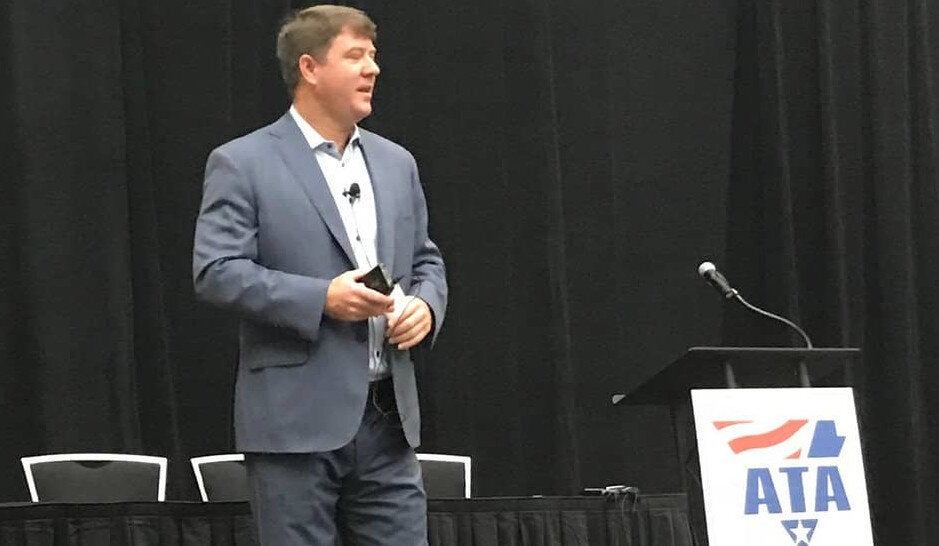
“It’s a hot topic now – there were protesters here in D.C., and the President has spoken on some of these issues,” Federal Motor Carrier Safety Administration (FMCSA) Acting Administrator Jim Mullen told attendees of a webinar hosted by the Intermodal Association of North America, or IANA, on May 28. However, he said, “the vast number of complaints we have about the freight brokerage space and the rates right now aren’t relative” to the federal broker transparency laws covered by 49 CFR 371.3, he said.
“In fact, we don’t have a specific complaint that a broker failed to abide by 371.3, in a situation in which the motor carrier hadn’t waived, contractually, the ability to get that financial data that the regulation encompasses.” But Mullen added: “We don’t expect this to go away anytime soon, and we take our regulatory obligations very seriously.”
Drivers accuse brokers of price-gouging
After weeks of demonstrations in Washington, drivers accusing brokers of cheating and price-gouging, the Owner-Operator Independent Drivers Association (OOIDA) petitioned the FMCSA to enforce federal broker transparency laws, as well as prohibit brokers from issuing contracts that require carriers to waive their rights to access freight transaction records.
“Brokers have been deliberately skirting federal transparency regulations for decades,” OOIDA President and CEO Todd Spencer asserted. “We certainly don’t think exempting yourself from federal regulations is legal, but this is precisely what is happening. It has to stop.”
Mullen said during the IANA discussion that the FMCSA is considering OOIDA’s petition. “Step one of that deliberation is, do we even have the statutory authority? Expect, perhaps, a notice and comment.”
Mullen noted also that when 371.3 was initially written into law there were different freight transaction processes in place. “Motor carriers paid brokers directly, versus the shipper paying the brokers,” he said. “So there’s perhaps some difference of opinion as to what the net effect of what that regulation was intended to be. I’ll save that debate for a different time.”
HOS’ big benefit
Speaking on the recently issued hours of service final rule, Mullen stressed that while the agency’s core focus was to improve safety, he acknowledged that modifying the 30-minute rest break – allowing the break to be satisfied by a driver using on-duty/not driving status rather than off-duty status – has the potential to provide the most meaningful benefits for carriers in terms of productivity and vehicle miles traveled.
In addition, he said, while his agency did not get as much feedback on the new short-haul provision as he had hoped, “that would be the next area that will probably have the most meaningful operational productivity benefits from our point of view,” he said. “But the industry will tell us that after the rule becomes effective and it has had time to analyze it.”
The final rule changes the short-haul exception by lengthening drivers’ maximum on‑duty period from 12 to 14 hours, and extends the distance limit within which the driver may operate from 100 air miles to 150 air miles.
Mullen also told IANA that the FMCSA’s national hours of service emergency exemption for the COVID-19 pandemic, extended until June 14 after it was initially declared on March 12, is being monitored very closely as to whether another extension will be needed.
“I would say that a good segment of the industry probably no longer needs that,” Mullen said. “There may be some sectors of the industry that might continue to need it, but we want to hear from the industry, and if you have feedback for us, we’re all ears.”
Waivers affecting the issuance of commercial driver’s licenses, commercial learner’s permits, and medical certificates, all set to expire June 30, are also being monitored for possible extension or cancellation, Mullen said.
Brokerage Compliance Symposium
The day before F3. Every compliance issue you face - fraud exposure, carrier liability, FMCSA rules, cargo theft, insurance gaps - navigated by attorneys and operators defining best practices in a changing industry.
F3 Awards Dinner
The night before F3. FreightTech100 companies honored. FreightTech 25 and Shipper of Choice winners revealed live. Cocktail reception into dinner and live music - 300 industry leaders in one purpose-built room.
F3: Future of Freight Festival
Industry-defining keynotes, rapid-fire technology demos, and industry leaders networking in experiences across Chattanooga - plus the inaugural F3 Awards Dinner featuring the FreightTech and Shipper of Choice reveals.
The day before F3. Every compliance issue you face - fraud exposure, carrier liability, FMCSA rules, cargo theft, insurance gaps - navigated by attorneys and operators defining best practices in a changing industry.
The Signal at Chattanooga Choo Choo • Chattanooga, TN Register NowThe night before F3. FreightTech100 companies honored. FreightTech 25 and Shipper of Choice winners revealed live. Cocktail reception into dinner and live music - 300 industry leaders in one purpose-built room.
The Signal at Chattanooga Choo Choo • Chattanooga, TN Register NowIndustry-defining keynotes, rapid-fire technology demos, and industry leaders networking in experiences across Chattanooga - plus the inaugural F3 Awards Dinner featuring the FreightTech and Shipper of Choice reveals.
The Signal at Chattanooga Choo Choo • Chattanooga, TN Register Now