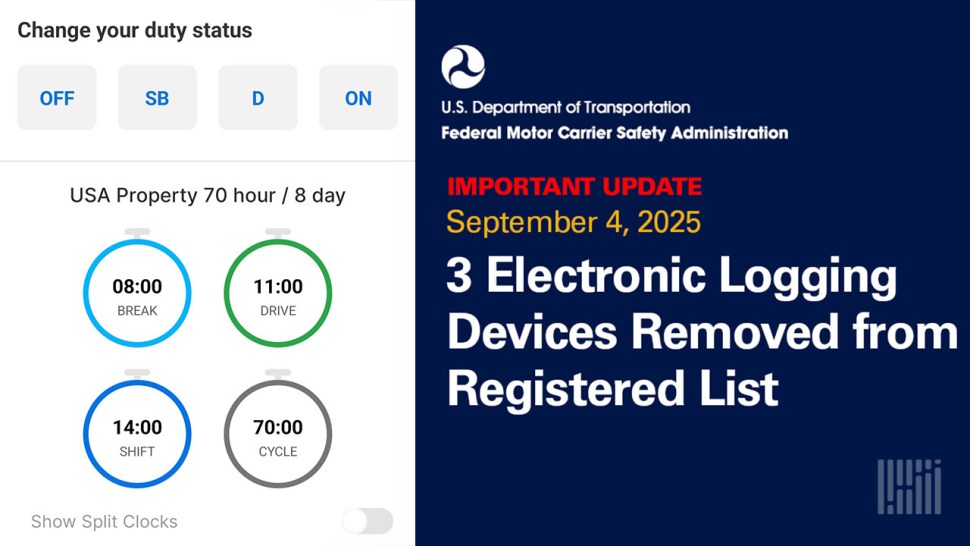
The Federal Motor Carrier Safety Administration on Wednesday removed three more electronic logging devices from its registered list, giving affected fleets until Nov. 3 to swap out the non-compliant systems before facing enforcement action.
The latest casualties, TT ELD PT30, ELOG42 and RENAISSANCE ELD, failed to meet minimum technical requirements under federal regulations, FMCSA said. All three devices now appear on the agency’s growing revoked devices list. “Motor carriers and drivers who continue to use the revoked ELDs listed above on or after November 3, 2025 will be in violation of 49 CFR 395.8(a)(1), ‘No record of duty status’ , and drivers will be placed out-of-service in accordance with the Commercial Vehicle Safety Alliance OOS Criteria,” FMCSA warned in its notice to industry.
In July, FMCSA yanked WALKER ELD and SR ELD from the approved list. Earlier this year, six more devices got the boot, including repeat offender Blue Star ELD, which has had devices revoked three separate times in nine months. The revolving door of ELD revocations is becoming a serious headache for carriers who chose bargain-basement providers only to find themselves scrambling for replacements when their devices get pulled. Some fleets have been through multiple ELD swaps, racking up installation costs, driver training time and compliance headaches with each switch.
Currently, 262 ELDs sit on FMCSA’s revoked list. While 219 of those were self-revoked by manufacturers, often because they went out of business or couldn’t maintain compliance, 43 were yanked by the agency for failing to meet federal standards. The most common violation? Display problems. Many of the recent revocations stem from ELDs that can’t be “reasonably viewed by an authorized safety official without entering the commercial motor vehicle,” a basic requirement that’s apparently tougher to nail down than it sounds.
Self-certification Creates Compliance Gaps
The US ELD system relies on manufacturers to police themselves through self-certification, an honor system that’s clearly not foolproof given the steady stream of revocations. ELD makers simply declare their devices compliant and register with FMCSA without independent verification.
Compare that to Canada’s approach. Our neighbors to the north require third-party certification for all ELD devices, with accredited testing bodies validating compliance before devices hit the market. Canadian ELDs must meet ISO/IEC 17065 standards and undergo annual retesting to maintain certification. The difference shows. While U.S. carriers deal with regular revocations and the resulting compliance chaos, Canadian fleets enjoy more stable ELD options backed by rigorous independent testing.
For U.S. carriers running cross-border, this creates a dual compliance challenge. They need different ELD systems for domestic and Canadian operations, or they must choose devices certified under Canada’s more stringent requirements.
Cheap ELDs Prove Expensive
The constant churn of ELD revocations showcases how many fleets learned the hard way that cheap ELDs often end up costing more than premium options. Each device swap hits carriers with hardware replacement costs, installation downtime and driver retraining. When that happens multiple times, as some unfortunate fleets have experienced, the “savings” from budget ELD providers quickly evaporate.
Beyond direct costs, ELD violations carry serious consequences. Fines range from $1,000 to $10,000 per violation. Drivers get placed out of service immediately. CSA scores take a hit, leading to more inspections and higher insurance premiums. Customer relationships suffer when loads get delayed by compliance problems. The math is brutal. A fleet running 10 trucks could face $50,000 in fines alone for using revoked ELDs past the deadline, not counting lost revenue from out-of-service drivers or the cost of emergency ELD replacements.
Attempts to raise service fees above those of competitors can cause a significant strain on owner-operators.
Established Providers Offer Stability
Reputable ELD companies like Motive, and other established players charge more upfront but deliver value through reliability and staying power. These providers invest heavily in compliance, employ dedicated engineering teams, and maintain robust quality assurance programs. They don’t disappear overnight or suddenly fail compliance audits. Major ELD providers offer 24/7 customer support, comprehensive driver training and regular software updates to address regulatory changes.
The feature gap is significant too. While budget ELD providers focus on bare-minimum compliance, established companies offer automated IFTA reporting, real-time fleet visibility, safety monitoring and business intelligence tools that improve operations beyond just logging hours.
Due diligence pays off
Smart carriers do their homework before choosing ELD providers. That means checking FMCSA’s registered devices list, researching provider track records and evaluating financial stability. It also means looking beyond sticker price to consider total cost of ownership.
The current revocation notice gives affected fleets a chance to upgrade rather than just replace. Instead of rushing to another bargain provider, carriers should consider investing in established ELD systems that won’t leave them scrambling again in six months. FMCSA maintains updated lists of registered and revoked devices at eld.fmcsa.dot.gov. Carriers can sign up for email alerts about ELD status changes to stay informed about potential compliance issues.
The agency strongly encourages fleets to act quickly rather than wait for providers to fix compliance problems. “FMCSA strongly encourages motor carriers to take the actions listed above now to avoid compliance issues in the event that these deficiencies are not addressed by the ELD provider,” the notice states.
For the thousands of carriers currently using the three revoked devices, the clock is ticking. Come Nov. 3, enforcement won’t distinguish between carriers who knew their ELDs were revoked and those who didn’t get the memo. Either way, drivers using non-compliant devices will be parked until they can produce proper logs.
The lesson here is, in the ELD market, you often get what you pay for. Carriers betting their compliance on cut-rate providers are gambling with their ability to keep trucks rolling, and in this business, that’s a bet most fleets can’t afford to lose.
Brokerage Compliance Symposium
The day before F3. Every compliance issue you face - fraud exposure, carrier liability, FMCSA rules, cargo theft, insurance gaps - navigated by attorneys and operators defining best practices in a changing industry.
F3 Awards Dinner
The night before F3. FreightTech100 companies honored. FreightTech 25 and Shipper of Choice winners revealed live. Cocktail reception into dinner and live music - 300 industry leaders in one purpose-built room.
F3: Future of Freight Festival
Industry-defining keynotes, rapid-fire technology demos, and industry leaders networking in experiences across Chattanooga - plus the inaugural F3 Awards Dinner featuring the FreightTech and Shipper of Choice reveals.
The day before F3. Every compliance issue you face - fraud exposure, carrier liability, FMCSA rules, cargo theft, insurance gaps - navigated by attorneys and operators defining best practices in a changing industry.
The Signal at Chattanooga Choo Choo • Chattanooga, TN Register NowThe night before F3. FreightTech100 companies honored. FreightTech 25 and Shipper of Choice winners revealed live. Cocktail reception into dinner and live music - 300 industry leaders in one purpose-built room.
The Signal at Chattanooga Choo Choo • Chattanooga, TN Register NowIndustry-defining keynotes, rapid-fire technology demos, and industry leaders networking in experiences across Chattanooga - plus the inaugural F3 Awards Dinner featuring the FreightTech and Shipper of Choice reveals.
The Signal at Chattanooga Choo Choo • Chattanooga, TN Register Now