Georgia is moving ahead with an idea that most of the country has only talked about: a stretch of interstate where the trucks get their own road.
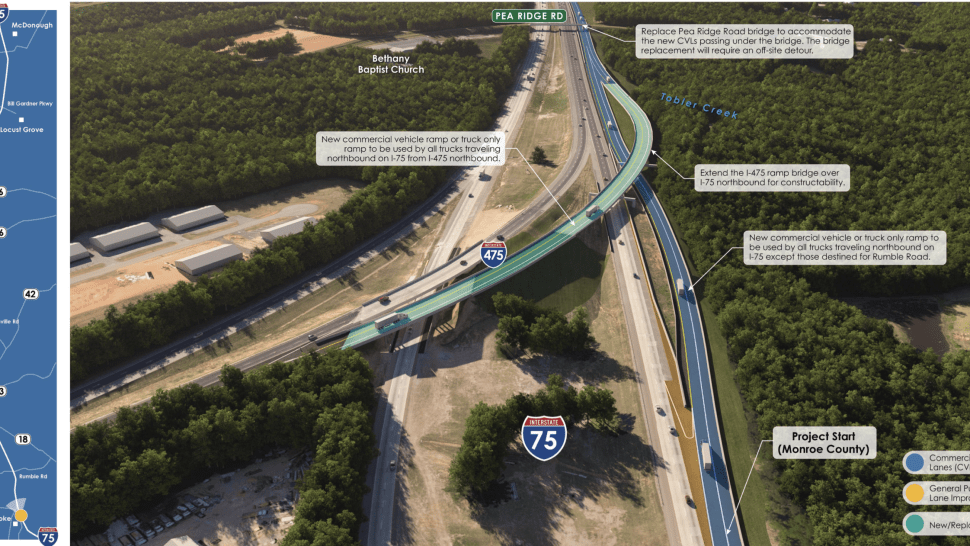
The Georgia Department of Transportation has released a construction timeline for its I-75 Commercial Vehicle Lanes project, and the plan is concrete. Design work will be finalized and construction will begin in 2027, with completion expected by the end of 2032. When it is done, northbound I-75 will carry two barrier-separated lanes reserved exclusively for commercial vehicles, running 41 miles from the I-75/I-475 interchange in Monroe County to near the State Route 20 interchange in Henry County, passing through Monroe, Lamar, Butts, Spalding, and Henry counties.
There is no toll. The commercial vehicle lanes, which GDOT refers to as the CVL, will be free for trucks to use.
For a project of this scale, the details matter, and so does the context, because this is not a minor widening. It is a roughly $3.5 billion bet on a specific idea about how to move freight through one of the most congested corridors in the country, and if it works, Georgia will not be the last state to try it.
What Is Actually Being Built
The core of the project is straightforward to describe and enormous to execute. GDOT is adding two new lanes along the northbound side of I-75, physically separated from the general purpose lanes by a barrier, and restricting them to commercial vehicles. Under the current proposal, all trucks with more than six wheels must use the CVL unless they are destined for a local exit within the project limits.
The 41-mile corridor runs south to north, beginning where I-75 splits from I-475 in Monroe County near Macon and ending near the SR 20 interchange in Henry County, in the McDonough area south of Atlanta. It threads through five counties and the towns along that stretch, including Forsyth, Locust Grove, and McDonough.
The project carries GDOT project number 0014203 and an estimated cost in the range of $3.5 billion, with the state’s eminent domain filings estimating around 173 affected parcels of property and tens of millions of dollars in right-of-way acquisition. This is a reconstruction and widening of the northbound right-of-way at a very large scale, which is part of why the timeline runs out to 2032.
It is also worth noting for anyone who has followed this project that the timeline has moved before. Earlier versions of the plan once targeted substantial completion around 2027, and the schedule has been revised more than once as GDOT restructured how the work would be bid and built. The dates announced now, construction beginning in 2027 and wrapping by the end of 2032, are the current official projection.
Why This Corridor, and Why It Matters
GDOT did not pick this stretch at random. It picked one of the worst freight chokepoints in the United States.
In the American Transportation Research Institute’s 2026 Top Truck Bottleneck List, I-75 at McDonough ranks as the tenth-worst truck bottleneck in the entire country. That is the northern end of exactly the corridor these lanes are meant to relieve. Georgia as a whole placed nine locations on ATRI’s 2026 top 100 list, second only to Texas, and three Georgia bottlenecks landed in the national top ten. The McDonough chokepoint on I-75 is the one this project is built to fix.
The freight volume through the corridor explains why. GDOT officials have said truck traffic through this stretch of I-75 is approaching 30% of average daily traffic, an unusually high share, and the department expects it to keep climbing as economic development and port activity in Georgia grow. When close to a third of the vehicles on a road are heavy trucks and the road is already failing at peak hours, separating the trucks from everything else becomes a serious proposal rather than a novelty.
The national backdrop makes the stakes clear. ATRI found that average rush-hour truck speeds at the country’s bottlenecks fell to 33.2 miles per hour in its 2026 analysis, and among the ten worst locations, average peak truck speed dropped to 29.6 miles per hour. ATRI states the total congestion cost in stark terms, saying the delays inflicted on truckers are the equivalent of 436,000 drivers sitting idle for an entire year. For an owner-operator paid by the mile, time lost crawling through McDonough is money that never gets earned back.
The Projection That Is Turning Heads
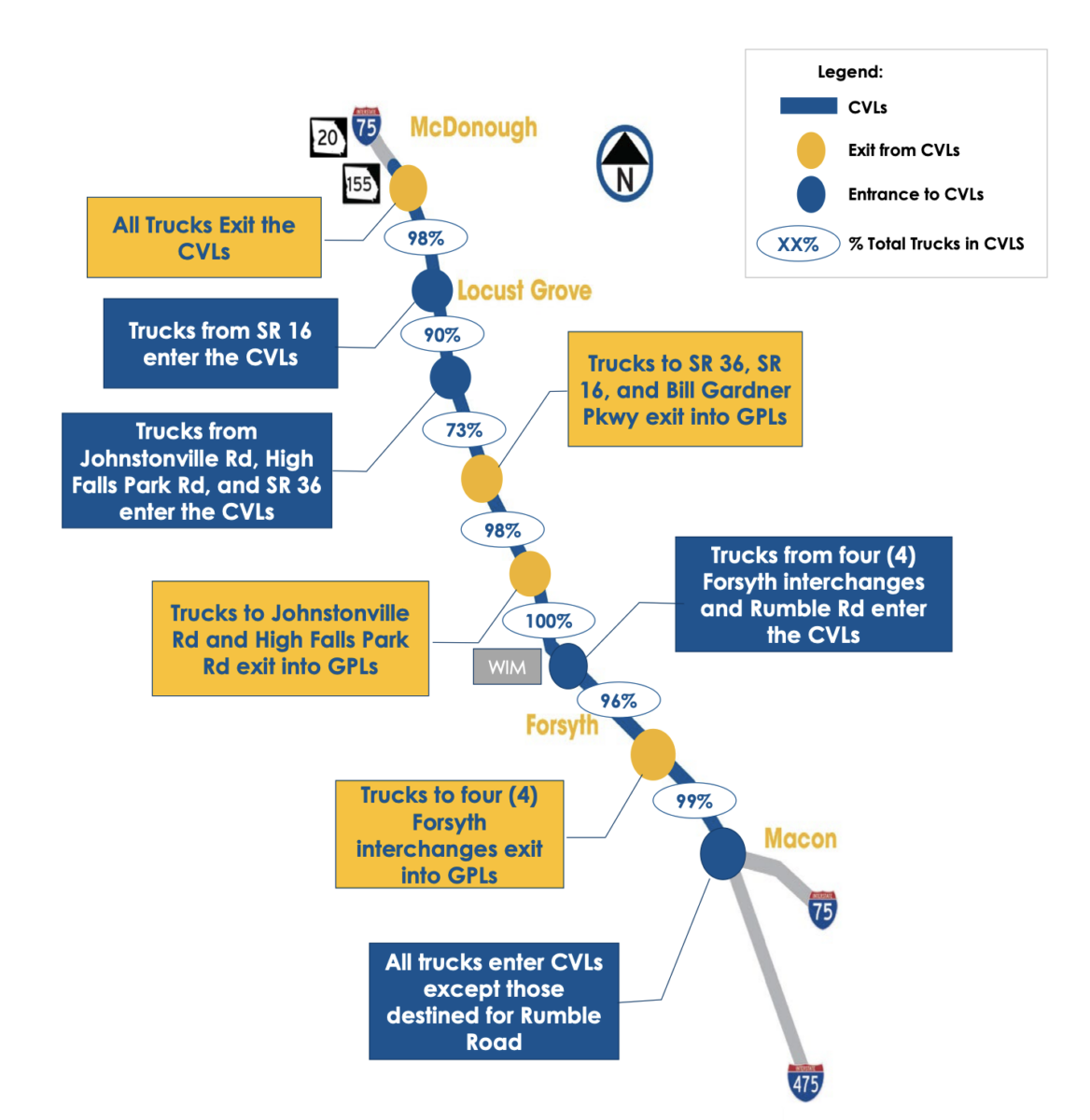
The number drawing the most attention is GDOT’s estimate of how many trucks will actually use the new lanes. The department projects that between 73% and 100% of trucks traveling within the project limits will shift out of the general purpose lanes and into the commercial vehicle lanes, depending on their destination.
That is a remarkable range, and the upper end of it, essentially every truck, is what makes this project notable. It reflects the design intent: with a mandate that trucks over six wheels use the CVL unless exiting locally, and with the lanes running the length of the worst part of the corridor, GDOT expects near-total adoption from through traffic.
The department also offered a more granular figure that shows how the traffic sorts itself out. About 27% of trucks entering the CVL near Macon are expected to exit before reaching McDonough, meaning a bit more than a quarter of the trucks that get on will peel off for local destinations along the way, while the remainder ride the full corridor toward the Atlanta metro. That split matters for how the lanes are engineered and where the entry and exit points sit.
What the Public Said, and How GDOT Responded
The project went through a public comment process, and the response was mixed but leaned supportive. Of 132 comments GDOT received, 57 were in support, 35 offered conditional support, 19 were opposed, and 21 were uncommitted. Taken together, that is 92 comments in the support or conditional-support column against 19 in opposition.
Two themes from the feedback are worth pulling out, because they speak directly to the people who will actually drive these lanes.
First, commenters asked GDOT to include professional truck drivers in the planning process. This is a recurring and legitimate frustration in freight infrastructure: decisions about how trucks move get made by people who do not drive them. GDOT responded that coordination with transportation organizations will be important throughout the life of the project, which is an acknowledgment rather than a firm commitment to a specific seat at the table, and it is the kind of response worth holding the department to as design work proceeds.
Second, commenters raised concerns about traffic merging at the northern end of the CVL, where the truck-only lanes eventually have to feed back into general traffic. Merge points are where separated-lane designs succeed or fail, and the concern is well founded. GDOT said its safety analysis shows the proposed merge area up to SR 155 is expected to see fewer crashes than the current no-build scenario, attributing the improvement to more channelized traffic flow and less weaving. The department also said an auxiliary lane between SR 155 and SR 20 will further improve operations at the merge point.
Whether that holds up in practice is one of the real open questions of the project, and it is the kind of thing professional drivers will be able to evaluate better than anyone once the lanes open.
The Parking Piece Riding Alongside It
The commercial vehicle lanes are the headline, but GDOT has paired the corridor work with truck parking investment, which is the quieter half of the freight-mobility problem and one this platform has covered before.
Alongside the CVL planning, GDOT has advanced a project to expand truck parking at Rest Area 22 along the corridor, budgeted at $2 million to add 36 truck parking spaces, with construction set to begin in summer 2027 and expected to take about 12 months. It is a modest number against the national parking shortage, but it reflects an understanding that moving trucks faster through a corridor and giving them somewhere legal to stop are two parts of the same problem. A driver who clears McDonough quickly still has to park legally at the end of the day.
What It Means for Drivers and Small Fleets
For any owner-operator or small fleet that runs the Southeast, the I-75 corridor between Macon and Atlanta is familiar territory, and often a dreaded one. The practical promise of this project is real: a barrier-separated, toll-free lane through one of the ten worst truck bottlenecks in the country would directly return time and fuel to the drivers who run it, and time is the one input a per-mile operation can never buy back.
There are reasons to keep expectations measured. Construction itself, running from 2027 to 2032, means years of work zones on an already difficult corridor before any relief arrives, and work zones are their own source of congestion and risk. The merge design at the northern end is unproven until it opens. And the timeline on this project has already moved more than once, so a 2032 completion is a projection, not a guarantee.
But the larger significance is hard to overstate. Dedicated truck lanes at this scale are rare in the United States, and a successful 41-mile stretch on I-75 would become the proof of concept that other states point to. Georgia alone has nine of the nation’s worst bottlenecks, which means the state has no shortage of places to apply the model next if this one works. For drivers, the project is worth watching not just for what it does to one corridor, but for what it might signal about how the country decides to move freight over the next decade.
For now, the timeline is set, the corridor is chosen, and the work is coming. The trucks that run northbound I-75 through McDonough are, according to GDOT’s own projection, about to get a road of their own. The fact that they took action to correct the problem is a win in itself.
Why It Matters
Georgia is spending roughly $3.5 billion to build 41 miles of toll-free, truck-only lanes through one of the ten worst freight bottlenecks in the country, a scale of dedicated-lane investment the United States has rarely attempted. If it works, it hands drivers back time and fuel on a corridor that currently crawls, and it becomes the proof of concept that decides whether other states build the same thing.
Brokerage Compliance Symposium
The day before F3. Every compliance issue you face - fraud exposure, carrier liability, FMCSA rules, cargo theft, insurance gaps - navigated by attorneys and operators defining best practices in a changing industry.
F3 Awards Dinner
The night before F3. FreightTech100 companies honored. FreightTech 25 and Shipper of Choice winners revealed live. Cocktail reception into dinner and live music - 300 industry leaders in one purpose-built room.
F3: Future of Freight Festival
Industry-defining keynotes, rapid-fire technology demos, and industry leaders networking in experiences across Chattanooga - plus the inaugural F3 Awards Dinner featuring the FreightTech and Shipper of Choice reveals.
The day before F3. Every compliance issue you face - fraud exposure, carrier liability, FMCSA rules, cargo theft, insurance gaps - navigated by attorneys and operators defining best practices in a changing industry.
The Signal at Chattanooga Choo Choo • Chattanooga, TN Register NowThe night before F3. FreightTech100 companies honored. FreightTech 25 and Shipper of Choice winners revealed live. Cocktail reception into dinner and live music - 300 industry leaders in one purpose-built room.
The Signal at Chattanooga Choo Choo • Chattanooga, TN Register NowIndustry-defining keynotes, rapid-fire technology demos, and industry leaders networking in experiences across Chattanooga - plus the inaugural F3 Awards Dinner featuring the FreightTech and Shipper of Choice reveals.
The Signal at Chattanooga Choo Choo • Chattanooga, TN Register Now