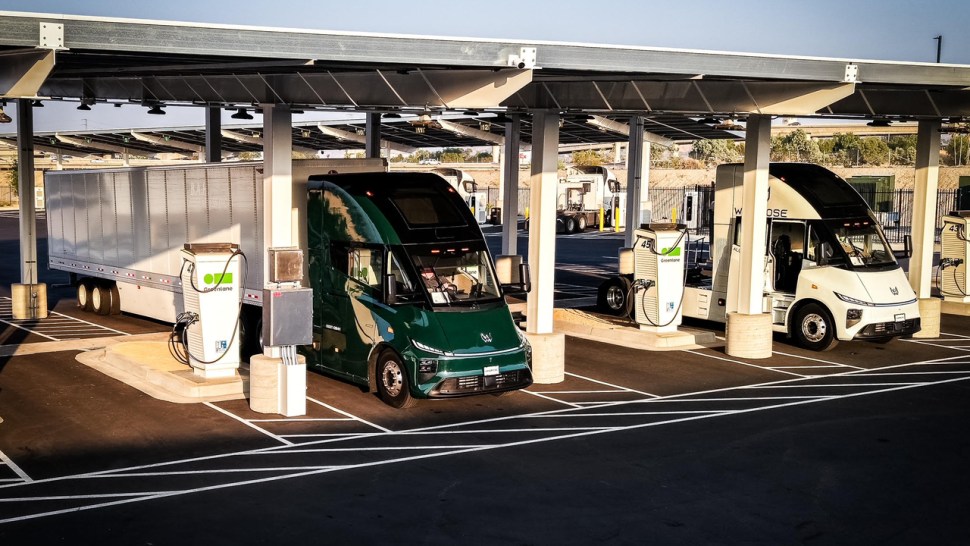
Windrose is offering three months of complimentary charging on the Greenlane network with every purchase of a Windrose Global E700 electric truck, a move designed to accelerate adoption by addressing one of the industry’s most persistent barriers: the total cost of ownership gap between electric and diesel vehicles.
The partnership follows incentive models proven successful in the passenger vehicle space and positions both companies to capitalize on what industry leaders describe as an inflection point for commercial electric vehicle adoption.
The partnership reflects a strategic shift in how charging infrastructure companies approach fleet electrification. Rather than building chargers and expecting customers to navigate the complexities of deployment, Greenlane has focused on lighting up specific freight lanes where carriers contract business with shippers.
Patrick Macdonald-King, CEO of Greenlane, said the arrangement serves multiple purposes for the charging network operator. “It makes an introduction to the customer, an introduction to Greenlane, and allows us to work with them to potentially put together a solution for long-term usage of the network for charging their vehicle, even housing their vehicle if that’s what they want to do,” Macdonald-King told FreightWaves.
Overcoming the EV truck cost barrier
The primary obstacle to electrification remains the upfront vehicle cost, which can reach double or triple the price of a comparable diesel truck. Programs like the California Air Resources Board’s (CARB) Hybrid and Zero-Emission Truck and Bus Voucher Incentive Project (HVIP) vouchers have proven essential in narrowing this gap.
These vouchers function as coupons that reduce truck costs based on use case and fleet size, with drayage applications receiving the highest benefit.
Market interest has been substantial. According to Macdonald-King, approximately $350 million in HVIP funding was allocated within roughly three weeks of becoming available. “The interest in going out and applying for these vouchers was pretty high,” he said.
Tesla has emerged as a dominant force in this market, capturing approximately 70% of voucher allocations. The Tesla Semi’s competitive positioning stems from three factors: a price point near $300,000 before incentives (reducible to $225,000-$250,000 with vouchers), extended battery range and megawatt charging capability.
“Now all of a sudden you’re talking about parity between the two where it makes just as much sense to buy it, especially when you got megawatt charging and you got longer range,” Macdonald-King said.
The collaboration builds on proven interoperability between the two companies. During pilot runs on the I-10 corridor between Greenlane’s charging hub in Colton, California, and Phoenix, Arizona, the Windrose Global E700 achieved a 772 kW peak charging rate and over 400 miles of range on a single charge while carrying a near-maximum payload of around 74,000 pounds.
Testing validated that both the I-10 and I-15 corridors can support fully operational electric freight with Greenlane’s infrastructure.
The emerging megawatt charging standard should help speed things up
The industry is shifting its approach to charging infrastructure from depot-focused solutions to corridor-based “lane lighting.” This operational model provides logistics companies with the infrastructure certainty needed to contract specific routes, such as the Port of Long Beach to Phoenix corridor.
Megawatt charging is becoming the industry standard, with Tesla, Volvo, Daimler and International all adopting a standardized plug. Macdonald-King said megawatt charging will become operational reality by the end of 2026, with additional manufacturers launching megawatt-enabled vehicles in 2027 and 2028.
The efficiency gains are significant. Current vehicles accept charging rates of approximately 200-250 kW. Megawatt charging (1,000 kW) reduces dwell time by 75%, bringing charge times to 20-25 minutes, comparable to the 15 minutes required for diesel refueling. This aligns with U.S. Department of Transportation-mandated 30-minute driver breaks, allowing charging to occur during required rest periods.
Power availability presents a challenge for high-demand charging sites. Greenlane addresses this through battery storage systems that provide grid resiliency and enable energy arbitrage, charging batteries during low-cost periods and deploying that stored energy during peak demand.
“Battery packs allow you to do a lot,” Macdonald-King said. “We can help keep customer costs in line at the same time as we can keep our margins and keep our business healthy.”
Greenlane launched an energy management platform approximately five months ago that automates decisions about when to draw from the grid versus stored power.
Looking ahead, the industry spent 2025 navigating regulatory uncertainty, but the market is stabilizing despite expiring federal incentives. The 30C tax credit ends June 30, and the $7,500 tax credit has already expired.
Macdonald-King said he does not anticipate significant new federal programs, though existing initiatives will continue. The National Electric Vehicle Infrastructure (NEVI) program survived cancellation attempts after pushback from multiple states.
Brokerage Compliance Symposium
The day before F3. Every compliance issue you face - fraud exposure, carrier liability, FMCSA rules, cargo theft, insurance gaps - navigated by attorneys and operators defining best practices in a changing industry.
F3 Awards Dinner
The night before F3. FreightTech100 companies honored. FreightTech 25 and Shipper of Choice winners revealed live. Cocktail reception into dinner and live music - 300 industry leaders in one purpose-built room.
F3: Future of Freight Festival
Industry-defining keynotes, rapid-fire technology demos, and industry leaders networking in experiences across Chattanooga - plus the inaugural F3 Awards Dinner featuring the FreightTech and Shipper of Choice reveals.
The day before F3. Every compliance issue you face - fraud exposure, carrier liability, FMCSA rules, cargo theft, insurance gaps - navigated by attorneys and operators defining best practices in a changing industry.
The Signal at Chattanooga Choo Choo • Chattanooga, TN Register NowThe night before F3. FreightTech100 companies honored. FreightTech 25 and Shipper of Choice winners revealed live. Cocktail reception into dinner and live music - 300 industry leaders in one purpose-built room.
The Signal at Chattanooga Choo Choo • Chattanooga, TN Register NowIndustry-defining keynotes, rapid-fire technology demos, and industry leaders networking in experiences across Chattanooga - plus the inaugural F3 Awards Dinner featuring the FreightTech and Shipper of Choice reveals.
The Signal at Chattanooga Choo Choo • Chattanooga, TN Register Now