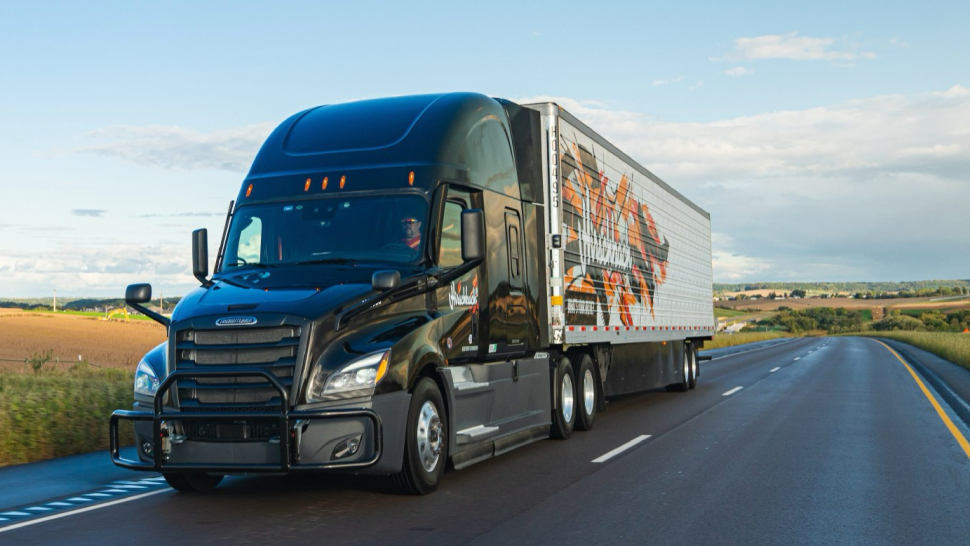
Every large fleet chasing AI eventually runs into the same fork in the road: buy a partner solution or build the technology in-house. Hirschbach Motor Lines picked a partner, and the trucking carrier is now automating driver communication through an AI agent built by Augment.
The rollout began on the brokerage side, where the agent, named Augie, now handles all outbound driver outreach across three interaction types: driver information requests, pickup arrivals and delivery arrivals.
Those three interactions represent the automatable slice of the work. They account for roughly 40% of Hirschbach’s overall track-and-trace volume, excluding power-only freight. Within that slice, Augie is already reaching drivers on more than 85% of the carrier’s Logistics Solutions loads and automating over 300 pickup and delivery check-ins a week.
“For me, the early success isn’t simply about the number of calls or messages Augie handles,” Ivan Ramirez, CTO at Hirschbach Motor Lines, told FreightWaves. “It’s that we’re proving AI can become part of the operating model and reliably own a defined portion of the work. That was the big unknown: it works really well in demo environments. How does it actually work in real environments? And we’ve gotten it there.”
Customers can also rename Augie. In the case of Hirschbach, they refer to their AI teammate as Hirschie.
The Buy-Versus-Build Decision Behind AI Driver Communication
The decision to bring in an outside AI partner came after roughly a year and a half of evaluating vendors, many of whom showed up with polished voice demos and little else built.
“I knew none of these guys had anything built,” Ramirez said. “They’d all just gone and raised a bunch of money and had this great idea on how they were going to build out these different AI platforms. For me and our team, it was really about the team. What team are we going to partner with?”
Augment stood out on three fronts, Ramirez said: a team that combined logistics experience with technology depth, a product roadmap that stretched beyond track-and-trace into appointment scheduling, load creation and carrier communication, and a willingness to let Hirschbach shape that roadmap rather than wait on a vendor’s release schedule.
“We did not want a traditional vendor relationship where we purchased a fixed product and waited for features,” Ramirez said. “We’ve done that before and it’s been a horrible experience. We wanted a partner willing to learn alongside us.”
That led to a deliberate build-versus-buy decision, even with a technology team capable of doing more in-house.
“We made a decision early on that Hirschbach is a transportation company that uses AI to operate better,” Ramirez said. “We’re not trying to become an AI infrastructure company. So let’s go find a really good partner where we can get to value a lot faster and get real operational value.”
Why Large Fleets Are Different
Selling AI into an enterprise carrier looks nothing like selling it into a startup-friendly niche, according to Harish Abbott, co-founder and CEO of Augment. Dedicated operations alone carry layers of complexity: multiple stops, multiple loads, bill of lading handling and facility-specific assignment rules.
“The very first thing in all of this is: how do we get folks out of the day-to-day busy stuff, the unglamorous work, so they can be freed up to do more creative work,” Abbott said.
Appointment scheduling is one of the biggest pain points large fleets bring to the table, Abbott said, particularly through high-volume retail portals.
“It’s not easy to make appointments, especially in these large portals like Walmart and others,” Abbott said. “Power-only is very different than live load, very different than dedicated runs.”
The bigger opportunity, he said, is tying appointment data back into hours-of-service and driver planning so fleets can see the whole network rather than one appointment at a time.
The Data Problem Behind the 20%
Roughly 70% to 80% of Hirschbach’s shipments arrive through EDI already structured for automation. The rest shows up messier: tender emails, PDFs, or a bill of lading handed straight to a driver on a dedicated run.
“How do you get them into the system, assigned to the right customer code, with a high degree of certainty so humans aren’t entering that, but also faster?” Abbott said. “So everything is detention. Accessorials are all tied to that shipment very early on versus finger-pointing that happens after a load is delivered.”
Ramirez pointed to the EDI 214 status message as an example of the inefficiency AI is meant to erase.
“If I look at my EDI transactions, the biggest part of the 214, that’s where the biggest expense is,” Ramirez said. “I’m already giving you guys all this stuff. Why are you reaching out for this stuff again? … We’re a low-margin business. I’m trying to figure out a way, and AI is a perfect answer to this stuff. It’s the stuff that we absolutely need to do. Let’s just let AI handle it and we’ll forget about it.”
Abbott said narrow, specific use cases, not a broad AI rollout, are what earn an operator’s trust.
“If you sprinkle AI across the board like ‘here’s this cool stuff and it’s going to make everybody’s life better,’ the operator’s like, ‘Okay, my life hasn’t changed. I’m still doing the same thing,'” Abbott said. “For operators, you have to be extremely specific: ‘Hey, you’re spending this much time on X and now let’s have AI or Augie take care of it.’ And they see that.”
The AI Agent Hirschbach Wants for Driver Retention
The next use case Hirschbach plans to activate is an AI assistant sitting between drivers and their driver leaders, fielding routine questions so leaders can spend their time on the conversations that actually keep drivers around.
“The biggest complaints we get right now from our drivers is ‘I can’t get ahold of my driver leader,'” Ramirez said. “I’m a driver leader. I have 50 to 60 drivers that I’m handling. I can’t be available for everyone at every single time to answer those calls.”
“I’ve listened to some of these conversations that driver leaders have with their drivers. A lot of it is, they’re literally psychologists,” Ramirez said. “A lot of these conversations are not freight-related. They’re 30-minute conversations about their family, their pay, ‘I need more miles.’ Those are the conversations we want our driver leaders having with their drivers because that’s how you retain more drivers.”
The longer-term vision goes beyond answering questions after the fact. Abbott described a model where the agent anticipates a delay and reschedules an appointment before a customer ever has to ask where a load is.
“What would be cool is that before the email comes from the customer, we reach out to the customer or the facility and say, ‘Hey, this driver is running late. I’m rescheduling the appointment. It’s done,'” Abbott said. “It’s sort of anticipating exceptions and actually being proactive about it versus today, in all our use cases for AI it’s very reactive.”
That kind of proactive rescheduling helps both sides of the load, he said, since a warehouse that knows a truck is running late can reallocate the labor it had lined up to unload it.
“Driver retention is a big thing for everyone,” Ramirez said. “I can’t wait to get to that use case.”
Brokerage Compliance Symposium
The day before F3. Every compliance issue you face - fraud exposure, carrier liability, FMCSA rules, cargo theft, insurance gaps - navigated by attorneys and operators defining best practices in a changing industry.
F3 Awards Dinner
The night before F3. FreightTech100 companies honored. FreightTech 25 and Shipper of Choice winners revealed live. Cocktail reception into dinner and live music - 300 industry leaders in one purpose-built room.
F3: Future of Freight Festival
Industry-defining keynotes, rapid-fire technology demos, and industry leaders networking in experiences across Chattanooga - plus the inaugural F3 Awards Dinner featuring the FreightTech and Shipper of Choice reveals.
The day before F3. Every compliance issue you face - fraud exposure, carrier liability, FMCSA rules, cargo theft, insurance gaps - navigated by attorneys and operators defining best practices in a changing industry.
The Signal at Chattanooga Choo Choo • Chattanooga, TN Register NowThe night before F3. FreightTech100 companies honored. FreightTech 25 and Shipper of Choice winners revealed live. Cocktail reception into dinner and live music - 300 industry leaders in one purpose-built room.
The Signal at Chattanooga Choo Choo • Chattanooga, TN Register NowIndustry-defining keynotes, rapid-fire technology demos, and industry leaders networking in experiences across Chattanooga - plus the inaugural F3 Awards Dinner featuring the FreightTech and Shipper of Choice reveals.
The Signal at Chattanooga Choo Choo • Chattanooga, TN Register Now