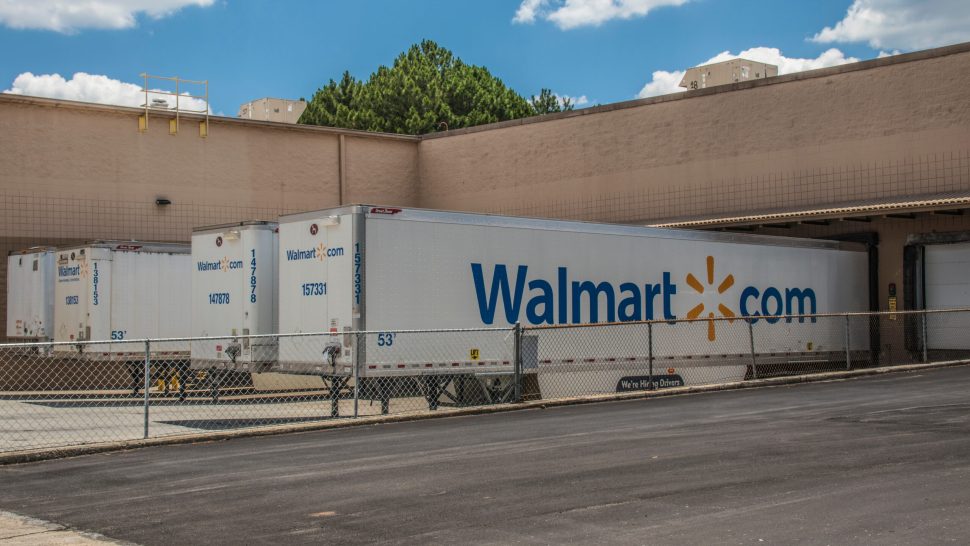
A shipment of condoms and personal lubricant valued at approximately $1.7 million was allegedly diverted after criminals compromised the identity of a legitimate trucking carrier and used that identity to secure freight bound for a Walmart distribution center.
According to reporting by Cybernews, the shipment originated in Lynn, Massachusetts, and was destined for a Walmart distribution center in Pennsylvania. The cargo consisted of approximately 103,000 units of ONE Condoms and Move lubricant manufactured by Global Protection Corp.
Company officials allege the theft did not involve a stolen trailer or a break-in. Instead, the scheme allegedly began with a phishing email disguised as a broker agreement. The email was reportedly sent to a legitimate trucking company and allowed criminals to gain access to the carrier’s systems and assume its identity.
According to public reporting, the attackers then used the carrier’s credentials to arrange transportation for the shipment. Legitimate drivers allegedly arrived with the correct shipment numbers and paperwork, unaware they were participating in a fraud scheme.
Cargo theft is becoming a cyber problem
The incident highlights a shift in how cargo theft is occurring across North America. Rather than stealing unattended trailers or breaking into warehouses, organized groups are increasingly targeting the identities and communications systems that keep freight moving.
In April, the FBI’s Internet Crime Complaint Center warned that cyber-enabled cargo theft losses in the United States and Canada reached nearly $725 million in 2025, an increase of approximately 60% from the previous year.
The FBI said criminals are increasingly using phishing emails, spoofed websites, compromised business accounts and fraudulent communications to impersonate legitimate brokers and carriers. Once trust is established, the freight moves exactly as intended until it arrives somewhere it was never supposed to go.
The methods described in the Global Protection case closely resemble those tactics. According to Cybernews, the shipment was allegedly rerouted to a warehouse in the Bronx after pickup and never arrived at its intended destination.
Legitimate carriers are becoming victims
Public reporting indicates the carrier whose identity was allegedly compromised was not involved in the theft and is considered a victim of the scheme.
That distinction has become increasingly important as identity-based fraud grows. In many modern cargo theft cases, the criminals never touch a lock or cut a seal. Instead, they exploit the trust brokers, shippers and carriers place in email accounts, load tenders and business identities.
The result is that legitimate companies can unknowingly become part of a theft without ever touching the cargo.
FreightWaves contacted Global Protection Corp., Walmart and the FBI seeking comment regarding the alleged theft and any related investigation. No responses had been received at the time of publication.
FreightWaves independently verified the FBI’s public warning regarding cyber-enabled cargo theft and confirmed that Global Protection Corp. manufactures the products identified in public reporting. FreightWaves has not independently verified the alleged theft, the identity of the carrier involved or the existence of any arrest related to the incident.
Update: After publication, Global Protection Corp. provided additional details to FreightWaves regarding the alleged theft and the steps the company has taken since the incident. According to Ryan Findling, director of operations at Global Protection Corp., the company has implemented two-step verification for truckload shipments, driver identification checks, secondary phone verification with brokers, and new employee training procedures.
Click here for more articles on cargo theft and freight fraud by Phillip Brink.
July 4 holiday period exposes supply chain vulnerabilities – FreightWaves
Why the safest freight brokerages are usually the most boring – FreightWaves
Brokerage Compliance Symposium
The day before F3. Every compliance issue you face - fraud exposure, carrier liability, FMCSA rules, cargo theft, insurance gaps - navigated by attorneys and operators defining best practices in a changing industry.
F3 Awards Dinner
The night before F3. FreightTech100 companies honored. FreightTech 25 and Shipper of Choice winners revealed live. Cocktail reception into dinner and live music - 300 industry leaders in one purpose-built room.
F3: Future of Freight Festival
Industry-defining keynotes, rapid-fire technology demos, and industry leaders networking in experiences across Chattanooga - plus the inaugural F3 Awards Dinner featuring the FreightTech and Shipper of Choice reveals.
The day before F3. Every compliance issue you face - fraud exposure, carrier liability, FMCSA rules, cargo theft, insurance gaps - navigated by attorneys and operators defining best practices in a changing industry.
The Signal at Chattanooga Choo Choo • Chattanooga, TN Register NowThe night before F3. FreightTech100 companies honored. FreightTech 25 and Shipper of Choice winners revealed live. Cocktail reception into dinner and live music - 300 industry leaders in one purpose-built room.
The Signal at Chattanooga Choo Choo • Chattanooga, TN Register NowIndustry-defining keynotes, rapid-fire technology demos, and industry leaders networking in experiences across Chattanooga - plus the inaugural F3 Awards Dinner featuring the FreightTech and Shipper of Choice reveals.
The Signal at Chattanooga Choo Choo • Chattanooga, TN Register Now