




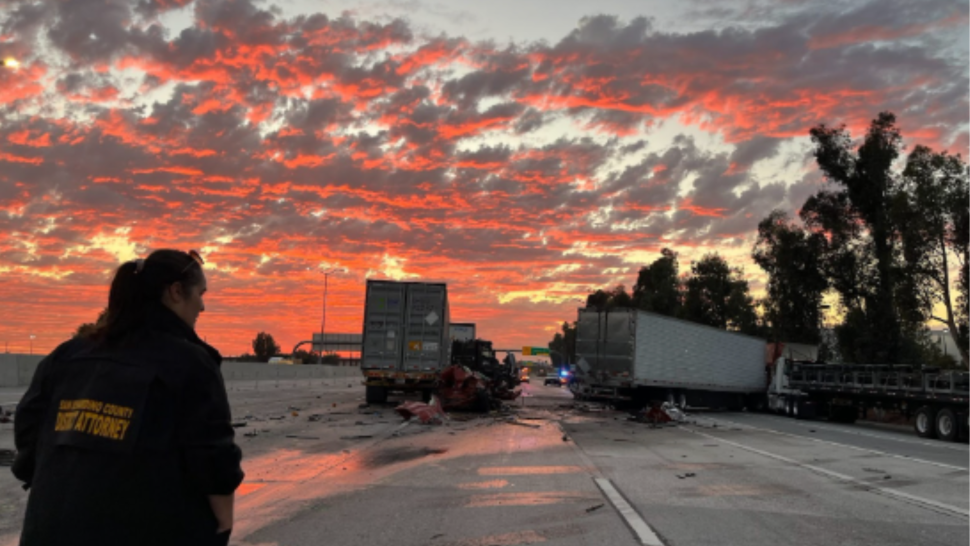
It should’ve just been another Tuesday.
But in the early hours on I-10 in California, three lives were lost — violently, unnecessarily — when a big rig, reportedly driven by an unauthorized immigrant under the influence, plowed into traffic. The impact was immediate. So was the outrage.
This wasn’t just a crash. It was another cry for action as the freight community has been calling out the non-domiciled CDL process and it’s loopholes along with lack of accountability in these instances.
And now, everyone’s pointing fingers. But the hard truth? This tragedy, like so many others, wasn’t just one driver’s fault.
It was the entire system.
The Non-Domiciled CDL Crisis Nobody Wants to Own
Let’s be real — non-domiciled CDLs aren’t new. Federal law allows individuals who are legally in the U.S. but don’t have permanent resident status to hold commercial licenses. That includes refugees, asylees, and visa holders who are authorized to work.
On paper, it sounds reasonable. But what’s supposed to be a structured system built for legitimate drivers has turned into something else entirely — a loophole-ridden mess exploited by bad actors, corrupt testing sites, and negligent oversight.
We’ve known for years that some of these licenses were obtained through fraudulent means. The FMCSA’s own crackdown exposed “irregularities” at licensing agencies, mostly concentrated in a handful of states. But here’s where the tension arose: how do you protect public safety without violating civil rights? Or do you?
The Civil Rights Collision
Immigrant advocates are fighting back, hard. Some argue the FMCSA’s proposed rule unfairly targets entire groups of people, many of whom are lawfully authorized to work in the U.S. They say it’s discrimination dressed up as regulation — punishing the legitimate for the sins of the corrupt.
And in the middle of this storm sits one undeniable fact: the truck in that California crash was 80,000 pounds of rolling steel, driven by someone who should’ve never been behind the wheel.
The question that keeps getting louder:
How many more lives are we willing to risk in the name of political correctness or bureaucratic red tape?
What Precedent Is Being Set?
Let’s break it down. The DOT’s $40 million penalty against California for failing to enforce English proficiency requirements wasn’t just a slap on the wrist — it was a direct message to every state:
Enforce the rules, or you won’t get paid.
That sets a powerful precedent. For years, some states have played fast and loose with compliance, turning a blind eye to language barriers, questionable licensing, and weak enforcement protocols. But now, the feds are coming for the checkbook — and that’s when change starts happening.
This isn’t just a California problem. It’s national. Data shows that many non-domiciled CDLs are issued in states with high volumes of immigrant populations. And social media rumors have only added fuel to the fire, with claims that many illegal ELD providers tied to fraudulent logs are based in Eastern Europe — the same regions where many of these licenses originate.
Coincidence? Maybe. But it’s a pattern worth investigating.
Who’s Really Accountable?
This is where it gets uncomfortable.
- The driver was under the influence and should have never been operating a CMV.
- The carrier who employed him should be investigated for negligence and licensing protocol violations.
- The state that issued the CDL — assuming it was done fraudulently or without adequate testing — bears responsibility.
- The federal regulators who took years to crack down on this despite repeated warning signs carry their own blame.
This is a systemic failure.
And until everyone — including the feds, state DMVs, enforcement agencies, and carriers — starts owning their role in this mess, nothing changes.
Can the Feds Just Invalidate Non-Domiciled CDLs?
That’s the question everyone’s whispering — but there is not much in regards to an answer outright. .
Can the federal government really cancel Non-Domicled CDLs overnight?
Technically, it appears that is a yes. But practically? It appears it would get messy.
The FMCSA has the authority to oversee CDL compliance through federal regulations. If a state is found to have issued licenses that don’t meet federal standards — whether due to fraud, improper documentation, or failure to verify immigration status — the agency can step in and decertify those credentials.
But here’s where it gets complicated:
- Each state handles its own licensing. That means mass invalidation would require coordination across multiple state DMVs, many of which have varying documentation and retention standards.
- Due process challenges will follow. Some drivers may fight back in court, arguing they followed legal procedures at the time of issuance and shouldn’t be penalized retroactively.
- Lawsuits are inevitable. With civil rights groups already monitoring the situation, a blanket revocation could trigger legal action — especially if valid work-authorized drivers are caught in the crossfire.
And let’s not ignore the real-world impact.
Final Thought
The trucking industry isn’t just fighting over freight rates anymore — we’re fighting for integrity.
This isn’t about politics. It’s about safety. It’s about public trust. It’s about whether we value this profession enough to protect it — even if that means making uncomfortable decisions.
The deaths in California weren’t just tragic — they were preventable. And if we let this moment pass without real accountability, we’re saying loud and clear that some lives matter less than others.
That’s not a freight market problem. That’s a moral one. Something needs to give, America is tired and frustrated with the amount of tragedy that has happened.
Brokerage Compliance Symposium
The day before F3. Every compliance issue you face - fraud exposure, carrier liability, FMCSA rules, cargo theft, insurance gaps - navigated by attorneys and operators defining best practices in a changing industry.
F3 Awards Dinner
The night before F3. FreightTech100 companies honored. FreightTech 25 and Shipper of Choice winners revealed live. Cocktail reception into dinner and live music - 300 industry leaders in one purpose-built room.
F3: Future of Freight Festival
Industry-defining keynotes, rapid-fire technology demos, and industry leaders networking in experiences across Chattanooga - plus the inaugural F3 Awards Dinner featuring the FreightTech and Shipper of Choice reveals.
The day before F3. Every compliance issue you face - fraud exposure, carrier liability, FMCSA rules, cargo theft, insurance gaps - navigated by attorneys and operators defining best practices in a changing industry.
The Signal at Chattanooga Choo Choo • Chattanooga, TN Register NowThe night before F3. FreightTech100 companies honored. FreightTech 25 and Shipper of Choice winners revealed live. Cocktail reception into dinner and live music - 300 industry leaders in one purpose-built room.
The Signal at Chattanooga Choo Choo • Chattanooga, TN Register NowIndustry-defining keynotes, rapid-fire technology demos, and industry leaders networking in experiences across Chattanooga - plus the inaugural F3 Awards Dinner featuring the FreightTech and Shipper of Choice reveals.
The Signal at Chattanooga Choo Choo • Chattanooga, TN Register Now